格物
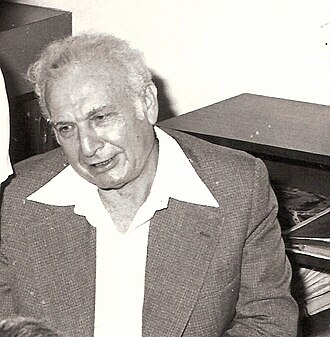
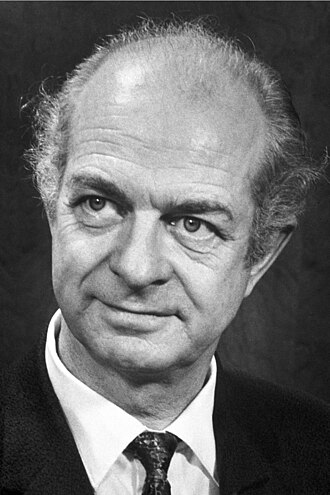
图:Imrich · CC BY-SA 3.0 · Wikimedia Commons
伊弗雷姆·卡齐尔1916—2009
Ephraim Katzir
Israeli scientist, 4th President of Israel (1973–1978) - (born 1916-2009)
伊弗雷姆·卡齐尔,以色列生物物理学家和以色列工党政治家。1973年至1978年担任以色列第四任总统。
摘自维基百科「伊弗雷姆·卡齐尔」,CC BY-SA 4.0
- 出生
- 1916 年 5 月 3 日,基辅
- 逝世
- 2009 年 5 月 30 日,雷霍沃特
- 国籍
- 以色列
- 学科
- 物理学、生物学
- 职业
- 大学教师、政治人物、生物物理学家
- 母语 / 工作语言
- 希伯来语
- 母校
- 耶路撒冷希伯来大学、哈佛大学、哥伦比亚大学、纽约大学坦登工程学院、Gymnasia Rehavia
- 工作单位
- 特拉维夫大学
研究领域
师承
博士导师1
来自 Wikidata 的「博士导师」「师从」「博士生」「学生」记录,可能不全。
所获奖项(8)
- 1959以色列国家奖
- 1960Rothschild Prize
- 1972汉斯·克雷布斯爵士奖
- 1977英国皇家学会外籍会员
- 1983honorary doctor of the University of Miami
- 1985日本国际奖
- —切尔尼霍夫斯基奖
- —honorary citizen of Jerusalem
学会与院士
百科正文
生平
卡齐尔出生在俄罗斯帝国统治下的基辅的埃夫拉姆·卡查尔斯基。1925年,他与家人一起移民到巴勒斯坦。在耶路撒冷希伯来大学研究化学和生物学,获得了博士学位。在国外留学以后,他返回以色列,并成为设在雷霍沃特魏茨曼科学研究所生物部门负责人。
卡齐尔是旨在寻求以色列独立的犹太武装“哈加纳”成员,在1966年他成为以色列国防军的首席科学家。他的哥哥阿哈隆,是一个享誉国际的化学物理学家,在1972年的卢德机场大屠杀中被杀害。卡齐尔是在哈佛大学工作期间,以色列总理果尔达·梅厄夫人与他商量后,宣布提名他为以色列总统。在担任总统期间爆发了第四次中东战争(赎罪日战争),1977年埃及总统萨达特还访问了耶路撒冷,打开了埃以直接对话的渠道。
在1978年,他因为他妻子尼娜的病情,拒绝连任总统。卸任总统后,继续从事科研工作。1959年,卡齐尔被授予以色列自然科学奖。1977年,他当选为英国皇家学会外籍院士。1985年,他被授予日本国际奖。 2000年,拉希基金会为表彰他的贡献,设立了卡齐尔奖学金。他于2009年5月30日在他雷霍沃特的家中病逝。
以上内容摘自维基百科「伊弗雷姆·卡齐尔」,按 CC BY-SA 4.0 使用,去掉了参考文献、外部链接等尾部小节,公式改写成了纯文本。全文、配图和出处见原文。
英文维基百科补充中文条目比较短,下面是英文条目「Ephraim Katzir」的原文
Ephraim Katzir (Hebrew: אֶפְרַיִם קָצִיר, romanized: Ep̄rayim Qaṣir; 16 May [O.S. 3 May] 1916 – 30 May 2009) was an Israeli biophysicist and Labor Party politician. He was the president of Israel from 1973 until 1978.
Biography
Efraim Katchalski (later Katzir) was the son of Yudel-Gersh (Yehuda) and Tzilya Katchalski, in Kiev, in the Russian Empire (today in Ukraine). In 1925 (several publications cite 1922), he immigrated to Mandatory Palestine with his family and settled in Jerusalem. In 1932, he graduated from Gymnasia Rehavia. A fellow classmate, Shulamit Laskov, remembers him as the "shining star" of the grade level. He was “an especially tall young man, a little pudgy, whose goodness of heart was splashed across his smiling face.” He excelled in all areas, “even in drawing and in gymnastics, where he was no slouch. He was the first in the class in arithmetic, and later on in mathematics. No one came close to him.”
Like his elder brother, Aharon, Katzir was interested in science. He studied botany, zoology, chemistry and bacteriology at the Hebrew University of Jerusalem. In 1938 he received an MSc, and in 1941 he received a PhD degree. In 1939, he graduated from the first Haganah officers' course, and became commander of the student unit in the field forces (Hish).
He and his brother worked on the development of new methods of warfare. In late 1947, after the outbreak of the 1948 Palestine war, and in anticipation of the War for Israel’s Independence, Katzir met the biochemist David Rittenberg, then working at Columbia University, stating: ‘I need germs and poisons for the [impending/ongoing Israeli] war of independence,’ Rittenberg referred the matter to Chaim Weizmann. Weizmann initially dismissed the request, branding Katzir a ‘savage’ and requested his dismissal from the Sieff Scientific Institute in Rehovot, but weeks later he relented, and his dismissal was rescinded.
Scientific career
After continuing his studies at the Polytechnic Institute of Brooklyn, Columbia University and Harvard University, he returned to Israel and became head of the Department of Biophysics at the Weizmann Institute of Science in Rehovot, an institution he helped to found. In 1966–1968, Katzir was Chief Scientist of the Israel Defense Forces. His initial research centered on simple synthetic protein models, but he also developed a method for binding enzymes, which helped lay the groundwork for what is now called enzyme engineering.
Presidency
In 1973, Golda Meir contacted Katzir at Harvard University, asking him to accept the presidency. He hebraicized his family name to Katzir, which means 'harvest'.
On 10 March 1973, Katzir was elected by the Knesset to serve as the fourth President of Israel. He received 66 votes to 41 cast in favour of his opponent Ephraim Urbach and he assumed office on 24 May 1973. During his appointment, UN approved resolution 3379 which condemned "Zionism as Racism". He was involved in the dispute between Mexico (where the resolution was initially promoted during the World Conference on Women, 1975) and the US Jewish community because of a touristic boycott against Mexico directed from the latter.
In November 1977, he hosted President Anwar Sadat of Egypt in the first ever official visit to Israeli-controlled territory by an Arab head of state. As of today, it remains the only such visit.
In 1978, he declined to stand for a second term due to his wife's illness, and was succeeded by Yitzhak Navon. After stepping down as President, he returned to his scientific work.
Awards and recognition
In 1959, Katzir was awarded the Israel Prize in life sciences.
In 1966, he was elected to the American Philosophical Society
In 1966, he was elected to the United States National Academy of Sciences
In 1972, he was awarded the Sir Hans Krebs Medal of the Federation of European Biochemical Societies
In 1976, he was elected to the American Philosophical Society
In 1977, he was elected a Foreign Member of the Royal Society (ForMemRS)
In 1985, he was awarded the Japan Prize.
In 2000, the Rashi Foundation established the Katzir Scholarship Program in honor of Katzir, one of the first members of its board of directors.
He is also a recipient of the Tchernichovsky Prize for exemplary translation.
He also received honorary degrees from various scientific societies and universities worldwide. The Department of Biotechnology Engineering at the ORT Braude Academic College of Engineering in Karmiel was named after him during his lifetime.
以上节选摘自英文维基百科「Ephraim Katzir」,按 CC BY-SA 4.0 使用,去掉了参考文献、外部链接等尾部小节,公式改写成了纯文本。篇幅所限,较长的小节只摘了开头一部分,有的小节没有收;全文、配图和出处见原文。
同年获同一奖项
同一学科、同时代的科学家


同一学科的科学家
更多 ›