格物
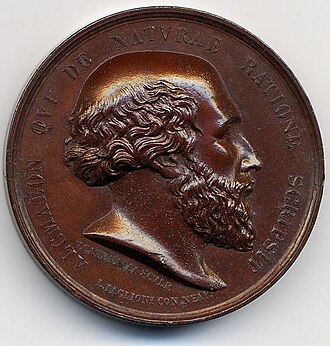
图:作者不详 · Public domain · Wikimedia Commons
- 出生
- 公元前 6 世纪,克罗托内
- 逝世
- 公元前 5 世纪,Kroton
- 学科
- 医学
- 职业
- 医生、哲学家
- 母语 / 工作语言
- 古希腊语
研究领域
主要贡献
代表成就
百科正文
阿尔克迈翁的自然哲学著作主要涉及医学和生物学领域。他强调大脑作为感知器官的重要性。感觉一定是沿着空气通道从感官进入大脑,尽管他从未看见任何通道,也没有这样的通道存在。
生平
阿尔克迈翁生于亚平宁半岛南端的古希腊殖民地克罗托内,父名佩里苏斯(Peirithous)。关于其生年的记载互有龃龉,约在前6世纪末到5世纪初之间。其著作主要关注医学题材,对占星术和气象学亦有所涉猎。今人对其生平所知仅此而已。
以上内容摘自维基百科「克罗顿的阿尔克迈翁」,按 CC BY-SA 4.0 使用,去掉了参考文献、外部链接等尾部小节,公式改写成了纯文本。全文、配图和出处见原文。
英文维基百科补充中文条目比较短,下面是英文条目「Alcmaeon of Croton」的原文
Alcmaeon of Croton (; Greek: Ἀλκμαίων ὁ Κροτωνιάτης, Alkmaiōn, gen.: Ἀλκμαίωνος; fl. 5th century BC) was an early Greek medical writer and philosopher-scientist. He has been described as one of the most eminent natural philosophers and medical theorists of antiquity and he has also been referred to as "a thinker of considerable originality and one of the greatest philosophers, naturalists, and neuroscientists of all time." His work in biology has been described as remarkable, and his originality likely made him a pioneer. Because of difficulties dating Alcmaeon's birth, his importance has been neglected.
Biography
Alcmaeon was born in Croton, Magna Graecia, and was the son of Peirithous. Alcmaeon is said by some to have been a pupil of Pythagoras, and he is believed to have been born c. 510 BC. Although he wrote primarily about medical topics, there is some suggestion that he was a philosopher of science, not a physician. He also practiced astrology and meteorology. Nothing more is known of the events of his life.
Work
During Alcmaeon's time, the medical school in Magna Graecia was regarded as the most famous; illnesses were studied in a scientific and experimental manner. Alcmaeon was considered by many an early pioneer and advocate of anatomical dissection and was said to be the first to identify Eustachian tubes. His celebrated discoveries in the field of dissection were noted in antiquity, but whether his knowledge in this branch of science was derived from the dissection of animals or of human bodies is disputed. Calcidius, on whose authority the fact rests, merely says "qui primus exsectionem aggredi est ausus," and the word exsectio would apply equally well in either case; some modern scholars doubt Calcidius' word entirely.
Alcmaeon also was the first to dwell on the internal causes of illnesses. It was he who first suggested that health was a state of equilibrium between opposing humors and that illnesses were because of problems in environment, nutrition and lifestyle. A book titled On Nature is attributed to him, though the original title may be different, as Alexandrian writers were known to have ascribed the title "On Nature" to a wide variety of works. According to Favorinus's account, Alcmaeon has been the first who wrote such a treatise on natural philosophy (φυσικὸν λόγον), however this has been disputed, because Anaximander wrote before Alcmaeon. Accounts which attribute an Alcmaeon of Croton to be the first to write animal fables, may be a reference to a poet with the same name. He also wrote several other medical and philosophical works, of which nothing but the titles and a few fragments have been preserved by Stobaeus, Plutarch, and Galen.
Pythagorean
Although Alcmaeon is often described as a pupil of Pythagoras, there are reasons to doubt whether he was a Pythagorean at all; his name seems to have crept into lists of Pythagoreans given us by later writers. Aristotle mentions him as nearly contemporary with Pythagoras, but distinguishes between the stoicheia (στοιχεῖα) of opposites, under which the Pythagoreans included all things; and the double principle of Alcmaeon, according to Aristotle, less extended, although he does not explain the precise difference. Since 1950 the scholarly consensus holds that Alcmaeon of Croton is a figure independent of the Pythagoreans.
Other doctrines of Alcmaeon have been preserved. He said that the human soul was immortal and partook of the divine nature, because like the heavenly bodies it contained in itself a principle of motion. The eclipse of the moon, which was also eternal, he supposed to arise from its shape, which he said was like a boat. All his doctrines which have come down to us relate to physics or medicine; and seem to have arisen partly out of the speculations of the Ionian School, with which rather than the Pythagorean, Aristotle appears to connect Alcmaeon, partly from the traditional lore of the earliest medical science.
Modern influence
Alcmaeon of Croton, an ancient Greek philosopher, physician, and scientist who lived during the 5th century BCE, is widely regarded as one of the founders of the medical tradition in ancient Greece and made some significant contributions to the fields of anatomy and physiology and the overall field of medicine as well. Alcmaeon's work had a large impact on the development of Western medicine and science. His ideas continue to influence our understanding of the human body and mind today.
以上节选摘自英文维基百科「Alcmaeon of Croton」,按 CC BY-SA 4.0 使用,去掉了参考文献、外部链接等尾部小节,公式改写成了纯文本。篇幅所限,较长的小节只摘了开头一部分,有的小节没有收;全文、配图和出处见原文。