格物
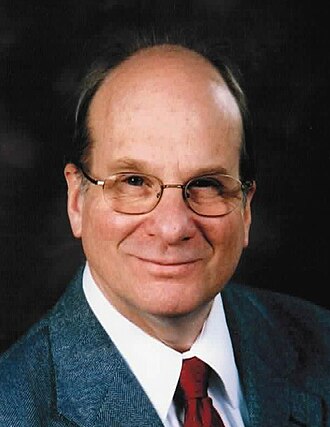
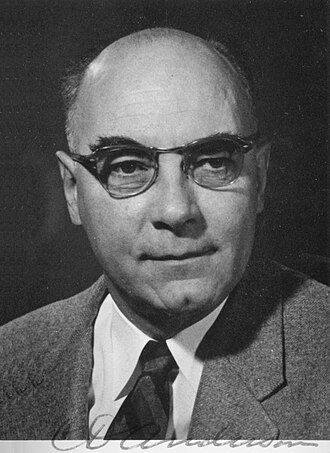
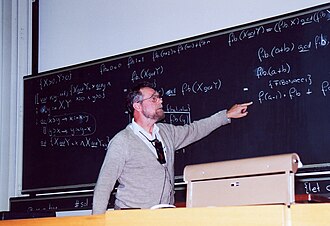
图:Credit Line: AIP Emilio Segrè Visual Archives · Copyrighted free use · Wikimedia Commons
路易斯·布鲁斯1943—2026
Louis E. Brus
化学家, 美国
路易斯·尤金·布鲁斯,美国哥伦比亚大学的化学与物理教授。他被称为量子点的胶体半导体纳米晶体的发现者。2023年,他与蒙吉·巴文迪和阿列克谢·叶基莫夫荣获诺贝尔化学奖,以表彰他们“对量子点的发现和合成”的贡献。
摘自维基百科「路易斯·布鲁斯」,CC BY-SA 4.0
- 出生
- 1943 年 8 月 10 日,克利夫兰
- 逝世
- 2026 年 1 月 11 日,哈得孙河畔黑斯廷斯
- 国籍
- 美国
- 学科
- 物理学、化学、博物与综合
- 职业
- 化学家、物理学家、大学教师
- 母语 / 工作语言
- 英语
- 母校
- 莱斯大学(理学士,1965 年)、哥伦比亚大学(哲学博士,1969 年)
- 工作单位
- 哥伦比亚大学、贝尔实验室
研究领域
师承
博士导师1
来自 Wikidata 的「博士导师」「师从」「博士生」「学生」记录,可能不全。
所获奖项(11)
- 2001朗缪尔奖
- 2006R·W·伍德奖
- 2008Kavli Prize in Nanoscience
- 2009威拉德·吉布斯奖
- 2010美国国家科学院化工科学奖
- 2011彼得·德拜奖
- 2012Bower Award and Prize for Achievement in Science
- 2012富兰克林研究所奖项
- 2012汤森路透引文桂冠奖
- 2013韦尔奇化学奖
- 2023诺贝尔化学奖
学会与院士
百科正文
早年生活和教育
路易斯·尤金·布鲁斯 (Louis Eugene Brus) 1943年出生于美国俄亥俄州克利夫兰。 在堪萨斯州罗兰帕克的高中期间,他对化学和物理产生了兴趣。
1961年,他获得海军预备役军官训练团 (Naval Reserve Officers Training Corps, NROTC) 大学奖学金进入莱斯大学,该奖学金要求他以见习官身份参加 NROTC 的海上活动。 他于1965年毕业,并前往哥伦比亚大学攻读博士学位。 在他的论文中,他在理查·伯索恩(Richard Bersohn)的指导下研究了碘化钠蒸气的光解。
1969年获得博士学位后,布鲁斯以中尉身份返回海军,并与林明璋合作在华盛顿特区的美国海军研究实验室担任科学参谋。
在伯索恩的推荐下,布鲁斯永久离开海军,并于1973年加入AT&T贝尔实验室,在那里他的工作导致了量子点的发现。 1996年,布鲁斯离开贝尔实验室,加入哥伦比亚大学化学系任教。
荣誉和奖项
2006年,获美国光学学会R·W·伍德奖。
2008年,获首届科维理纳米科学奖。
2010年,获莱斯大学校友协会杰出校友奖。
2012年,获富兰克林研究所Bower科学成就奖。
2023年,获得诺贝尔化学奖。
以上内容摘自维基百科「路易斯·布鲁斯」,按 CC BY-SA 4.0 使用,去掉了参考文献、外部链接等尾部小节,公式改写成了纯文本。全文、配图和出处见原文。
英文维基百科补充中文条目比较短,下面是英文条目「Louis E. Brus」的原文
Louis Eugene Brus (August 10, 1943 – January 11, 2026) was an American chemist, and the Samuel Latham Mitchell Professor of Chemistry at Columbia University. He was the co-discoverer of the colloidal semi-conductor nanocrystals known as quantum dots. In 2023, he was awarded the Nobel Prize in Chemistry.
Early life and education
Louis Eugene Brus was born in Cleveland, Ohio, on August 10, 1943. During high school in Roeland Park, Kansas, he developed an interest in chemistry and physics.
He entered Rice University in 1961 with a Naval Reserve Officers Training Corps (NROTC) college scholarship, which required him to participate in NROTC activities at sea as a midshipman. In 1965, he graduated from Rice with a B.S. degree in chemical physics, and then moved to Columbia University for his doctoral research. For his dissertation, he worked on the photodissociation of sodium iodide vapor, under the supervision of Richard Bersohn. After obtaining his Ph.D. degree in chemical physics in 1969, Brus returned to the Navy as a lieutenant and served as a scientific staff officer in collaboration with Lin Ming-chang, at the United States Naval Research Laboratory in Washington, D.C.
Under the recommendation of Bersohn, Brus left the Navy permanently and joined AT&T Bell Laboratories in 1973, where he did the work that led to the discovery of quantum dots. In 1996, Brus left Bell Labs and joined the faculty in the Department of Chemistry at Columbia University.
Work on quantum dots
Brus was a foundational figure in the research and development of quantum dots. Quantum dots are tiny semiconducting crystals whose nanoscale size gives them unique optical and electronic properties. He was independently the first to synthesize them in a solution in 1982. At the time, he was studying organic photochemistry on cadmium sulfide particle surfaces using pump–probe Raman spectroscopy, looking for possible applications for solar-energy. He noticed that the optical properties of the crystals changed after leaving them for 24 hours. He attributed this change in band gap energy to Ostwald ripening when the crystal increased in size. Brus provided the theoretical framework for understanding the behavior of quantum dots in terms of quantum size effects. He identified the connection between the particle size of semiconductors and the wavelength of the light they emit, now known as the Brus equation.
Brus tried to contact researchers in the Soviet Union. It was in 1990 that he finally met Alexey Ekimov and Alexander Efros, who had first developed the semiconductor nanocrystals in glass in 1981 under more rudimentary conditions, however their research was not available in the United States.
At Bell Labs, Brus worked with postdoc researchers Paul Alivisatos and Moungi Bawendi in a research project with organometallic synthetic chemist Michael L. Steigerwald on reducing the size of the quantum dots.
Death
Brus died of myelodysplastic syndrome in Hastings-on-Hudson, New York on January 11, 2026, at the age of 82.
Awards and honors
Brus was elected a fellow of the American Academy of Arts and Sciences in 1998, a member of the United States National Academy of Sciences in 2004, and was a member of the Norwegian Academy of Science and Letters.
He received the Distinguished Alumni Award from the Association of Rice University Alumni in 2010. He was co-recipient of the 2006 R. W. Wood Prize of the Optical Society of America "for the discovery of nanocrystal quantum dots and pioneering studies of their electronic and optical properties" shared with Alexander Efros and Alexey Ekimov. He also received the inaugural Kavli Prize for nanoscience along with Sumio Iijima in 2008 for "their large impact in the development of the nanoscience field of the zero and one dimensional nanostructures in physics, chemistry and biology". In 2009 he was awarded the Willard Gibbs Award "for his leading role in the creation of chemical quantum dots". Brus was chosen for the 2010 NAS Award in Chemical Sciences. In 2012 he received the Franklin Institute's Bower Award and Prize for Achievement in Science, and was selected as a Clarivate Citation laureate in Chemistry "for discovery of colloidal semiconductor nanocrystals (quantum dots)".
In 2023, Brus was awarded the Nobel Prize in Chemistry jointly with Ekimov and Moungi Bawendi "for the discovery and synthesis of quantum dots". Bawendi had worked as a postdoc with Brus, when they were in Bell Labs.
He was inducted as a 2025 fellow of the National Academy of Inventors.
以上内容摘自英文维基百科「Louis E. Brus」,按 CC BY-SA 4.0 使用,去掉了参考文献、外部链接等尾部小节,公式改写成了纯文本。全文、配图和出处见原文。
同年获同一奖项
同一学科、同时代的科学家




同一学科的科学家
更多 ›