格物
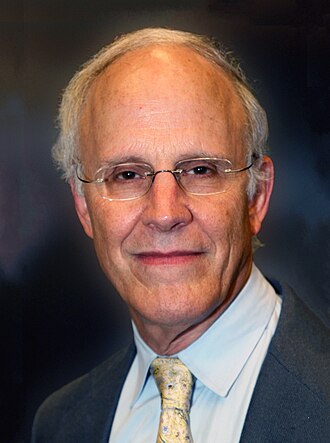
James P. Eisenstein1952—
英文简介American physicist
James P. Eisenstein is an American physicist. He is currently the Frank J. Roshek Professor of Physics and Applied Physics, Emeritus, at the California Institute of Technology. He received a share of the 2025 Wolf Prize in Physics for his experimental research on strongly interacting two-dimensional electron systems. He co-discovered the 5/2 filling factor state of the fractional quantum Hall effect and demonstrated the Bose–Einstein condensation of excitons in two dimensions.
摘自英文维基百科「James P. Eisenstein」(英文维基百科,暂无中文条目),CC BY-SA 4.0
- 出生
- 1952 年 5 月 15 日,圣路易斯
- 国籍
- 美国
- 学科
- 物理学
- 职业
- 物理学家
- 母校
- 加州大学伯克利分校
- 工作单位
- 加州理工学院、贝尔实验室
所获奖项(4)
- 2007奥利弗·巴克利奖
- 2025沃尔夫物理学奖
- —美国物理学会会士
- —美国文理科学院院士
学会与院士
百科正文
本条目暂无中文维基百科条目,下面是英文维基百科原文。
Academic career
Eisenstein received his AB degree from Oberlin College in 1974 and a PhD in physics from the University of California, Berkeley in 1980. Following a few years as an assistant professor of physics at Williams College, Eisenstein became a member of the technical staff at Bell Laboratories at Murray Hill, New Jersey in 1983. In 1996 Eisenstein accepted a professorship in physics at the California Institute of Technology in Pasadena, California. In 2005, he became the Frank J. Roshek Professor of Physics and Applied Physics at Caltech. Eisenstein assumed emeritus status in 2018 and suspended his experimental research program in 2021.
He has served on various National Research Council committees including the Solid State Sciences Committee and the Board on Physics and Astronomy. He was an associate editor of the Annual Review of Condensed Matter Physics from 2014 to 2017.
Research
Following doctoral research on the hydrodynamic properties of superfluid 3-He, at Bell Labs Eisenstein switched his focus to the experimental properties of two-dimensional electron systems in semiconductor heterostructures. At very low temperatures and high magnetic fields, such systems exhibit a host of exotic phenomena, notably the integer and fractional quantum Hall effects.
The even-denominator fractional quantum Hall state, at filling v=5/2, is believed to possess quasiparticles with non-abelian braiding statistics, a property key to proposed topological quantum computer architectures. Eisenstein co-discovered this state at filling factor 5/2, where the resistance depended on the direction, reminiscent of a liquid crystal. This discovery allowed him to study of the correlated motion of excitons in 2D, demonstrating their ability to form Bose–Einstein condensates. For these experiments, he shared the 2025 Wolf Prize in Physics with Jainendra K. Jain and Moty Heiblum.
The stripe and bubble phases reveal that in the quantum regime point-like electrons can organize themselves into configurations which resemble classical liquid crystals comprising complex asymmetric molecules.
Exciton condensation was originally theorized, in the 1960's, to occur in bulk semimetals in the absence of a magnetic field. Surprisingly, the phenomenon was first detected in closely-spaced double layer 2D electron systems at high magnetic field. In effect, at low temperature electrons in one layer can bind onto the vacancies between electrons in the other layer. The condensed phase has numerous exotic properties.
Awards and honors
- 1992 Fellow of the American Physical Society
- 1993 Distinguished Member of the Technical Staff, Bell Laboratories
- 2003 Morris Loeb Lecturer, Harvard University
- 2005 Election to the U.S. National Academy of Sciences
2007 Oliver E. Buckley Prize of the American Physical Society, shared with Steven M. Girvin and Allan H. MacDonald. Citation reads "for fundamental experimental and theoretical research on correlated many-electron states in low dimensional systems."
2025 Wolf Prize in Physics, along with Mordehai Heiblum and Jainendra K. Jain for “advancing our understanding of the surprising properties of two-dimensional electron systems in strong magnetic fields.
以上内容摘自英文维基百科「James P. Eisenstein」,按 CC BY-SA 4.0 使用,去掉了参考文献、外部链接等尾部小节,公式改写成了纯文本。全文、配图和出处见原文。