格物
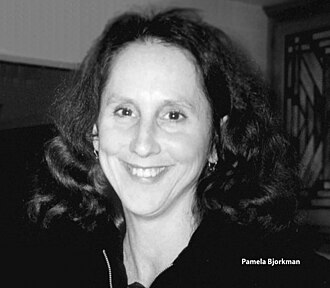
图:PLoS · CC BY 3.0 · Wikimedia Commons
帕梅拉·比约克曼1956—
Pamela J. Bjorkman
American biochemist
帕梅拉·简·比约克曼,生于俄勒冈州波特兰,美国生物化学家、分子生物学家,加州理工学院教授,霍华德·休斯医学研究所研究员。
摘自维基百科「帕梅拉·比约克曼」,CC BY-SA 4.0
- 出生
- 1956 年,波特兰
- 国籍
- 美国
- 学科
- 物理学、化学、生物学
- 职业
- 生物化学家、分子生物学家、大学教师、生物物理学家
- 母校
- 哈佛大学、俄勒冈大学、University of Oregon College of Arts and Sciences
- 工作单位
- 南加州大学、加州理工学院
研究领域
师承
博士生1
来自 Wikidata 的「博士导师」「师从」「博士生」「学生」记录,可能不全。
所获奖项(12)
- 1993威廉·布拉德利·科利奖
- 1994盖尔德纳国际奖
- 1996保罗·埃尔利希和路德维希‧达姆施泰特奖
- 1997美国文理科学院院士
- 2002马克斯·普朗克研究奖
- 2006欧莱雅-教科文组织女科学家奖
- 2007美国科学促进会会士
- 2010国立卫生研究院院长先驱奖
- 2020汤森路透引文桂冠奖
- 2021珀尔·美斯特·格林加德奖
- 2025沃尔夫医学奖
- —Camille Dreyfus Teacher-Scholar Awards
学会与院士
百科正文
比约克曼的主要贡献是开创了主要组织相容性复合体的晶体学研究。她率先识别了这种复合体一种蛋白的晶体结构。比约克曼被认为是免疫反应过程中不同的蛋白质的结构、功能和相互作用的研究的领导者之一。1994年,获盖尔德纳国际奖。
以上内容摘自维基百科「帕梅拉·比约克曼」,按 CC BY-SA 4.0 使用,去掉了参考文献、外部链接等尾部小节,公式改写成了纯文本。全文、配图和出处见原文。
英文维基百科补充中文条目比较短,下面是英文条目「Pamela Bjorkman」的原文
Pamela Jane Bjorkman NAS, AAAS (also spelled Pamela J. Björkman, Portland, Oregon) is an American biochemist and molecular biologist. She is the David Baltimore Professor of Biology and Biological Engineering at the California Institute of Technology (Caltech). Her research centers on the study of the three-dimensional structures of proteins related to class I MHC, or major histocompatibility complex, proteins of the immune system, and proteins involved in the immune responses to viruses. Bjorkman's goal is to improve current therapeutic applications. Bjorkman is most well known as a pioneer in the field of structural biology.
Early life and education
Bjorkman grew up in Parkrose, a neighborhood in Portland, Oregon. She became interested in science in high school and attended Willamette University for one year before transferring to the University of Oregon, where she earned a Bachelor of Arts degree in chemistry. As an undergraduate student, Bjorkman completed lab work with Larry Church at Reed College and O. Hayes Griffith at the University of Oregon.
In 1978, she began her PhD in biochemistry at Harvard University, where she joined the lab of Don Craig Wiley, an American structural biologist whose lab utilized x-ray crystallography. Bjorkman received her PhD from Harvard in 1984. She stayed on in Wiley's lab in a postdoctoral position where she ultimately solved the first crystal structure of an MHC protein—the HLA-A2 human histocompatibility antigen. This work was published in 1987, first at 3.5Å resolution (PDB entry 1HLA) and then refined at 2.6Å (PDB entry 3HLA).
Career and Research
Bjorkman continued her postdoctoral research at Stanford University in Mark Davis’ laboratory, studying the T-cell receptors that recognize antigens presented in the binding groove of MHC proteins. They developed a model explaining how this recognition mechanism works. While at Stanford, Bjorkman married neurobiologist Kai Zinn, also currently a full professor at Caltech. Bjorkman and Zinn have two children.
In 1989, Bjorkman joined the Biology faculty at the California Institute of Technology as an assistant professor. She earned tenure as an associate professor in 1995 and was promoted to full professor in 1998. She was an HHMI investigator from 1989 to 2015. She became the David Baltimore Professor of Biology and Biological Engineering in 2018 and Merkin Institute professor in 2021.
The Bjorkman Laboratory at Caltech focuses on investigating immune responses to viral pathogens with the ultimate goal of improving therapeutics and contributing to vaccine development. Her research focuses particularly on HIV-1, influenza, hepatitis C, and, since the COVID-19 pandemic, SARS-CoV-2. During the pandemic, Bjorkman worked with Michel Nussenzweig, a frequent collaborator, to study coronavirus spike protein structures. This research has implications for vaccine development as new SARS-CoV-2 variants arise.
The Bjorkman Lab utilizes x-ray crystallography, electron microscopy, electron tomography, cryo-electron microscopy, and fluorescent microscopy to study pathogen envelope glycoproteins and the molecular structures involved in the cell surface recognition of viral pathogens. Bjorkman's research also focuses on engineering antibody reagents and the development of mosaic nanoparticles for use in broadly effective vaccines.
Bjorkman's research has been published in journals like Nature and Science.
Awards
- 1989 Pew Scholar in the Biomedical Sciences by the Pew Charitable Trusts
- 1993 Cancer Research Institute William B. Coley Award
- 1994 Gairdner Foundation International Award (jointly with Don Wiley)
- 1994 James R. Klinenberg Science Award from the Arthritis Foundation
- 1996 AAI-PharMingen Investigator Award
- 1996 Paul Ehrlich and Ludwig Darmstaedter Prize
- 1997 Fellow of the American Academy of Arts and Sciences
- 1997 James R. Klinenberg Science Award from the Arthritis Foundation
- 2001 Member of the National Academy of Sciences
- 2002 Max Planck Research Award
- 2002 Member of the American Philosophical Society
- 2004 Rose Payne Distinguished Scientist Award
- 2006 L'Oreal-UNESCO Women in Science
- 2010 National Institute of Health Director's Pioneer Award
- 2021 Greengard Prize
- 2025 Wolf Prize in Medicine
以上内容摘自英文维基百科「Pamela Bjorkman」,按 CC BY-SA 4.0 使用,去掉了参考文献、外部链接等尾部小节,公式改写成了纯文本。全文、配图和出处见原文。
同一学科、同时代的科学家








同一学科的科学家
更多 ›