格物
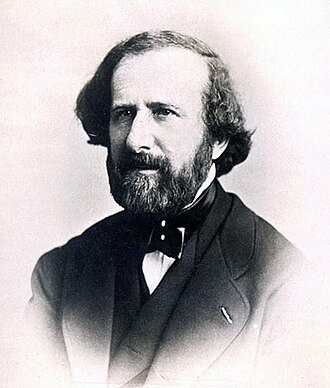
图:Charles Reutlinger, b.1816 · Public domain · Wikimedia Commons
- 出生
- 1819 年 9 月 23 日,巴黎
- 逝世
- 1896 年 9 月 18 日,château de Venteuil
- 国籍
- 比利时
- 学科
- 物理学、天文学、工程与发明、博物与综合
- 职业
- 物理学家、天文学家、工程师
- 母语 / 工作语言
- 法语
- 母校
- 法国巴黎斯坦尼斯学校(1840 年)、巴黎医学院(1841 年)、法兰西公学院
研究领域
主要贡献
代表成就
以他 / 她命名
师承
来自 Wikidata 的「博士导师」「师从」「博士生」「学生」记录,可能不全。
所获奖项(4)
- 1849法国荣誉军团骑士勋章
- 1866伦福德奖
- 1875英国皇家学会外籍会员
- —埃菲尔铁塔上所刻的72人列表
学会与院士
百科正文
生平
1819年出生于法国巴黎。
他早期的工作与改善摄影的程序有关,然后他与莱昂·傅科合作,参与了一系列光和热的干涉现象研究。在1848年,他发现了电磁波的多普勒效应;1849年,他发表了用他的方法测量得到的光速(参见斐索-傅科仪);在1850年,与E. Gounelle测量了电流的速度。
在1853年,他描述了如何使用螺旋管来增加电容(后来称为电容器)的效能,然后他又研究固体中的热胀冷缩,并应用光的干涉现象测量水晶的膨胀。1860年他成为法国皇家学会的会员,1849年9月,他首次使用旋转齿轮 装置,在地球上测得相对精确的光速。 他的设计巧妙, 利用齿轮、光源和反射镜来测量光速1878年加入经度局。他于1896年9月18日在旺特伊逝世。
以上内容摘自维基百科「阿尔芒·斐索」,按 CC BY-SA 4.0 使用,去掉了参考文献、外部链接等尾部小节,公式改写成了纯文本。全文、配图和出处见原文。
英文维基百科补充中文条目比较短,下面是英文条目「Hippolyte Fizeau」的原文
Armand Hippolyte Louis Fizeau (French: [ipɔlit fizo]; 23 September 1819 – 18 September 1896) was a French physicist who, in 1849, measured the speed of light to within 5% accuracy. In 1851, he measured the speed of light in moving water in an experiment known as the Fizeau experiment.
Biography
Fizeau was born in Paris to Louis and Beatrice Fizeau. He married into the de Jussieu botanical family. His earliest work was concerned with improvements in photographic processes. Following suggestions by François Arago, Léon Foucault and Fizeau collaborated in a series of investigations on the interference of light and heat. In 1848, he predicted the redshifting of electromagnetic waves.
In 1849, Fizeau calculated a value for the speed of light to a better precision than the previous value determined by Ole Rømer in 1676. He used a beam of light reflected from a mirror 8633 meters away. The beam passed through the gaps between the teeth of a rapidly rotating wheel with 720 teeth. The speed of the wheel was increased until, at 12.6 rotations per second, the returning light hit the next tooth and could not be seen. At 25.2 rotations per second, the light was again visible. This gives a result of
2 x 8633m x 25.2 x 720/s = 313,274,304 m/s, which is within 5% of the correct value (299,792,458 meters per second). (See Fizeau's measurement of the speed of light in air.) Fizeau made the first suggestion in 1864 that the "speed of a light wave be used as a length standard".
In 1850, he measured the relative speeds of light in air and water using a rotating mirror; however, Foucault independently achieved the same result seven weeks earlier.
Fizeau was involved in the discovery of the Doppler effect, which is known in French as the Doppler–Fizeau effect.
In 1853, Fizeau described the use of a capacitor (sometimes termed a "condenser") as a means to increase the efficiency of the induction coil. Later, he studied the thermal expansion of solids and applied the phenomenon of interference of light to the measurement of the dilatations of crystals. He became a member of the Académie des Sciences in 1860 and a member of the Bureau des Longitudes in 1878. He died in France at Venteuil on 18 September 1896.
"Fizeau" is one of the 72 names inscribed on the frieze below the first platform of the Eiffel Tower, all of whom were French scientists, mathematicians, engineers, or industrialists from the hundred years before the tower's public opening for the 1889 World's Fair. Of the 72, Fizeau is the only one who was still alive when the tower was opened.
The crater Fizeau on the far side of the Moon is named after him.
以上内容摘自英文维基百科「Hippolyte Fizeau」,按 CC BY-SA 4.0 使用,去掉了参考文献、外部链接等尾部小节,公式改写成了纯文本。全文、配图和出处见原文。
同一学科、同时代的科学家



同一学科的科学家
更多 ›