格物
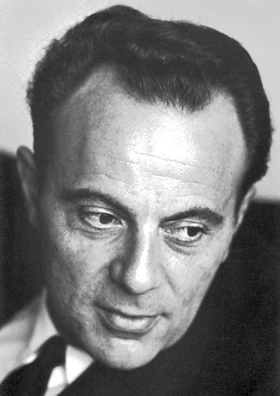
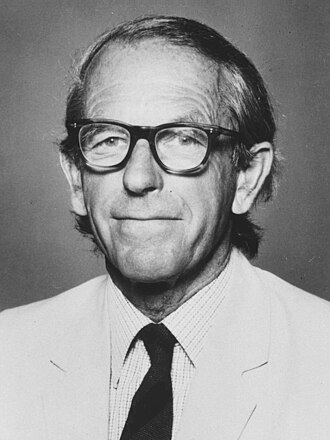
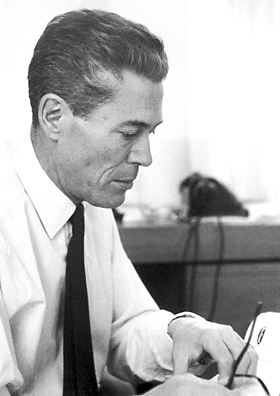
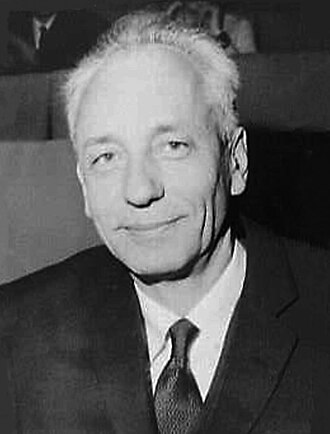
图:作者不详 · Public domain · Wikimedia Commons
弗朗索瓦·雅各布1920—2013
François Jacob
生物化学家, 法国
弗朗索瓦·雅各布 是一位犹太裔法国生物学家,他与雅克·莫诺发现了酶在原核生物转录作用调控中的角色,也就是后来所知的乳糖操纵组。两人与安德列·利沃夫共同获得了1965年的诺贝尔生理学或医学奖。
摘自维基百科「方斯華·賈克柏」,CC BY-SA 4.0
- 出生
- 1920 年 6 月 17 日,南锡
- 逝世
- 2013 年 4 月 20 日,巴黎十四区
- 国籍
- 法国
- 学科
- 化学、生物学、医学
- 职业
- 生物化学家、大学教师、遗传学家、生理学家
- 母语 / 工作语言
- 法语
- 母校
- 卡尔诺高中、巴黎医学院(哲学博士,1947 年)
- 工作单位
- 法兰西公学院(1964—1991)
研究领域
师承
博士生1
来自 Wikidata 的「博士导师」「师从」「博士生」「学生」记录,可能不全。
所获奖项(14)
- 1962夏尔-列奥波·马亚奖
- 1962Mendel Medal
- 1965诺贝尔生理学或医学奖
- 1973英国皇家学会外籍会员
- 1974Arnold-Reymond prize
- 1977列文虎克演讲
- 1982汉斯·克雷布斯爵士奖
- 1993honorary doctor of the University of Valencia
- —荣誉军团大十字勋章
- —战争十字章 1939年-1945年
- —Grand Officer of the National Order of Merit
- —Companion of the Liberation
- —honorary doctor from the NOVA University Lisbon
- —honorary doctorate of the Autonomous University of Madrid
学会与院士
百科正文
雅各布后来又与悉尼·布伦纳(2002年因线虫研究而获得诺贝尔奖)提出了核糖体进行转译时的作用方式假说,并由后来的实验证实。1996年,雅各布成为法兰西学术院院士。2013年4月19日逝世。
以上内容摘自维基百科「方斯華·賈克柏」,按 CC BY-SA 4.0 使用,去掉了参考文献、外部链接等尾部小节,公式改写成了纯文本。全文、配图和出处见原文。
英文维基百科补充中文条目比较短,下面是英文条目「François Jacob」的原文
François Jacob (French: [ʒakɔb]; 17 June 1920 – 19 April 2013) was a French biologist. He shared the 1965 Nobel Prize in Physiology or Medicine with Jacques Monod and André Lwoff "for their discoveries concerning genetic control of enzyme and virus synthesis". He and Monod originated the idea that control of enzyme levels in all cells occurs through regulation of transcription. For his work in the French Resistance, he received the Cross of Liberation, the Légion d'honneur and Croix de guerre.
He wrote popular science, and in 1994 received the inaugural Lewis Thomas Prize.
Early years
Jacob was born the only child of Simon, a merchant, and Thérèse (Franck) Jacob, in Nancy, France. An inquisitive child, he learned to read at a young age. Albert Franck, Jacob's maternal grandfather, a four-star general, was Jacob's childhood role model. At seven he entered the Lycée Carnot, where he was schooled for the next ten years; in his autobiography, he describes his impression of it: "a cage". He was antagonized by rightist youth at the Lycée Carnot around 1934. He describes his father as a "conformist in religion", while his mother and other family members important in his childhood were secular Jews; shortly after his bar mitzvah, he became an atheist.
Though interested (and talented) in physics and mathematics, Jacob was horrified at the prospect of spending two additional years in "an even more draconian regime" to prepare for higher study at the Polytechnique. Instead, after observing a surgical operation that cemented his "slight interest" in medicine, he entered medical school.
During the German occupation of France—and on the heels of his mother's death—Jacob left France for Great Britain to join the war effort. Jacob, who had only completed his second year of medical studies, joined the medical company of the French 2nd Armored Division in 1940. He was injured in a German air attack in 1944 and returned to now-liberated Paris on 1 August 1944. For his wartime service, he was awarded France's WWII highest decoration for valor, the Cross of Liberation, as well as Légion d'honneur and Croix de guerre.
After his recovery, Jacob returned to medical school and began researching tyrothricin and learning the methods of bacteriology in the process.
Research
In 1958, Monod was watching a film with his wife and told her "I think I’ve just thought up something important." In 1961 Jacob and Monod explored the idea that the control of enzyme expression levels in cells is a result of regulation of transcription of DNA sequences. Their experiments and ideas gave impetus to the emerging field of molecular developmental biology, and of transcriptional regulation in particular.
For many years it had been known that bacterial and other cells could respond to external conditions by regulating levels of their key metabolic enzymes, and/or the activity of these enzymes. For instance, if a bacterium finds itself in a broth containing lactose, rather than the simpler sugar glucose, it must adapt itself to the need to 1) import lactose, 2) cleave lactose to its constituents glucose and galactose, and 3) convert the galactose to glucose. It was known that cells ramp up their production of the enzymes that do these steps when exposed to lactose, rather than wastefully producing these enzymes all the time. Studies of enzyme activity control were progressing through theories of the (allosteric) action of small molecules on the enzyme molecule itself (switching it on or off), but the method of controlling the enzyme production was not well understood at the time.
With the earlier determination of the structure and central importance of DNA, it became clear that all proteins were being produced in some way from its genetic code, and that this step might form a key control point. Jacob and Monod made key experimental and theoretical discoveries that demonstrated that in the case of the lactose system outlined above (in the bacterium E.
Honours and awards
- 1962 Grand Prix Charles-Leopold Mayer by the Académie des Sciences
- 1964 elected to the American Academy of Arts and Sciences
- 1965 Nobel Prize in Physiology or Medicine with André Lwoff and Jacques Monod
- 1969 elected to the United States National Academy of Sciences
- 1969 elected to the American Philosophical Society
- 1973 Elected a Foreign Member of the Royal Society (ForMemRS)
- 1996 Lewis Thomas Prize for Writing about Science
- 1996 Académie Française Seat 38
以上节选摘自英文维基百科「François Jacob」,按 CC BY-SA 4.0 使用,去掉了参考文献、外部链接等尾部小节,公式改写成了纯文本。篇幅所限,较长的小节只摘了开头一部分,有的小节没有收;全文、配图和出处见原文。