 格物
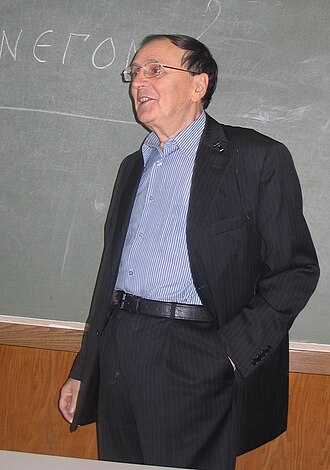
图:Mitrius · Public domain · Wikimedia Commons
科学家 ›
安德烈·阿纳托利耶维奇·扎利兹尼亚克1935—2017
Andrey Zaliznyak
Russian linguist (1935-2017)
安德烈·阿纳托利耶维奇·扎利兹尼亚克,苏联和俄罗斯语言学家,历史语言学、重音学、方言学和语法的专家。语言学博士。扎利兹尼亚克在晚年十分关注语言学的普及与反对伪科学。
摘自维基百科「安德烈·扎利茲尼亞克」,CC BY-SA 4.0
- 出生
- 1935 年 4 月 29 日,莫斯科
- 逝世
- 2017 年 12 月 24 日,莫斯科
- 国籍
- 苏联、俄罗斯
- 职业
- 语言学家、方言学家、大学教师、语文学家
- 母语 / 工作语言
- 俄语
- 母校
- 巴黎大学(1958 年)、Philological Faculty of Moscow State University(1958 年)、索邦大学(1958 年)
- 工作单位
- 莫斯科俄罗斯历史研究所(1960—)、Philological Faculty of Moscow State University、莫斯科国立大学(?—1982)
研究领域
主要贡献
代表成就
师承
博士导师2
博士生4
来自 Wikidata 的「博士导师」「师从」「博士生」「学生」记录,可能不全。
所获奖项(6)
- 1997杰米多夫奖
- 2007罗蒙诺索夫金质奖章
- 2007俄罗斯联邦国家奖
- 2007Solzhenitsyn Prize
- 2011honorary citizen of Veliky Novgorod
- 2015AA Shakhmatov Prize
学会与院士
百科正文
英文维基百科补充中文条目比较短,下面是英文条目「Andrey Zaliznyak」的原文
Andrey Anatolyevich Zaliznyak (Russian: Андре́й Анато́льевич Зализня́к; 29 April 1935 – 24 December 2017) was a Russian linguist who specialized in historical linguistics, morphology, accentology, and dialectology. He served as the leading researcher on medieval Novgorod birchbark documents and proved the authenticity of The Tale of Igor's Campaign. His Grammatical Dictionary of the Russian Language (1977) remains the standard reference for Russian inflection and forms the basis for most Russian language processing algorithms.
Biography
Andrey Zaliznyak was born in Moscow on 29 April 1935 to Anatoly Andreyevich Zaliznyak, an engineer, and Tatiana Konstantinovna Krapivina, a chemist. During World War II, the family was in evacuation. There, Andrey joined a German language class, but his teacher called him incapable of learning languages; his mother was advised not to waste time in teaching him German. Instead of repeating phrases after the teacher, Zaliznyak composed a table of German words for six colors. After the war, Zaliznyak was sent to relatives to Pruzhany in Western Belarus; his relatives had a lot of Polish-language books, and he met a priest who knew Latin. He became fascinated by languages and bought multiple grammar books. Several years later, he had a head injury while playing football and spent four days unconscious; bedridden, he spent two weeks with a French grammar book. As a teenager he learned Polish, Latin, English, Italian, and Spanish to a various degree of proficiency.
In 1951 Zaliznyak participated in the first Language and Literature Olympiad organized by the philology department at Moscow State University, where he met his future wife, Yelena Paducheva, for the first time. He took first place, and she took third; in the following year, the two came joint first. Paducheva later became his classmate at MSU.
Zaliznyak began studying linguistics at MSU in 1952, focusing on English and Swedish. In 1956, he was chosen to be sent to France as an exchange student for a year.
Major contributions
Russian language and morphology
Zaliznyak's first monograph, Russian Nominal Inflection (Русское именное словоизменение, 1967), established a derivational architecture for analyzing Russian morphology, contrasting with the Soviet preference for declarative approaches that avoided paradigms and derivation. He "proposed algorithmic definitions of case and gender categories", inspired by mathematicians Andrey Kolmogorov and Vladimir Uspensky. His analysis identified more than the traditional six Russian cases, including partitive, locative, and special adnumeral forms. He defined morphological gender as combinations of inflectional types and distinguished it from syntactic gender based on agreement patterns.
Together with his wife Yelena Paducheva, Zaliznyak proposed "a typology of relative clauses in the vein of Émile Benveniste's work" in 1975. The paper was called "a precursor to the study of grammaticalization".
In 1977, Zaliznyak published the Grammatical Dictionary of the Russian Language (Грамматический словарь русского языка), which was the first publication to include a full overview of Russian words with precise grammar characteristics of each one. It consists of 110,000 words, arranged alphabetically by last character (e.g., баба, жаба, раба, изба, бомба, рыба, судьба). Zaliznyak collected words on thin paper cards in four wooden boxes taken from a bakery. The dictionary became heavily used in the 1990s on the Russian Internet for web search, spell checkers, and online translators.
Personal life
Zaliznyak married linguist Yelena Paducheva in 1958, with whom he co-authored several papers. Their daughter, Anna Zaliznyak, was born in 1959. She also became a linguist, and specializes in Russian aspectology and semantic typology.
Colleagues described him as "a warm, supportive and modest person, completely uninterested in fame and awards, but devoted to science and the quest for truth. A very decent and admirable human being."
Zaliznyak loved Paris, and at the end of 1980s, when Soviet citizens were allowed to travel abroad, often travelled to France, Italy, and other European countries by train. He lectured in Russian, English, French, and once in Italian.
Zaliznyak had a heart attack in 1984, and later had heart surgery in Sweden. He died in Moscow on 24 December 2017 at age 82.
Awards and honors
- 1997: Demidov Prize
- 2007: State Prize of the Russian Federation
- 2007: Solzhenitsyn Prize
- 2007: Lomonosov Gold Medal
- 2015: Shakhmatov Prize
以上节选摘自英文维基百科「Andrey Zaliznyak」,按 CC BY-SA 4.0 使用,去掉了参考文献、外部链接等尾部小节,公式改写成了纯文本。篇幅所限,较长的小节只摘了开头一部分,有的小节没有收;全文、配图和出处见原文。