格物
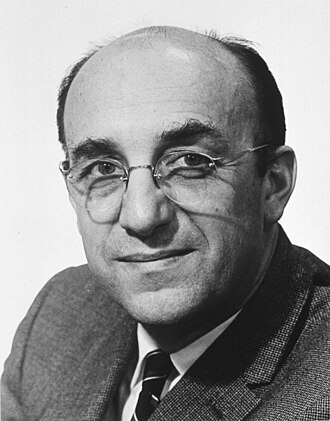
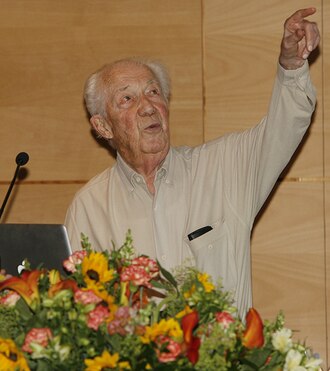
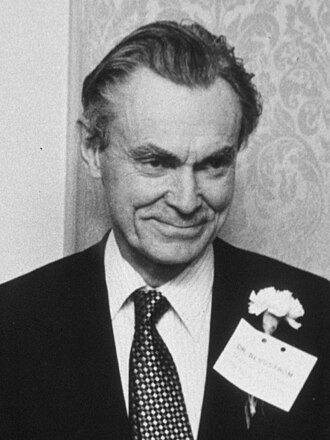
图:作者不详 · Public domain · Wikimedia Commons
罗歇·吉耶曼1924—2024
Roger Guillemin
French-American neuroscientist (1924–2024)
罗歇·夏尔·路易·吉耶曼,法国科学家,后加入美国国籍。他的主要研究领域是神经激素,并因此获得1976年美国国家科学奖章和1977年诺贝尔生理学或医学奖。
摘自维基百科「罗歇·吉耶曼」,CC BY-SA 4.0
- 出生
- 1924 年 1 月 11 日,第戎
- 逝世
- 2024 年 2 月 21 日,圣迭戈
- 国籍
- 法国、美国
- 学科
- 化学、生物学、医学
- 职业
- 生物化学家、大学教师、神经学家
- 母语 / 工作语言
- 法语、英语
- 母校
- 蒙特利尔大学(哲学博士)、勃艮第大学、Lycée Carnot
- 工作单位
- 法兰西公学院(1960—)、索尔克生物学研究所(1970—)
研究领域
师承
博士生1
来自 Wikidata 的「博士导师」「师从」「博士生」「学生」记录,可能不全。
所获奖项(16)
- 1974盖尔德纳国际奖
- 1975拉斯克基础医学研究奖
- 1976美国国家科学奖章
- 1977诺贝尔生理学或医学奖
- 1977Dickson Prize in Medicine
- 1977honorary doctor of the University of Chicago
- 1977doctor honoris causa from the University of Dijon
- 1984honorary doctor of the University of Manitoba
- 1986巴黎第七大学名誉博士
- 1989honorary doctorate of Claude Bernard University Lyon 1
- 1996honorary doctorate at the Laval University
- 1998honorary doctor of the Marie and Louis Pasteur University
- 2015荣誉军团司令
- —美国文理科学院院士
- —honorary doctorate of the Autonomous University of Madrid
- —honorary doctor of the University of Sherbrooke
学会与院士
百科正文
生平
吉耶曼出生于法国勃艮第第戎,在勃艮第大学完成大学学业后,于1949年在里昂大学得到了医学硕士学位。之后他前往蒙特利尔,在蒙特利尔大学汉斯·谢耶博士的指导下于1953年获得了博士学位。同年他前往美国,进入位于休斯敦的贝勒医学院工作,1965年加入美国国籍。
1970年,他在圣地牙哥建立了一个实验室,在那里一直工作到1989年退休。
以上内容摘自维基百科「罗歇·吉耶曼」,按 CC BY-SA 4.0 使用,去掉了参考文献、外部链接等尾部小节,公式改写成了纯文本。全文、配图和出处见原文。
英文维基百科补充中文条目比较短,下面是英文条目「Roger Guillemin」的原文
Roger Charles Louis Guillemin (French pronunciation: [ʁɔʒe ʃaʁl lwi ɡijmɛ̃]; January 11, 1924 – February 21, 2024) was a French-American neuroscientist. He received the National Medal of Science in 1976, and the Nobel Prize for Medicine in 1977 for his work on neurohormones, sharing the prize that year with Andrew Schally and Rosalyn Sussman Yalow.
Biography
Guillemin was born in Dijon, France. After secondary studies at the Lycée Carnot in Dijon, he began his medical studies at the University of Dijon in 1943. He completed his medical studies at the University of Lyon and received MD degree in 1949. He worked as a doctor in a small village in Burgundy, and went to Montreal, Quebec, Canada, to work with Hans Selye at the Institute of Experimental Medicine and Surgery at the Université de Montréal where he received a Ph.D. in 1953. In 1965, he became a naturalized citizen of the United States.
In 1954, Guillemin observed that pituitary cells do not produce hormones unless hypothalamic cells are present, which supported the theory that the hypothalamus controls the pituitary through hormones, dubbed releasing factors. Guillemin moved to Baylor College of Medicine, in Houston, to develop that finding. Andrzej V. Schally, known in the US as Andrew Schally, joined him in 1957. Their partnership dissolved after five years for lack of progress and personal conflicts; Schally moved to the Veterans Affairs Hospital in New Orleans.
Both scientists then worked independently, processing large quantities of hypothalami: Guillemin used over two million sheep hypothalami, and Schally used pig brains—funded by the US government. The release factors are present in an extremely low amounts in the hypothalamus, and it was hard to detect them using the instrumentation available at that time. Their rivalry intensified, particularly regarding scientific credit. In 1969, as government funding was about to be cut off, Roger Burgus from Guillemin's team made a breakthrough by identifying the thyrotropin-releasing factor (TRF), which controls the thyroid gland. The achievement secured continued funding and led to the identification of another releasing factor, FRF, which controls reproductive systems. Guillemin and Schally discovered the structures of Thyrotropin-releasing hormone (TRH) and Gonadotropin-releasing hormone (GnRH) in separate laboratories. They were awarded the 1977 Nobel Prize in Physiology or Medicine for this discovery.
In 1970, he joined the Salk Institute in La Jolla, where he was the head of the Laboratories for Neuroendocrinology until his retirement in 1989. Here, he discovered somatostatin, and was "among the first" to isolate endorphins. A Guillemin protégé, Wylie Vale Jr., established his own laboratory at Salk in 1977; their attempts of finding releasing factors was described as "yet another furious rivalry." Vale's lab was first to purify and sequence the CRF.
In 2007, Guillemin was an interim president of the Salk Institute.
Guillemin signed, along with other Nobel Prize winners, a petition requesting a delegation of the Committee on the Rights of the Child of the United Nations to visit a Tibetan child who had been under house arrest in China since 1995, namely Gedhun Choekyi Nyima, who was recognized as the 11th Panchen Lama by the 14th Dalai Lama, Tenzin Gyatso.
Guillemin turned 100 on January 11, 2024, and died in San Diego, California the following month, on February 21.
He was married to Lucienne Jeanne Billard for 69 years until her death in 2021, at the age of 100. They had five daughters and a son.
Awards and honors
- National Academy of Sciences, 1974
- Canada Gairdner International Award, 1974
- Albert Lasker Award for Basic Medical Research, 1975
- Dickson Prize in Medicine, 1976
- Passano Award in Medical Sciences, 1976
- National Medal of Science, 1976
- American Academy of Arts and Sciences, 1977
- Nobel Prize in Physiology or Medicine, 1977
以上内容摘自英文维基百科「Roger Guillemin」,按 CC BY-SA 4.0 使用,去掉了参考文献、外部链接等尾部小节,公式改写成了纯文本。全文、配图和出处见原文。