格物
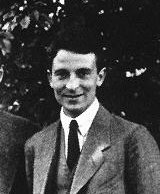
图:Transferred from en.wikipedia to Commons by Magnus Manske us… · Public domain · Wikimedia Commons
- 出生
- 1894 年 9 月 15 日,Mörby
- 逝世
- 1977 年 2 月 5 日,斯德哥尔摩
- 国籍
- 瑞典
- 学科
- 物理学、博物与综合
- 职业
- 物理学家、大学教师、理论物理学家
- 母语 / 工作语言
- 瑞典语
- 母校
- 斯德哥尔摩大学、哥本哈根大学
- 工作单位
- 密歇根大学(1923—1926)、斯德哥尔摩大学(1930—1962)、隆德大学(1926—1931)、莱顿大学(1964—1964)
主要贡献
代表成就
以他 / 她命名
师承
博士生2
来自 Wikidata 的「博士导师」「师从」「博士生」「学生」记录,可能不全。
所获奖项(2)
- 1937Björkén Prize
- 1959马克斯·普朗克奖章
学会与院士
百科正文
生平
奥斯卡·克莱因出生于斯德哥尔摩省丹德吕德市,为斯德哥尔摩首席拉比戈特利布·克莱因之子,戈特利布·克莱因来自从匈牙利胡门内。他在年轻的时候成为挪威诺贝尔研究所学生,师从斯凡特·奥古斯特·阿伦尼乌斯,当第一次世界大战爆发后,他正前往法国,准备师从让·佩兰,之后他应征入伍。
从1917年开始,他在哥本哈根大学与尼尔斯·玻尔工作数年,并获得斯德哥尔摩大学博士学位。1923年,他获得安娜堡密歇根大学教职,并与妻子格尔达科赫离开丹麦。奥斯卡·克莱因于1925年回到哥本哈根,与保罗·埃伦费斯特在莱顿研究,然后在1926年于隆德大学研究。
克莱因于1959年被授予马克斯·普朗克奖章。他于1962年退休。
奥斯卡·克莱因与西奥多·卡鲁扎发明卡鲁扎-克莱因理论,提议第四个空间维度卷曲成一个半径非常小的圆,所以粒子沿着这个轴移动很短的距离,就会回到起始点。粒子在回到起始点前所能行进的距离则称作是该维度的大小。这个额外维度(extra dimension)是一个紧集,而时空具有紧致维度的现象则称作是紧化。
1938年,他提出玻色子交换模型来解释电弱相互作用(放射性衰变),几年后,汤川秀树提出类似想法。卡鲁扎-克莱因理论也可以被推广成杨-米尔斯理论。
奥斯卡·克莱因纪念讲座每年在斯德哥尔摩大学举行。
以上内容摘自维基百科「奧斯卡·克萊因」,按 CC BY-SA 4.0 使用,去掉了参考文献、外部链接等尾部小节,公式改写成了纯文本。全文、配图和出处见原文。
英文维基百科补充中文条目比较短,下面是英文条目「Oskar Klein」的原文
Oskar Benjamin Klein (Swedish: [ˈklajn]; 15 September 1894 – 5 February 1977) was a Swedish theoretical physicist now best remembered for the Klein-Gordon equation of relativistic quantum mechanics, the Kaluza-Klein theory, a unified field theory of gravitation and electromagnetism, and the Klein–Nishina cross section in quantum electrodynamics.
Biography
Klein was born in Danderyd outside Stockholm, son of the chief rabbi of Stockholm, Gottlieb Klein from Humenné in Kingdom of Hungary, now Slovakia and Antonie (Toni) Levy. He became a student of Svante Arrhenius at the Nobel Institute at a young age and was on the way to Jean-Baptiste Perrin in France when World War I broke out and he was drafted into the military.
From 1917, he worked a few years with Niels Bohr in the University of Copenhagen and received his doctoral degree at the University College of Stockholm (now Stockholm University) in 1921. In 1923, he received a professorship at University of Michigan in Ann Arbor and moved there with his recently wedded wife, Gerda Koch from Denmark. Klein returned to Copenhagen in 1925, spent some time with Paul Ehrenfest in Leiden, then became docent at Lund University in 1926 and in 1930 accepted the offer of the professorial chair in physics at the Stockholm University College, which had previously been held by Erik Ivar Fredholm until his death in 1927. Klein was awarded the Max Planck Medal in 1959. He retired as professor emeritus in 1962.
Klein discovered in 1926 the Klein-Gordon equation, the simplest and prototypical example of relativistic wave equation. It describes the behavior of scalar fields, such as e.g., those associated to the pions. Walter Gordon, independently discovered and published the equation a few months later, as well as Vladimir Fock. The Klein-Gordon equation is an example of Stigler's law as it was first discovered by Erwin Schrödinger in 1925 but not published until after Klein, Gordon and Fock's papers because Schrödinger was initially discouraged by the fact that it did not give the right fine structure for the hydrogen atom.
Klein is also credited for inventing the idea, part of Kaluza–Klein theory, that extra dimensions may be physically real but curled up and very small, an idea essential to string theory.
In 1938, he proposed a boson-exchange model for charge-charging weak interactions (radioactive decay), a few years after a similar proposal by Hideki Yukawa. His model was based on a local isotropic gauge symmetry and anticipated the later successful theory of Yang–Mills.
Oskar Klein died on 5 February 1977 in Stockholm, Sweden.
The Oskar Klein Memorial Lecture, held annually at the University of Stockholm, has been named after him. The Oskar Klein Centre for Cosmoparticle Physics in Stockholm, Sweden is also in his honor.
以上内容摘自英文维基百科「Oskar Klein」,按 CC BY-SA 4.0 使用,去掉了参考文献、外部链接等尾部小节,公式改写成了纯文本。全文、配图和出处见原文。
同一学科、同时代的科学家



同一学科的科学家
更多 ›