格物
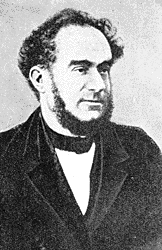
图:Unknown authorUnknown authorThe original uploader was Rsabba… · Public domain · Wikimedia Commons
卡洛·马泰乌奇1811—1868
Carlo Matteucci
Italian politician and physicist (1811–1868)
卡洛·马泰乌奇,意大利物理学家和神经生理学家,生物电研究的先驱。
摘自维基百科「卡洛·马泰乌奇」,CC BY-SA 4.0
- 出生
- 1811 年 6 月 20 日,弗利
- 逝世
- 1868 年 6 月 24 日,里窝那
- 国籍
- 意大利王国
- 学科
- 物理学、生物学、博物与综合
- 职业
- 物理学家、神经学家、政治人物、生理学家
- 母语 / 工作语言
- 意大利语
- 母校
- 博洛尼亚大学、巴黎综合理工学院
- 工作单位
- 比萨大学
师承
来自 Wikidata 的「博士导师」「师从」「博士生」「学生」记录,可能不全。
所获奖项(4)
- 1844科普利奖章
- 1847honorary member of the Physics Association (Frankfurt am Main, Germany)
- —法国荣誉军团勋章
- —匈牙利圣史蒂芬勋章
学会与院士
百科正文
生平
卡洛·马泰乌奇出生于罗马涅省的弗利。他的父亲是医生温琴佐·马泰乌奇,母亲是基娅拉·福尔菲。1825年至1828年,他在博洛尼亚大学学习数学,1829年获得博士学位。1829年至1831年,他在巴黎综合理工学院从事研究。1832年,他回到意大利,先后在博洛尼亚(1832年),佛罗伦萨,拉文纳(1837年)和比萨从事研究。
1847年起,他积极参与政治活动,1860年被选为意大利参议员,同时成为意大利电报线路的总监。两年后,他被任命为教育部长。
1868年,马泰乌奇死于Ardenza附近的里窝那。
以上内容摘自维基百科「卡洛·马泰乌奇」,按 CC BY-SA 4.0 使用,去掉了参考文献、外部链接等尾部小节,公式改写成了纯文本。全文、配图和出处见原文。
英文维基百科补充中文条目比较短,下面是英文条目「Carlo Matteucci」的原文
Carlo Matteucci (20 June 1811 – 24 June 1868) was an Italian physicist and neurophysiologist who was a pioneer in the study of bioelectricity.
Biography
Carlo Matteucci was born at Forlì, in the province of Romagna, to Vincenzo Matteucci, a physician, and Chiara Folfi. He studied mathematics at the University of Bologna from 1825 to 1828, receiving his doctorate in 1829. From 1829 to 1831, he studied at the École Polytechnique in Paris, France. Upon returning to Italy, Matteucci studied at Bologna (1832), Florence, Ravenna (1837) and Pisa. He established himself as the head of the laboratory of the Hospital of Ravenna and became a professor of physics at the local college. In 1840, by recommendation of François Arago (1786–1853), his teacher at the École Polytechnique, to the Grand-Duke of Tuscany, Matteucci accepted a post of professor of physics at the University of Pisa.
Instigated by the work of Luigi Galvani (1737–1798) on bioelectricity, Matteucci began in 1830 a series of experiments which he pursued until his death in 1865. Using a sensitive galvanometer of Leopoldo Nobili, he was able to prove that injured excitable biological tissues generated direct electrical currents, and that they could be summed up by adding elements in series, like in Alessandro Volta’s (1745-1827) electric pile. Thus, Mateucci was able to develop what he called a "rheoscopic frog", by using the cut nerve of a frog's leg and its attached muscle as a kind of sensitive electricity detector. His work in bioelectricity influenced directly the research developed by Emil du Bois-Reymond (1818–1896), a student of the great German biologist Johannes Peter Müller (1801–1858) in Berlin, who tried the duplicate Matteucci's experiments and ended up discovering the nerve's action potential. In 1844, for these studies, Matteucci was awarded with the Copley medal by the Royal Society.
From 1847, he took an active part in politics, and in 1860 was chosen an Italian senator, at the same time becoming inspector-general of the Italian telegraph lines. Two years later he was appointed Minister of Education.
Personal life
On 7 September 1846, Matteucci married Robinia Elizabeth Young (c. 1811–1897) at Marylebone Church in London. Robinia was the adopted daughter of Mary Ancrum Young (c. 1790–1867), widow of Rev. Robert Young, D.D., minister of the Scots Church, London Wall. Mary Young is buried in the English Cemetery, Florence, where her tomb bears a dedicatory inscription from Carlo and Robinia Matteucci.
Matteucci died at Ardenza, near Livorno, on 24 June 1868.
以上内容摘自英文维基百科「Carlo Matteucci」,按 CC BY-SA 4.0 使用,去掉了参考文献、外部链接等尾部小节,公式改写成了纯文本。全文、配图和出处见原文。
同一学科、同时代的科学家



同一学科的科学家
更多 ›