格物
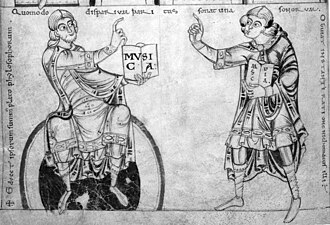
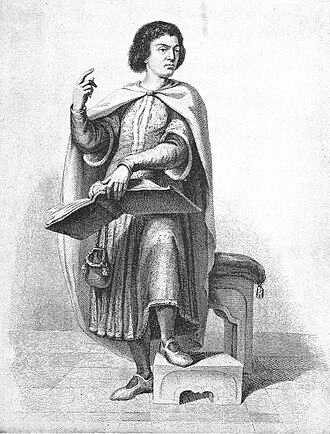
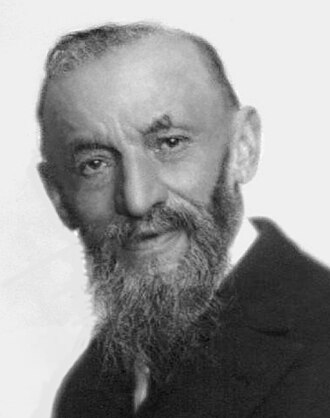
图:AnonymousUnknown author · Public domain · Wikimedia Commons
- 出生
- 60 年,杰拉什
- 逝世
- 120 年
- 国籍
- 古罗马
- 学科
- 数学、博物与综合
- 职业
- 数学家、音乐学家、音乐理论家、哲学家
- 母语 / 工作语言
- 古希腊语
研究领域
百科正文
尼科马库斯(或译尼科马科斯,希腊语:Νικόμαχος,英语:Nicomachus,约60年—约120年), 古希腊数学家,著作有《算术概论》(Introduction to Arithmetic)。
以上内容摘自维基百科「尼科马库斯」,按 CC BY-SA 4.0 使用,去掉了参考文献、外部链接等尾部小节,公式改写成了纯文本。全文、配图和出处见原文。
英文维基百科补充中文条目比较短,下面是英文条目「Nicomachus」的原文
Nicomachus of Gerasa (Ancient Greek: Νικόμαχος ὁ Γερασηνός; c. 60 – c. 120 AD) was a Greek Neopythagorean philosopher from Gerasa (now Jerash, Jordan).
Like many Pythagoreans, Nicomachus wrote about the mystical properties of numbers, best known for his works Introduction to Arithmetic and Manual of Harmonics, which are an important resource on Ancient Greek mathematics and Ancient Greek music in the Roman period. Nicomachus' work on arithmetic became a standard text for Neoplatonic education in Late antiquity, with philosophers such as Iamblichus and John Philoponus writing commentaries on it. A Latin paraphrase by Boethius of Nicomachus's works on arithmetic and music became standard textbooks in medieval education.
Life
Little is known about the life of Nicomachus except that he was a Pythagorean who came from Gerasa. His Manual of Harmonics was addressed to a lady of noble birth, at whose request Nicomachus wrote the book, which suggests that he was a respected scholar of some status. He mentions his intent to write a more advanced work, and how the journeys he frequently undertakes leave him short of time.The approximate dates in which he lived (c. 100 AD) can only be estimated based on which other authors he refers to in his work, as well as which later mathematicians who refer to him. He mentions Thrasyllus in his Manual of Harmonics, and his Introduction to Arithmetic was apparently translated into Latin in the mid 2nd century by Apuleius,while he makes no mention at all of either Theon of Smyrna's work on arithmetic or Ptolemy's work on music, implying that they were either later contemporaries or lived in the time after he did.
Philosophy
Historians consider Nicomachus a Neopythagorean based on his tendency to view numbers as having mystical properties rather than their mathematical properties, citing an extensive amount of Pythagorean literature in his work, including works by Philolaus, Archytas, and Androcydes. He writes extensively on numbers, especially on the significance of prime numbers and perfect numbers and argues that arithmetic is ontologically prior to the other mathematical sciences (music, geometry, and astronomy), and is their cause. Nicomachus distinguishes between the wholly conceptual immaterial number, which he regards as the 'divine number', and the numbers which measure material things, the 'scientific' number. Nicomachus provided one of the earliest Greco-Roman multiplication tables; the oldest extant Greek multiplication table is found on a wax tablet dated to the 1st century AD (now found in the British Museum).
Metaphysics
Although Nicomachus is considered a Pythagorean, John M. Dillon says that Nicomachus's philosophy "fits comfortably within the spectrum of contemporary Platonism." In his work on arithmetic, Nicomachus quotes from Plato's Timaeus to make a distinction between the intelligible world of Forms and the sensible world, however, he also makes more Pythagorean distinctions, such as between Odd and even numbers. Unlike many other Neopythagoreans, such as Moderatus of Gades, Nicomachus makes no attempt to distinguish between the Demiurge, who acts on the material world, and The One which serves as the supreme first principle.
Legacy
Late antiquity
The Introduction to Arithmetic of Nicomachus was a standard textbook in Neoplatonic schools, and commentaries on it were written by Iamblichus (3rd century) and John Philoponus (6th century).
The Arithmetic (in Latin: De Institutione Arithmetica) of Boethius was a Latin paraphrase and a partial translation of the Introduction to Arithmetic. The Manual of Harmonics also became the basis of the Boethius' Latin treatise titled De institutione musica.
Medieval European philosophy
The work of Boethius on arithmetic and music was a core part of the Quadrivium liberal arts and had a great diffusion during the Middle Ages.
Nicomachus's theorem
At the end of Chapter 20 of his Introduction to Arithmetic, Nicomachus points out that if one writes a list of the odd numbers, the first is the cube of 1, the sum of the next two is the cube of 2, the sum of the next three is the cube of 3, and so on. He does not go further than this, but from this it follows that the sum of the first n cubes equals the sum of the first n(n+1)/2 odd numbers, that is, the odd numbers from 1 to n(n+1)-1. The average of these numbers is obviously n(n+1)/2, and there are n(n+1)/2 of them, so their sum is (n(n+1)/2)². Many early mathematicians have studied and provided proofs of Nicomachus's theorem.
以上节选摘自英文维基百科「Nicomachus」,按 CC BY-SA 4.0 使用,去掉了参考文献、外部链接等尾部小节,公式改写成了纯文本。篇幅所限,较长的小节只摘了开头一部分,有的小节没有收;全文、配图和出处见原文。
同一学科的科学家
更多 ›