格物
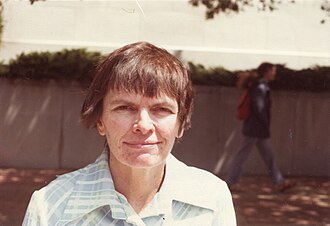
图:George Bergman · CC BY-SA 4.0 · Wikimedia Commons
- 出生
- 1919 年 12 月 8 日,圣路易斯
- 逝世
- 1985 年 7 月 30 日,伯克利
- 国籍
- 美国
- 学科
- 数学、博物与综合
- 职业
- 数学家、哲学家、大学教师
- 母语 / 工作语言
- 英语
- 母校
- 加州大学伯克利分校(哲学博士,1949 年)、圣地亚哥高中(1936 年)、圣地亚哥州立大学(1939 年)
- 工作单位
- 加州大学伯克利分校(1976—1985)、兰德公司(1949—1950)
研究领域
师承
博士导师1
来自 Wikidata 的「博士导师」「师从」「博士生」「学生」记录,可能不全。
所获奖项(2)
- 1983麦克阿瑟天才奖
- 1985美国文理科学院院士
学会与院士
百科正文
英文维基百科补充中文条目比较短,下面是英文条目「Julia Robinson」的原文
Julia Hall Bowman Robinson (December 8, 1919 – July 30, 1985) was an American mathematician noted for her contributions to the fields of computability theory and computational complexity theory—most notably in decision problems. Her work on Hilbert's tenth problem (now known as Matiyasevich's theorem or the MRDP theorem) played a crucial role in its ultimate resolution. Robinson was a professor at UC Berkeley, the first female mathematician to be elected to the National Academy of Sciences, and a 1983 MacArthur Fellow.
Early years
Robinson was born in St. Louis, Missouri, the daughter of Ralph Bowers Bowman and Helen (Hall) Bowman. Her father owned a machine equipment company while her mother was a school teacher before marriage. Her mother died when Robinson was 2 years old and her father remarried. Her older sister was the mathematical popularizer and biographer Constance Reid and her younger sister is Billie Comstock.
When she was 9 years old, she was diagnosed with scarlet fever, which was shortly followed by rheumatic fever. This caused her to miss two years of school. When she was well again, she was privately tutored by a retired primary school teacher.
Mathematical contributions
After graduating, Robinson continued in graduate studies at Berkeley. As a graduate student, Robinson was employed as a teaching assistant with the Department of Mathematics and later as a statistics lab assistant by Jerzy Neyman in the Berkeley Statistical Laboratory, where her work resulted in her first published paper, titled "A Note on Exact Sequential Analysis".
Robinson received her PhD degree in 1948 under Alfred Tarski with a dissertation on "Definability and Decision Problems in Arithmetic".
Her dissertation showed that the theory of the rational numbers was an undecidable, by demonstrating that elementary number theory could be defined in terms of the rationals.
Professorship at UC Berkeley
Robinson was not allowed to teach in the Mathematics Department at Berkeley after marrying Raphael M. Robinson in 1941, as there was a rule that prevented family members from working together in the same department. Robinson then instead stayed in the statistics department despite wanting to teach calculus.
Although Raphael retired in 1973, it was not until 1976 she was offered a full-time professorship position at Berkeley after the department heard of her nomination to the National Academy of Sciences.
Honors
After Yuri Matiyasevich solved Hilbert's tenth problem by means of the J.R. hypothesis and the Fibonacci number sequence, Saunders Mac Lane nominated Robinson for the National Academy of Sciences. Alfred Tarski and Jerzy Neyman also flew out to Washington, D.C. to further explain to the National Academy of Sciences why her work is so important and how it tremendously contributed to mathematics. In 1975, she was the first female mathematician to be elected to the National Academy of Sciences.
Robinson was chosen as the first female president of the American Mathematical Society (for the term of 1983–1984) but was unable to complete her term as she was suffering from leukemia.
Political work
In the 1950s Robinson was active in local Democratic party activities. She was Alan Cranston's campaign manager in Contra Costa County when he ran for his first political office, state controller.
"I don't remember exactly what happened, but the end result was that Julia involved herself during those years in the nitty-gritty of Democratic Party politics—she registered voters, stuffed envelopes, rang door- bells in neighborhoods where people expected to be paid for their vote. She even served as Alan Cranston's campaign manager for Contra Costa County when he successfully ran for state controller—his first political office."
Death and legacy
In 1984, Robinson was diagnosed with leukemia, and she died in Oakland, California, on July 30, 1985.
"One of Julia's last requests was that there be no funeral service and that those wishing to make a gift in her memory contribute to the Alfred Tarski Fund, which she had been instrumental in setting up in honor of her late teacher, friend, and colleague. Modest to the end, she let her character and achievements speak for themselves."
One of her sisters, Constance Reid, won the Mathematical Association of America's George Pólya Award in 1987 for writing the article "The Autobiography of Julia Robinson".
以上节选摘自英文维基百科「Julia Robinson」,按 CC BY-SA 4.0 使用,去掉了参考文献、外部链接等尾部小节,公式改写成了纯文本。篇幅所限,较长的小节只摘了开头一部分,有的小节没有收;全文、配图和出处见原文。
同一学科、同时代的科学家




同一学科的科学家
更多 ›