格物
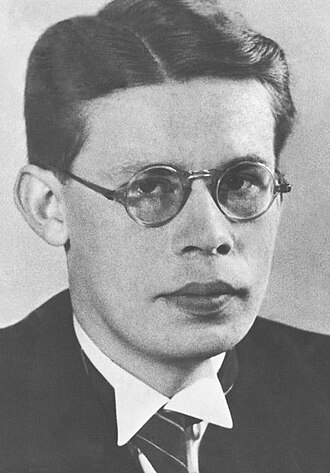
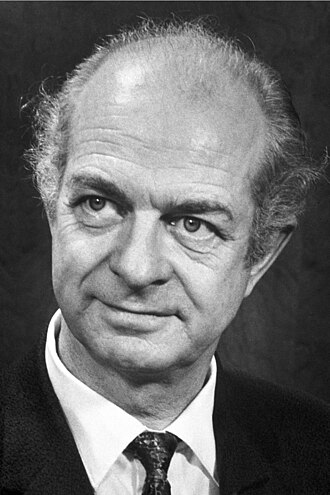
图:作者不详 · Public domain · Wikimedia Commons
尼古拉·博戈柳博夫1909—1992
Nikolai Bogolyubov
Soviet mathematician and theoretical physicist (1909-1992)
马克斯·普朗克奖章 1973罗蒙诺索夫金质奖章 1984狄拉克奖章(ICTP) 1992罗蒙诺索夫金质奖章
尼古拉·尼古拉耶维奇·博戈柳博夫,苏联数学家,理论物理学家,主要科学贡献在量子场论、经典与量子统计力学,动态系统理论等。
摘自维基百科「尼古拉·尼古拉耶维奇·博戈柳博夫」,CC BY-SA 4.0
- 出生
- 1909 年 8 月 8 日,下诺夫哥罗德
- 逝世
- 1992 年 2 月 13 日,莫斯科
- 国籍
- 俄罗斯帝国、苏联、俄罗斯
- 学科
- 物理学、数学、工程与发明、博物与综合
- 职业
- 数学家、理论物理学家、发明家、非虚构文学作家
- 母语 / 工作语言
- 俄语
- 母校
- 基辅国立大学
- 工作单位
- 基辅国立大学(1934—1959)、斯捷克洛夫数学研究所(1950—)、莫斯科国立大学(1950—)、杜布纳联合原子核研究所(1956—1965)、Bogolyubov Institute for Theoretical Physics(1965—1973)、杜布纳联合原子核研究所(1965—1988)
研究领域
主要贡献
代表成就
师承
博士生24
来自 Wikidata 的「博士导师」「师从」「博士生」「学生」记录,可能不全。
所获奖项(37)
- 1944荣誉徽章勋章
- 1947State Stalin Prize, 1st degree
- 1948红旗劳动勋章
- 1953斯大林奖
- 1953Stalin Prize, 2nd degree
- 1953列宁勋章
- 1954红旗劳动勋章
- 1957Mikhail Lomonosov Award
- 1958列宁奖
- 1959列宁勋章
- 1966希纳曼数学物理奖
- 1967列宁勋章
- 1969社会主义劳动英雄
- 1969Helmholtz Medal
- 1969镰刀与槌子奖章
- 1969Order of Cyril and Methodius, 1st Class
- 1969列宁勋章
- 1973马克斯·普朗克奖章
- 1974富兰克林奖
- 1975列宁勋章
- 1976honorary doctor of Comenius University
- 1977波兰共和国功绩勋章
- 1979社会主义劳动英雄
- 1979列宁勋章
- 1979镰刀与槌子奖章
- 1981Karpinsky Award
- 1984苏联国家奖
- 1984十月革命勋章
- 1984罗蒙诺索夫金质奖章
- 1989Lyapunov Prize
- 1992狄拉克奖章(ICTP)
- —乌克兰科学与技术荣誉个人
- —国旗勋章
- —Grand Star of People's Friendship
- —罗蒙诺索夫金质奖章
- —Commander with Star of the Order of Merit of the Republic of Poland
- —一级国旗勋章
学会与院士
百科正文
英文维基百科补充中文条目比较短,下面是英文条目「Nikolay Bogolyubov」的原文
Nikolay Nikolayevich Bogolyubov (21 August 1909 – 13 February 1992) was a Soviet mathematician and theoretical physicist known for his significant contributions to quantum field theory, classical and quantum statistical mechanics, and the theory of dynamical systems; he was the recipient of the 1992 Dirac Medal for his works and studies.
Biography
Early life (1909–1921)
Nikolay Bogolyubov was born on 21 August 1909 in Nizhny Novgorod, Russia. His father, Nikolay Mikhaylovich Bogolyubov, was a Russian Orthodox priest and a teacher of theology, philosophy, and psychology at the Nizhny Novgorod Theological Seminary. His mother, Olga Nikolayevna, née Lyuminarskaya, was a music teacher.
Six months after Nikolay's birth, the family moved to Nezhin (present-day Ukraine), where his father taught him until 1913.
From 1913 to 1918, the family lived in Kiev. Nikolay was initially homeschooled. His father taught him the basics of arithmetic, as well as German, French, and English. At the age of six, he attended a preparatory class in the Kiev Gymnasium. However, he did not stay in the gymnasium for long, as the family moved to the village of Velyka Krucha. From 1919 to 1921, he studied at the Velykokruchanska seven-year school, which was the only educational institution he graduated from.
Kiev period (1921–1940)
The family soon moved to Kiev in 1921, where they continued to live in poverty as the elder Nikolay Bogolyubov only found a position as a priest in 1923. After finishing seven years of school, Bogolyubov independently studied physics and mathematics, and by the age of 14, he was already participating in the seminar of the Department of Mathematical Physics at Kiev University under the supervision of academician Dmitry Grave.
In 1924, at the age of 15, Bogolyubov wrote his first published scientific paper On the behavior of solutions of linear differential equations at infinity. In 1925, he entered Ph.D. program at the Academy of Sciences of the Ukrainian SSR under the supervision of the well-known contemporary mathematician Nikolay Krylov and obtained the degree of Candidate of Sciences (equivalent to a Ph.D.) in 1928, at the age of 19, with the doctoral thesis titled On direct methods of variational calculus.
Research
Fundamental works of Bogolyubov were devoted to asymptotic methods of nonlinear mechanics, quantum field theory, statistical field theory, variational calculus, approximation methods in mathematical analysis, equations of mathematical physics, theory of stability, theory of dynamical systems, and to many other areas.
He built a new theory of scattering matrices, formulated the concept of microscopical causality, obtained important results in quantum electrodynamics, and investigated on the basis of the edge-of-the-wedge theorem the dispersion relations in elementary particle physics. He suggested a new synthesis of the Bohr theory of quasiperiodic functions and developed methods for asymptotic integration of nonlinear differential equations which describe oscillating processes.
Mathematics and non-linear mechanics
In 1932–1943, in the early stage of his career, he worked in collaboration with Nikolay Krylov on mathematical problems of nonlinear mechanics and developed mathematical methods for asymptotic integration of non-linear differential equations. He also applied these methods to problems of statistical mechanics.
In 1937, jointly with Nikolay Krylov he proved the Krylov–Bogolyubov theorems.
In 1956, at the International Conference on Theoretical Physics in Seattle, USA (September, 1956), he presented the formulation and the first proof of the edge-of-the-wedge theorem. This theorem in the theory of functions of several complex variables has important implications to the dispersion relations in elementary particle physics.
Statistical mechanics
1939 Jointly with Nikolay Krylov gave the first consistent microscopic derivation of the Fokker–Planck equation in the single scheme of classical and quantum mechanics.
1945 Suggested the idea of hierarchy of relaxation times, which is significant for statistical theory of irreversible processes.
1946 Developed a general method for a microscopic derivation of kinetic equations for classical systems. The method was based on the hierarchy of equations for multi-particle distribution functions known now as Bogoliubov–Born–Green–Kirkwood–Yvon hierarchy.
以上节选摘自英文维基百科「Nikolay Bogolyubov」,按 CC BY-SA 4.0 使用,去掉了参考文献、外部链接等尾部小节,公式改写成了纯文本。篇幅所限,较长的小节只摘了开头一部分,有的小节没有收;全文、配图和出处见原文。
同年获同一奖项
同一学科、同时代的科学家


同一学科的科学家
更多 ›