 格物
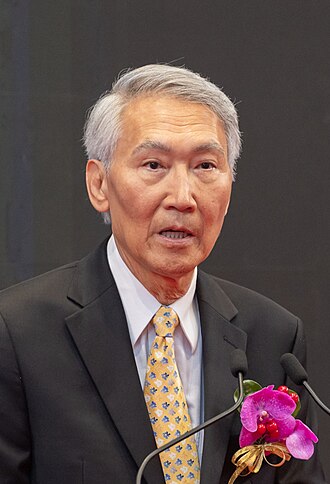
图:總統府 · CC BY 2.0 · Wikimedia Commons
- 出生
- 1947 年 7 月 12 日,北京市
- 国籍
- 中华民国、美国
- 职业
- 电气工程师、大学教师
- 母语 / 工作语言
- 英语、官话
- 母校
- 国立台湾大学(理学士,1968 年)、加州大学伯克利分校(哲学博士,1973 年)、国立台湾大学(理学硕士,1970 年)
- 工作单位
- 加州大学伯克利分校、麻省理工学院、台积电
研究领域
所获奖项(7)
- 1997IEEE Jack A. Morton Award
- 2002IEEE Donald O. Pederson Award in Solid-State Circuits
- 2009IEEE西泽润一奖
- 2013菲尔·卡夫曼奖
- 2014国家技术奖章
- 2015Fellow of the National Academy of Inventors
- 2020IEEE 荣誉奖章
学会与院士
百科正文
生平
胡正明于1947年出生于北京,于襁褓中随家人前往台湾。
1968年毕业于国立台湾大学电机工程系,后赴美国留学。先后于1970年、1973年获柏克莱加州大学硕士、博士学位,毕业后前往麻省理工学院任助理教授。1976年起,任教于柏克莱加州大学电子工程与计算机科学系。
1996年,创办思略微电子有限公司(Celestry Design Technologies, Inc.),兼任董事长。2001年至2004年间,担任台积电首任技术执行长,兼任柏克莱加州大学台积电杰出讲座教授。2004年后回校任教。2008年起,任SanDisk公司董事。2020年起,成为人机界面大厂敦泰电子董事。
奖项和荣誉
胡正明是电机电子工程师学会(IEEE)会士(1989年)、美国国家工程院院士(1997年)、中央研究院院士(2004年)、工业技术研究院院士(2016年)、中国科学院外籍院士(2007年),并且是国立交通大学、中国科学院微电子所、清华大学等院校荣誉教授。他拥有百余项专利,发表过900篇论文,还曾获得过R&D100奖(1996年)、IEEE Jack Morton奖(1997年)、潘文渊基金会杰出研究奖(1999年)、IEEE固态电路奖(2002年)、IEEE Paul Rappaport奖(2003年)、IEEE西泽润一奖(2009年)、美国亚裔工程师(AAEOY)杰出终身成就奖(2011年)、美国国家科学奖章(2016年)等奖项、IEEE荣誉奖章(2020年)、2022-2023年“应用科学组”总统科学奖。
以上内容摘自维基百科「胡正明」,按 CC BY-SA 4.0 使用,去掉了参考文献、外部链接等尾部小节,公式改写成了纯文本。全文、配图和出处见原文。
英文维基百科补充中文条目比较短,下面是英文条目「Chenming Hu」的原文
Chenming Hu (Chinese: 胡正明; pinyin: Hú Zhèngmíng; born 12 July 1947), also known by his English name Calvin Hu, is a Taiwanese-American electronic engineer who specializes in microelectronics. He is TSMC Distinguished Professor Emeritus in the electronic engineering and computer science department of the University of California, Berkeley. In 2014, the National Medal of Technology and Innovation cited "For pioneering innovations in microelectronics including reliability technologies, the first industry-standard model for circuit design, and the first 3-dimensional transistors, which radically advanced semiconductor technology.
Early life and education
Hu was born in Beijing on July 12, 1947. When he was an infant, his family fled to Taiwan during the Great Retreat. He graduated from National Taiwan University in 1968 with a Bachelor of Science (B.S.) in electrical engineering, then completed graduate studies in the United States, where he earned a Master of Science (M.S.) in 1970 and his Ph.D. in 1973 from the University of California, Berkeley, under professor John Roy Whinnery. His doctoral dissertation was titled, "Nematic Liquid Crystal Optical Waveguides".
Career
Hu began his academic career as an assistant professor at the Massachusetts Institute of Technology (MIT) from 1973 to 1976. In 1976, he joined the University of California, Berkeley as a professor of Electrical Engineering and Computer Sciences, where he remained for decades. He served as the Chancellor’s Chair Professor (1998–2001) and TSMC Distinguished Chair Professor (2001–2013) and currently holds the title of professor emeritus and professor of the graduate school.
Hu is known for his role in transistor modeling. Since 1995, he has led the ongoing development of BSIM (Berkeley Short-channel IGFET Model), the industry-standard transistor modeling tool for integrated circuit (IC) design, which is provided royalty-free and underpins the design of trillions of dollars’ worth of IC products.
Hu has supported education and community service initiatives. He served as Chairman of the East Bay Chinese School (1988–1990) and Chairman of Friends of Children with Special Needs (2015–2017). The Chenming Hu Innovation Lab at UC Berkeley and the Chenming and Margaret Hu Medical Center at Asian Health Services are named in his honor.
Research
Hu is credited with leading the invention and development of the FinFET (Fin Field-Effect Transistor) in 1999, a 3D thin-body transistor architecture that overcame scaling limitations of traditional planar transistors. Intel hailed FinFET as “the most radical shift in semiconductor technology in over 50 years.” The technology is now used in virtually all modern microprocessors, smartphones, and AI chips.
In 1995, amid predictions of Moore’s Law's imminent end, Hu conceived the FinFET, a three-dimensional transistor structure with a thin raised channel wrapped by the gate on three sides. Developed under a DARPA-funded project, the FinFET allowed for reduced leakage current and continued transistor scaling below 25 nanometers. Intel introduced FinFETs into commercial production in 2011, and the technology remains foundational to modern CPUs, GPUs, AI processors, and mobile devices.
In addition to FinFET, Hu made contributions to IC device scaling, reliability modeling, and low-power transistor design. His research has shaped the semiconductor industry for more than four decades.
Personal life
Hu lives in California with his family and has two sons, Raymond and Jason.
Awards and honors
1997: elected to the United States National Academy of Engineering
1997: IEEE Jack Morton Award, "for outstanding contributions to semiconductor devices and technology"
2002: IEEE Solid-State Circuits Award (for developing the first international standard transistor model BSIM)
2002: IEEE Paul Rappaport Award
2009: IEEE Jun-ichi Nishizawa Medal, "for technical contributions to MOS device reliability, scaling of CMOS and compact device modeling"
- 2011: Asian American Engineer of the year award,
- 2011: National Taiwan University Distinguished Alumni Award,
- 2011: Semiconductor Industry Association Award,
- 2013: Phil Kaufman Award for Distinguished Contributions to EDA,
2014: National Medal of Technology and Innovation, given at the White House by Barack Obama in 2016.
2015: SEMI Award for North America, for the BSIM transistor family.
2016: Pan Wen Yuan Award, by the Industrial Technology Research Institute.
2020: IEEE Medal of Honor Award.
2023: Taiwan Presidential Science Prize
以上节选摘自英文维基百科「Chenming Hu」,按 CC BY-SA 4.0 使用,去掉了参考文献、外部链接等尾部小节,公式改写成了纯文本。篇幅所限,较长的小节只摘了开头一部分,有的小节没有收;全文、配图和出处见原文。