格物
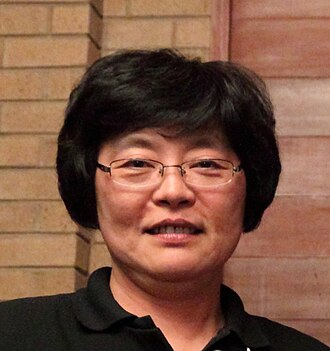
图:Wsko.ko · CC BY-SA 3.0 · Wikimedia Commons
常瑞华1960—
Constance J. Chang-Hasnain
美国科学家
常瑞华,华裔美国科学家,籍贯中国大陆哈尔滨,生于台湾,加州大学伯克利分校Whinnery荣休教授,中国工程院外籍院士、美国国家工程院院士、国际电气与电子工程师学会会士、美国光学学会会士,同时也是深圳博升光电董事长兼创始人。曾任柏克莱加州大学工学院副院长及电子工程与计算机科学系Whinnery讲座教授,清华-伯克利深圳学院共同院长。2023年起,任香港中文大学(深圳)学勤讲座教授,负责学校微电子学科群建设。
摘自维基百科「常瑞華」,CC BY-SA 4.0
- 出生
- 1960 年 10 月 1 日,中华民国
- 国籍
- 中华民国
- 学科
- 物理学、计算机科学
- 职业
- 物理学家、电气工程师、大学教师、计算机科学家
- 母语 / 工作语言
- 英语
- 母校
- 戴维斯加利福尼亚大学、加州大学伯克利分校(哲学博士,1987 年)
- 工作单位
- 加州大学伯克利分校、斯坦福大学
研究领域
主要贡献
代表成就
师承
博士导师1
来自 Wikidata 的「博士导师」「师从」「博士生」「学生」记录,可能不全。
所获奖项(13)
- 1992Packard Fellowship for Science and Engineering
- 1994Alfred P. Sloan Fellow
- 1997IEEE Fellow
- 1997Fellow of the Optical Society
- 2003William Streifer Scientific Achievement Award
- 2007Nick Holonyak Jr. Award
- 2009古根海姆学者奖
- 2009洪堡奖
- 2009马克斯·普朗克研究奖
- 2011IEEE David Sarnoff Award
- 2015UNESCO Medal for Contributions to the Development of Nanoscience and Nanotechnologies
- 2018大川奖
- 2018Fellow of the National Academy of Inventors
学会与院士
百科正文
生平
常瑞华于1960年生于台湾。她的父亲是哈尔滨人,16岁时来到台湾。常瑞华高中就读于台北市立第一女子高级中学。
1978年中华民国与美国断交,为方便回乡,常父率领全家移民美国。她曾就读于斯坦福大学旁的山麓社区大学,后转学至加州大学戴维斯分校,取得电子和计算工程学士学位。之后进入加州大学伯克利分校,并于1987年获博士学位。毕业后,她曾在贝尔实验室工作。此后又先后任教于斯坦福大学电机系、加州大学伯克利分校电机系,并历任电机系主任、光电奈米技术研究中心主任。她获选美国国家工程学院吉尔布芮丝讲座,是当届得奖人之中惟一的华裔与惟一的女性。
以上内容摘自维基百科「常瑞華」,按 CC BY-SA 4.0 使用,去掉了参考文献、外部链接等尾部小节,公式改写成了纯文本。全文、配图和出处见原文。
英文维基百科补充中文条目比较短,下面是英文条目「Constance J. Chang-Hasnain」的原文
Constance J. Chang-Hasnain is a Taiwanese-American electrical engineer who is the chairperson and founder of Berxel Photonics Co. Ltd. and Whinnery Professor Emerita of the University of California, Berkeley. She was President of Optica in 2021.
Education
She obtained a B.S. degree in electrical and computer engineering from University of California, Davis in 1982, an M.S. and a Ph.D. in electrical engineering and computer science from the University of California, Berkeley in 1984 and 1987, respectively.
Career
She was a member of technical staff at Bellcore from 1987 to 1992 and assistant professor at Stanford University between 1992 and 1995. She joined the University of California Berkeley as professor of electrical engineering and computer sciences in 1996. She was Whinnery Distinguished Chair Professor 2006–2020; chair of the Nanoscale Science and Engineering Graduate Group 2006–2017; and associate dean for strategic alliances of College of Engineering 2014–2019. She was the founding co-director of Tsinghua-Berkeley Shenzhen Institute (TBSI) 2015–2020 and the chief academic officer of Berkeley Education Alliance for Research in Singapore (BEARS) 2015–2018.
Chang-Hasnain was president of Optica in 2021, and has been an Optica member since graduate school. She has been an active volunteer and held several leadership positions in the society. She served as associate editor of the IEEE Journal of Lightwave Technologies from 2005 to 2006, and editor-in-chief from 2007 to 2012. She was elected director-at-large of the board of directors from 1998 to 2000 and served on Optica's Centennial Advisory Panel from 2014 to 2016. She was elected as Optica's vice president in 2019.
She served as CLEO program co-chair in 1997 and general co-chair in 1999, OSA Slow and Fast Light Topical Meeting program co-chair in 2006 and general co-chair in 2007, and OSA Frontiers in Optics Conference general co-chair in 2007. She was the general technical co-chair in 2004 and general co-chair for the Asia Pacific Optical Communications Conference in 2005.
Chang-Hasnain was elected a member of the National Academy of Engineering in 2018 for contributions to wavelength tunable diode lasers and multiwavelength laser arrays.
She is a Fellow of the IEEE, The Optical Society, and the Institution of Engineering and Technology.
Her research interests include VCSELs, high contrast gratings, and nanostructure growth. In 2024, she received the IEEE Nick Holonyak Jr. Medal for pioneering contributions to vertical-cavity surface-emitting laser (VCSEL) and VCSEL-based photonics for optical communications and sensing. She was awarded with the 2022 Welker Award for her contributions to vertical cavity surface emitting laser (VCSEL) photonics, nano-photonics and high contrast metastructures for optical communications and optical sensing. She also received the Okawa Prize in 2018 for pioneering and outstanding research of VCSEL photonics through the development of their novel functions for optical communications and optical sensing.
She joined the Chinese University of Hong Kong, Shenzhen in 2023 and currently serves as the X.Q. Deng Presidential Chair Professor at the School of Science and Engineering of CUHKSZ.
Awards
- IEEE LEOS Distinguished Lecturer Award, 1994
- Curtis W. McGraw Research Award from the American Society of Engineering Education, 2000
- IEEE William Streifer Scientific Achievement Award, 2003
- National Academy of Engineering, Gilbreth Lecturer Award, 2005
- Nick Holonyak Jr. Award, Optical Society of America, 2007
For contributions to the control of diode lasers: vertical cavity surface emitting laser arrays, injection locking and slow light
Guggenheim Fellow, 2009
Humboldt Research Award, Alexander von Humboldt Stiftung Foundation, 2009
Vannevar Bush Faculty Fellowship (formerly National Security Science and Engineering Faculty Fellowship), 2008
- IEEE David Sarnoff Award, 2011
- UNESCO Medal For the Development of Nanoscience and Nanotechnologies, 2015
- Elected Member, National Academy of Engineering, 2018
- The Okawa Prize, 2018
- The Welker Award, 2022
- The IEEE Nick Holonyak Jr. Medal Award, 2024
以上内容摘自英文维基百科「Constance J. Chang-Hasnain」,按 CC BY-SA 4.0 使用,去掉了参考文献、外部链接等尾部小节,公式改写成了纯文本。全文、配图和出处见原文。
同一学科、同时代的科学家




同一学科的科学家
更多 ›