格物
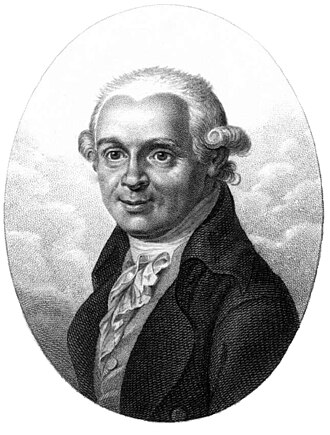
图:Christian Leberecht Vogel · Public domain · Wikimedia Commons
- 出生
- 1749 年 9 月 25 日,奥谢奇尼察
- 逝世
- 1817 年 6 月 30 日,德累斯顿
- 国籍
- 萨克森王国
- 学科
- 地球科学
- 职业
- 地质学家、大学教师、矿物学家、法学
- 母语 / 工作语言
- 德语
- 母校
- 弗赖堡大学、弗莱贝格工业大学、莱比锡大学
- 工作单位
- 弗莱贝格工业大学
研究领域
师承
学生4
来自 Wikidata 的「博士导师」「师从」「博士生」「学生」记录,可能不全。
所获奖项(1)
- —Honorary Fellow of the Royal Society of Edinburgh
学会与院士
百科正文
英文维基百科补充中文条目比较短,下面是英文条目「Abraham Gottlob Werner」的原文
Abraham Gottlob Werner (German: [ˈaːbʁaham ˈɡɔtloːp ˈvɛʁnɐ]; 25 September 1749 – 30 June 1817) was a German geologist who set out an early theory about the stratification of the Earth's crust and propounded a history of the Earth that came to be known as Neptunism. While most tenets of Neptunism were eventually set aside, Werner is remembered for his demonstration of chronological succession in rocks; for the zeal with which he infused his pupils; and for the impulse he thereby gave to the study of geology. He has been called the "father of German geology".
Life
Werner was born in Wehrau (now Osiecznica, Lower Silesian Voivodeship), a village in Prussian Silesia. His family had been involved in the mining industry for many years. His father, Abraham David Werner, was a foreman at a foundry in Wehrau.
Werner was educated at Freiberg and Leipzig, where he studied law and mining, and was then appointed as Inspector and Teacher of Mining and Mineralogy at the small, but influential, Freiberg Mining Academy in 1775.
While in Leipzig, Werner became interested in the systematic identification and classification of minerals. Within a year he published the first modern textbook on descriptive mineralogy, Von den äusserlichen Kennzeichen der Fossilien (On the External Characters of Fossils [or of Minerals]; 1774).
During his career, Werner published very little, but his fame as a teacher spread throughout Europe, attracting students, who became virtual disciples, and spread his interpretations throughout their homelands, e.g.
Werner's theory
Starting from the pre-existing traditions of stratigraphy and cosmogony in Europe, Werner applied superposition in a classification similar to that of Johann Gottlob Lehmann. He believed that the Earth could be divided into five formations:
Primitive (Urgebirge) Series: intrusive igneous rocks and high rank metasediments considered to be the first precipitates from the ocean before the emergence of land.
Transition (Übergangsgebirge) Series: more indurated limestones, dikes, sills, and thick sequences of greywackes that were the first orderly deposits from the ocean. These were "universal" formations extending without interruption around the world.
Secondary or Stratified (Flötz) Series: the remaining, stratified fossiliferous rocks and certain associated "trap" rocks. These were thought to represent the emergence of mountains from beneath the ocean and were formed from the resulting products of erosion deposited on their flanks.
Criticism
A principal focus of Neptunism that provoked almost immediate controversy involved the origin of basalt. Basalts, particularly formed as sills, were differentiated from surface lava flows, and the two were not recognized as the same rock type by Werner and his students during this period. Lavas and volcanoes of igneous origin were treated as very recent phenomena unrelated to the universal ocean that formed the layers of the Earth. Werner believed that volcanoes only occurred in proximity to coal beds. Burning melted overlying basalts and wackes, producing basalts and lavas typically at low elevations. Basalt at higher elevations proved to Werner that they were chemical precipitates of the ocean.
A second controversy surrounding Neptunism involved the volumetric problems associated with the universal ocean.
Legacy
Werner's ability as a lecturer attracted students from all over Europe. Applications of his ideas fomented debate, particularly over the origin of basalt, in the so-called Neptunist-Plutonist controversy. Among his most famous students was Alexander von Humboldt, who stayed in Freiberg in 1791-92, and initially subscribed to Werner's Neptunist ideas before departing from them in his later years.
The variety of scapolite known as wernerite is named in his honour. Werner is credited with coining the term geognosy, for the geological study of the Earth's structure, specifically its exterior and interior construction.
In 1805, he described the mineral zoisite and named it after Sigmund Zois, who sent him its specimens from Saualpe in Carinthia.
Werner’s major work, Von den äußerlichen Kennzeichen der Foßilien (1774), contained a comprehensive colour scheme he had devised for the description and classification of minerals.
以上节选摘自英文维基百科「Abraham Gottlob Werner」,按 CC BY-SA 4.0 使用,去掉了参考文献、外部链接等尾部小节,公式改写成了纯文本。篇幅所限,较长的小节只摘了开头一部分,有的小节没有收;全文、配图和出处见原文。
同一学科、同时代的科学家
同一学科的科学家
更多 ›