格物
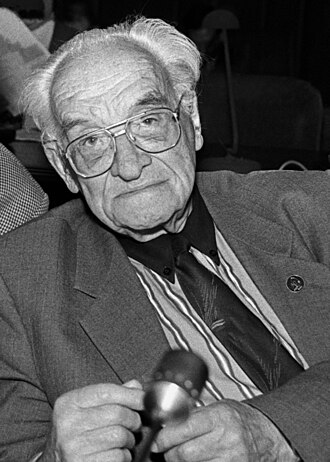
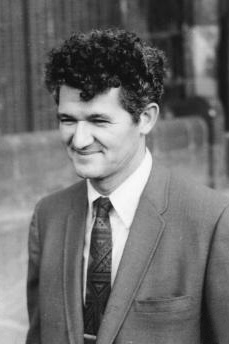
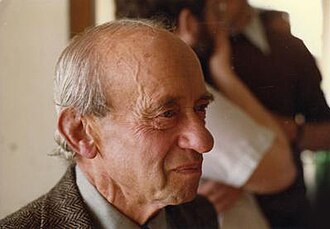
图:Leo Medvedev/Лев Леонидович Медведев · CC BY-SA 4.0 · Wikimedia Commons
弗拉基米尔·亚历山德罗维奇·科捷利尼科夫1908—2005
Vladimir Kotelnikov
Soviet scientist (1908-2005)
弗拉基米尔·亚历山德罗维奇·科捷利尼科夫 是苏联无线电物理学家,雷达天文学家。苏联密码无线电通信技术的先驱。苏联科学院院士,副院长。社会主义劳动英雄。
摘自维基百科「弗拉基米尔·科捷利尼科夫」,CC BY-SA 4.0
- 出生
- 1908 年 8 月 24 日,喀山
- 逝世
- 2005 年 2 月 11 日,莫斯科
- 国籍
- 苏联、俄罗斯帝国、俄罗斯
- 学科
- 数学、天文学、工程与发明、博物与综合
- 职业
- 工程师、政治人物、数学家、天文学家
- 母语 / 工作语言
- 俄语
- 母校
- 莫斯科动力学院(1930 年)、鲍曼莫斯科国立技术大学
- 工作单位
- V.A. Kotelnikov Institute of Radio-engineering and Electronics(1954—1988)、莫斯科动力学院、OKB MEI(1948—1953)、莫斯科物理技术学院
研究领域
主要贡献
以他 / 她命名
所获奖项(21)
- 1943State Stalin Prize, 1st degree
- 1946State Stalin Prize, 1st degree
- 1964列宁奖
- 1969列宁勋章
- 1969社会主义劳动英雄
- 1974A. S. Popov Gold Medal
- 1978列宁勋章
- 1978社会主义劳动英雄
- 1981罗蒙诺索夫金质奖章
- 1983十月革命勋章
- 1987Keldysh Gold Medal
- 1988红旗劳动勋章
- 1998Order "For Merit to the Fatherland", 2nd class
- 1998冯·卡门航天奖
- 2000贝尔奖
- 2003Order "For Merit to the Fatherland", 1st class
- —荣誉徽章勋章
- —1941-1945年大卫国战争中忘我劳动奖章
- —Council of Ministers of the Soviet Union Prize
- —列宁勋章
- —红旗劳动勋章
学会与院士
百科正文
生平
1908年生于喀山。祖父彼得·科捷利尼科夫是喀山大学教授。父亲亚历山大·科捷利尼科夫长期从事数学与力学研究。1926年进入鲍曼莫斯科国立技术大学学习,1930年最终毕业于莫斯科动力学院。在苏联邮电人民委员部工作了一段时间后,1931年开始在莫斯科动力学院深造。他在通信领域取得了重大成果,并领导成立了莫斯科-哈巴罗夫斯克生产线,用于制造单波段无线电通信设备。1941年苏德战争爆发后,他被疏散到乌法,领导团队开发和维护新通信系统。1943年和1946年两次获得斯大林奖金。
1948年加入联共(布)。1947年至1953年,他担任莫斯科动力学院无线电工程系主任,特别设计局局长兼首席设计师。1954年至1988年历任苏联科学院无线电工程与电子研究所副所长、所长。1953年当选苏联科学院院士。1970年3月至1988年9月担任苏联科学院第一副院长。1973年7月至1980年担任俄罗斯科学院副主席。2000年获贝尔奖。
2005年2月11日去世,享年97岁。安葬于莫斯科孔策沃公墓。
研究成果
1933年,科捷利尼科夫在论文中首次将正弦基本函数插值公式应用于连续信道上的消息传输问题,这一结果后经美国电子工程师克劳德·香农于1948年发表的论文发扬光大,被称为采样定理。
以上内容摘自维基百科「弗拉基米尔·科捷利尼科夫」,按 CC BY-SA 4.0 使用,去掉了参考文献、外部链接等尾部小节,公式改写成了纯文本。全文、配图和出处见原文。
英文维基百科补充中文条目比较短,下面是英文条目「Vladimir Kotelnikov」的原文
Vladimir Aleksandrovich Kotelnikov (Russian: Владимир Александрович Котельников; 6 September 1908 – 11 February 2005) was an information theory and radar astronomy pioneer from the Soviet Union. He was elected a member of the Russian Academy of Sciences in the Department of Technical Science (radio technology) in 1953. From 30 July 1973 to 25 March 1980 Kotelnikov served as chairman of the Supreme Soviet of the RSFSR.
Career timeline
1926–31 study of radio telecommunications at the Bauman Moscow State Technical University and Moscow Power Engineering Institute, dissertation in engineering science.
1931–41 worked at the MEI as an engineer, scientific assistant, laboratory director and lecturer.
1941–44 worked as a developer in the telecommunication industry.
1944–80 full professor at the MEI.
1953–87 deputy director and since 1954 director of the Institute of Radio-engineering and Electronics of the Russian Academy of Sciences (IRE RAS).
1970–88 vice-president of the RAS; since 1988 adviser of the presidium.
Achievements
He is known mostly for having discovered, before e.g. Edmund Whittaker, Harry Nyquist, or Claude Shannon, the sampling theorem in 1933 (and hence, in Russian literature, it is known as the Kotelnikov's theorem).
This result of Fourier analysis was known in harmonic analysis since the end of the 19th century and circulated in the 1920s and 1930s in the engineering community. He was the first to write down a precise statement of this theorem about signal transmission. He also was a pioneer in the use of signal theory in modulation and communications.
He is also a creator of the theory of optimum noise immunity.
He obtained several scientific prizes for his work in radio astronomy and signal theory. In 1961, he oversaw one of the first efforts to probe the planet Venus with radar. In June 1962 he led the first probe of the planet Mercury with radar.
Kotelnikov was also involved in cryptography, proving the absolute security of the one-time pad; his results were delivered in 1941, the time of Nazi Germany's invasion of the Soviet Union, in a report that apparently remains classified. In this, as with the above-mentioned sampling theorem, he and Claude Shannon in the US reached the same conclusions independently of each other.
For his achievements, Kotelnikov was awarded the IEEE 2000 Gold Medal of Alexander Graham Bell and the honorable IEEE Third Millennium Medal. Prof. Bruce Eisenstein, the President of the IEEE, described Kotelnikov as follows: "The outstanding hero of the present. His merits are recognized all over the world. In front of us is the giant of radio engineering thought, who has made the most significant contribution to media communication development".
Honours and awards
Order "For Merit to the Fatherland":
1st class (21 September 2003) – for outstanding achievement in the development of science and many years of fruitful activity
2nd class (6 July 1998) – for outstanding service to the state, his great personal contribution to the development of national science and training of highly qualified personnel
- Twice Hero of Socialist Labour (1969, 1978)
- Six Orders of Lenin
- Order of the Red Banner of Labour, twice
- Order of the Badge of Honour
- Lenin Prize (1964)
- Two Stalin Prizes (1943, 1946)
- Badge "For Services to Moscow" (26 August 2003)
- Prize of the Council of Ministers
- Lomonosov Gold Medal (1981)
- Popov Gold Medal (1974)
- Gold Medal of the Academy of Sciences of the USSR (1987)
- IEEE Award in honor of Hernand and Sosthenes Behn (1973)
- Main prize of the Eduard Rhein Foundation (1999)
- IEEE Alexander Graham Bell Medal (of the USA) (2000)
The Koronian asteroid 2726 Kotelnikov was named in his honor in 1984.
Kotel'nikov's name has also been given to a naval vessel and the Institute of Radio-engineering and Electronics.
以上内容摘自英文维基百科「Vladimir Kotelnikov」,按 CC BY-SA 4.0 使用,去掉了参考文献、外部链接等尾部小节,公式改写成了纯文本。全文、配图和出处见原文。
同年获同一奖项
同一学科、同时代的科学家


同一学科的科学家
更多 ›