格物
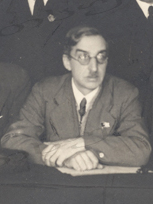
图:作者不详 · Public domain · Wikimedia Commons
尼科洛·穆斯赫利什维利1891—1976
Nikoloz Muskhelishvili
Georgian mathematician (1891-1976)
Nikoloz (Niko) Muskhelishvili was a Soviet Georgian mathematician, physicist and engineer who was one of the founders and first President (1941–1972) of the Georgian SSR Academy of Sciences.
摘自英文维基百科「Nikoloz Muskhelishvili」(英文维基百科,暂无中文条目),CC BY-SA 4.0
- 出生
- 1891 年 2 月 4 日,第比利斯
- 逝世
- 1976 年 7 月 15 日,第比利斯
- 国籍
- 俄罗斯帝国、外高加索民主联邦共和国、格鲁吉亚民主共和国、苏联
- 学科
- 物理学、数学、博物与综合
- 职业
- 数学家、物理学家、大学教师、政治人物
- 母语 / 工作语言
- 格鲁吉亚语、俄语
- 母校
- Faculty of Physics and Mathematics of the Saint Petersburg University、圣彼得堡国立大学
- 工作单位
- 苏联科学院(1939—)、第比利斯国立大学、格鲁吉亚工业大学、格鲁吉亚国家科学院(1941—1972)
研究领域
师承
博士生1
来自 Wikidata 的「博士导师」「师从」「博士生」「学生」记录,可能不全。
所获奖项(14)
- 1941斯大林奖
- 1941列宁勋章
- 1944红旗劳动勋章
- 1944保卫高加索奖章
- 1945社会主义劳动英雄
- 1945列宁勋章
- 1945镰刀与槌子奖章
- 19461941-1945年大卫国战争中忘我劳动奖章
- 1947Stalin Prize, 2nd degree
- 1960劳动英勇奖章
- 1969Panetti Ferrari Award
- 1971十月革命勋章
- 1972罗蒙诺索夫金质奖章
- —honorary member of the National Academy of Sciences of Azerbaijan
学会与院士
百科正文
本条目暂无中文维基百科条目,下面是英文维基百科原文。
Nikoloz (Niko) Muskhelishvili (Georgian: ნიკოლოზ (ნიკო) მუსხელიშვილი; 16 February [O.S. 4 February] 1891 – 15 July 1976) was a Soviet Georgian mathematician, physicist and engineer who was one of the founders and first President (1941–1972) of the Georgian SSR Academy of Sciences (now Georgian National Academy of Sciences).
Life and career
Muskhelishvili was born on 16 February [O.S. 4 February] 1891 in Tbilisi, then part of the Russian Empire into a family of engineers. He graduated from local grammar school in 1909 and afterwards from the Physics and Mathematics Faculty of Saint Petersburg in 1914. Immediately after his graduation he became head of Applied Mathematics of the same faculty and in 1918 passed the exam for the master's degree. His first scientific magazine was published already earlier in 1915 containing a number of issues on elasticity theory. From 1917 to 1920 he worked as assistant director of the Petrograd University and also taught mathematics in other institutions in Saint Petersburg. At request of the short-lived Democratic Republic of Georgia he moved back to his native country in 1920 in order to organize the establishment of a national scientific school. There Muskhelishvili conducted lessons in the Tbilisi State University and Polytechnic Institute as an assistant professor and from 1922 to 1938 as head professor. After the Soviet invasion of Georgia in 1921, Muskhelishvili was allowed to carry on his works in the Transcaucasian Soviet Academy of Sciences and since 1933 was corresponding member of the USSR Academy of Sciences. He became a member of the CPSU in 1940.
In 1941 based on the former Georgian Academy of Sciences a new USSR Academy of Sciences was established by the Georgian SSR and Muskhelishvili got elected as its first president and academician. Simultaneously he also became director of the Tbilisi Mathematics Institute named after AM Rasmadze, and held that position until his death in 1976.
From 1956 to 1976 Muskhelishvili was chairman of the National Committee of the USSR on Theoretical and Applied Mechanics (established by the Decree of the Presidium of the Academy of Sciences). Since 1957 he was also member of the Presidium of the Academy of Sciences. In 1972 due to health problems the professor resigned from the post of president of the Georgian SSR Academy of Sciences but in recognition for his outstanding achievements and services was elected honorary president of the academy. He was also an academician and honorary professor of the Academies of Sciences of the Armenian and Azerbaijani SSRs since 1961. Muskhelishvili was an honorary member of the Bulgarian Academy of Sciences since 1952, Polish Academy of Sciences since 1960 and the Berlin Academy of Sciences since 1967. He also held the position of deputy chairman of the Supreme Soviet of the Soviet Union in eight convocations from 1937 to 1974.
Nikoloz Muskhelishvili died on 15 July 1976 in Tbilisi and is buried in the Mtatsminda Pantheon.
Contributions to science
Muskhelishvili conducted fundamental research on the theories of physical elasticity, Integral equations, Boundary value problems and other. He was one of the first to apply the theory of functions of complex variables to the problems of elasticity theories, proposing a number of techniques that have been successfully implemented in numerous areas of mathematics, theoretical physics and mechanics. His works solved all major problems of the Plane Elasticity Theory opening a wide class of domains reducing the plane problem to finite systems of linear algebraic equations c singular kernels. He is also credited with major contributions to the theory of linear boundary value problems for analytic functions and one-dimensional integral equations. Muskhelishvili is the author of various scientific articles, monographs and textbooks on mathematics which have been used by universities since their publishing. Highest regarded ones are the monographs "Some basic problems of the mathematical theory of elasticity" (1933) and "Singular Integral Equations" (1947).
Involvement in military research
During World War II Muskhelishvili was responsible for retargeting the preoccupation of the Academy of Science to national defense. He completed a series of research, experimental and theoretical work in different areas of applied mathematics, physics and mechanics, which all had great practical importance and decisive impact on the development of a range of military hardware during and after the war. However, the exact scale is unknown and classified. His achievements and involvement in the defense sphere earned him several awards, including the Medal "For the Defence of the Caucasus". He got also awarded for the launch of the world's first artificial satellite into space in 1961 on which development he had contributed as well. Muskhelishvili was a renowned specialist in engineering able to apply a lot of his theories and solutions, including torsion bar suspension for tracked vehicles such as tanks. Most of his research, theories, and ideas were considered and implemented for the development of certain vehicles during the Cold War, some of which already originated from his earlier theoretical work during World War II, on the elasticity of specific material under specific circumstances such as different temperature, weight, composition etc. His work practically applied to anything from land-based vehicles to aircraft, rockets, and satellites.
Membership in scientific academies
- Corresponding Member of the USSR Academy of Sciences
- Academician of the USSR Academy of Sciences
- Academician of Academy of Sciences of the Georgian SSR
- Honorary Academician of Armenian Academy of Sciences
- Honorary Academician of Azerbaijan Academy of Sciences
- Foreign Member of Bulgarian Academy of Sciences
- Foreign Member of Polish Academy of Sciences
- Foreign Member of German (Berlin) Academy of Sciences
Notable awards
- Hero of Socialist Labour (1945)
- Stalin Prize (1941), (1947)
- Order of Lenin (1941), (1945), (1952), (1961), (1966), (1975)
- Order of the October Revolution (1970)
- Order of the Red Banner of Labour (1944)
- Gold Medal of the Turin Academy of Sciences (1969)
- Gold Medal of the Slovak Academy of Sciences (1970)
- Cyril and Methodius I degree (1970)
- Lomonosov Gold Medal (1972)
The Georgian Academy of Sciences established a prize named after Nikoloz Muskhelishvili.
Main publications
"On the equilibrium of elastic circular disks under the influence of stresses applied at the points of their encirclement and acting in their domains". (Russian), Izv. Electrotekhnich. Inst., Petrograd, 12 (1915), 39–55 (jointly with G. V. Kolosov).
"On thermal stresses in the plane problem of the theory of elasticity". (Russian), Izv. Electrotekhnich. Inst., Petrograd, 13 (1916), 23–37.
"On defining a harmonic function by conditions given on the contour". (Russian) Zh. Fiz.-mat.ob-va, Perm Univ., 1918, (1919), Issue I, 89–93.
"Applications des intégrales analogues à celles de Cauchy et quelques problèmes de la physique mathématique". - Tiflis, Edition de l'Université de Tiflis, Imprimerie de l'Etat, 1922.
以上节选摘自英文维基百科「Nikoloz Muskhelishvili」,按 CC BY-SA 4.0 使用,去掉了参考文献、外部链接等尾部小节,公式改写成了纯文本。篇幅所限,较长的小节只摘了开头一部分,有的小节没有收;全文、配图和出处见原文。
同年获同一奖项
同一学科、同时代的科学家



同一学科的科学家
更多 ›