格物
- 出生
- 1942 年 11 月 11 日,匹兹堡
- 国籍
- 美国
- 学科
- 化学、生物学、博物与综合
- 职业
- 生物学家、分子生物学家、生物化学家、大学教师
- 母校
- 麻省理工学院、泰勒·奥尔德迪斯高中
- 工作单位
- 麻省理工学院、哈佛大学
研究领域
师承
博士生3
学生1
来自 Wikidata 的「博士导师」「师从」「博士生」「学生」记录,可能不全。
所获奖项(25)
- 1983罗伯·柯霍奖
- 1984Howard Taylor Ricketts Prize
- 1984NAS分子生物学奖
- 1984Bristol-Myers Squibb Award for Distinguished Achievement in Cancer Research
- 1987小艾尔弗雷德·P·斯隆奖
- 1992盖尔德纳国际奖
- 1992马克斯·普朗克研究奖
- 1994哈维奖
- 1996马克斯·德尔布吕克奖章
- 1996Robert J. and Claire Pasarow Foundation Award for Distinguished Contributions to Cancer Research
- 1996AACR-G.H.A. Clowes Award for Outstanding Basic Cancer Research
- 1997美国国家科学奖章
- 1997庆应医学奖
- 2002汤森路透引文桂冠奖
- 2004沃尔夫医学奖
- 2004阿斯图里亚斯亲王奖科学技术奖
- 2006华伦阿尔波特奖
- 2007奥托·瓦尔堡奖章
- 2008InBev-Baillet Latour Health Prize
- 2009法国科学院大奖章
- 2013生命科学突破奖
- 2016AACR Award for Lifetime Achievement in Cancer Research
- —Pour le Mérite for Sciences and Arts order
- —阿尔伯特·爱因斯坦世界科学奖
- —北极星勋章司令大十字章
学会与院士
百科正文
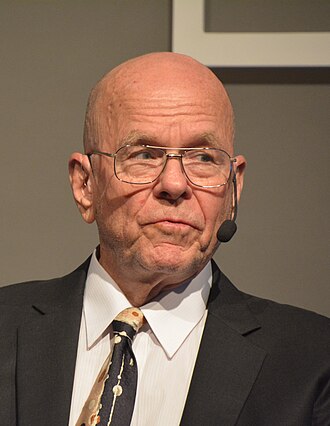
他是麻省理工学院的丹尼尔·K·路德维希癌症研究教授(Daniel K. Ludwig Professor for Cancer Research),并是美国癌症学会研究教授(American Cancer Society Research Professor)。
研究
温伯格的主要研究领域是人类癌症的癌变机理。他是:
首次发现人类癌基因Ras(Ras subfamily)的人之一;
首次发现肿瘤抑制基因Rb1(Retinoblastoma gene)的人之一。
温伯格现在也是博劳德研究所的研究员。于1982年创立了“怀特海德生物医学研究所”(Whitehead Institute for Biomedical Research)。
荣誉
温伯格获得很多学术荣誉,包括:
1984年,获得Bristol-Myers award;
1988年,获得general motors metal for cancer research
- 1992年,选举为瑞典皇家科学院院士;
- 1997年,美国国家科学奖章;
- 2004年,沃尔夫医学奖(和钱永健共享);
- 美国国家科学院院士;
2007年,乌普萨拉大学荣誉博士学位。
以上内容摘自维基百科「罗伯特·温伯格」,按 CC BY-SA 4.0 使用,去掉了参考文献、外部链接等尾部小节,公式改写成了纯文本。全文、配图和出处见原文。
英文维基百科补充中文条目比较短,下面是英文条目「Robert Weinberg (biologist)」的原文
Robert Allan Weinberg (born November 11, 1942) is an American biologist, Daniel K. Ludwig Professor for Cancer Research at Massachusetts Institute of Technology (MIT), director of the Ludwig Center of the MIT, and American Cancer Society Research Professor. His research is in the area of oncogenes and the genetic basis of human cancer.
Robert Weinberg is also affiliated with the Broad Institute and is a founding member of the Whitehead Institute for Biomedical Research. Weinberg and Eric Lander, a colleague at M.I.T., are co-founders of Verastem, a biopharmaceutical company focused on discovering and developing drugs to treat cancer by targeting cancer stem cells.
Career
Weinberg earned a B.S. in biology from the Massachusetts Institute of Technology in 1964 and PhD in biology from the same institute in 1969. He was an instructor in biology at Stillman College in Tuscaloosa, Alabama (1965–1966), and a postdoc in Ernest Winocour's lab at the Weizmann Institute of Science (1969–1970) and in Renato Dulbecco's lab at the Salk Institute for Biological Studies (1970–1972). He joined MIT in 1972.
Research
He is best known for his discoveries of the first human oncogene Ras and the first tumor suppressor gene Rbp. 371-381, which is partially documented in Natalie Angier′s book, Natural Obsessions, about her year spent in Weinberg's lab.
In the late 20th century, advances in genetics led to the discovery of over one hundred cancer cell types. Cancer cells were noted for their bewildering diversity. It was hard to identify the principles that cancers had in common.
He and Douglas Hanahan wrote the seminal paper "The Hallmarks of Cancer", published in January 2000, that gave the six requirements for one renegade cell to cause a deadly cancer: In 2011, they published an updated review article entitled "Hallmarks of cancer: the next generation".
Weinberg is well known for both his cancer research and for his mentorship of many eminent scientists, including Tyler Jacks, William C. Hahn, Clifford Tabin, Sendurai Mani and Cornelia Bargmann. He is currently studying cancer cell metastasis.
He is also the author of the textbook The Biology of Cancer published by Garland Science, as well as two important accounts intended for a wider audience: One Renegade Cell: How Cancer Begins (1999) (Science Masters Series); and Racing to the Beginning of the Road: The Search for the Origin of Cancer (1996).
As of 2026, Weinberg has an h-index of 222 according to Google Scholar.
Awards and honors
In 1985, Weinberg received the Golden Plate Award of the American Academy of Achievement. Weinberg won the National Medal of Science and the Keio Medical Science Prize in 1997. In 1999, he received the Albert Einstein World Award of Science in recognition of his valuable and pioneering contributions in the field of Biomedical Sciences and for his productive trajectory related to the genetic and molecular basis of neoplastic disease. He was elected to the American Philosophical Society in 2000. He obtained the Wolf Prize in Medicine in 2004 (shared with Roger Y. Tsien), and he is a member of the U.S. National Academy of Sciences. In 2007 he received an honorary doctorate degree in commemoration of Linnaeus from Uppsala University. He is a member of the Royal Swedish Academy of Sciences since 1992. In 2009 he was presented the Hope Funds Award in Basic Research. In 2013 he was awarded the $3 million Breakthrough Prize in Life Sciences for his work and in 2021 he received the Japan Prize.
Retractions
To this day Weinberg has had five research papers retracted where he is listed as a co-author. The retractions include one paper in Cell, one in Cancer Cell, two in Genes & Development and one in Cancer Research. This is out of over 450 publications since 1963.
The reasons given for the retraction of one paper (DOI: 10.1016/j.cell.2009.03.04) include: "Falsification/Fabrication of Data" and "Manipulation of Results".
以上内容摘自英文维基百科「Robert Weinberg (biologist)」,按 CC BY-SA 4.0 使用,去掉了参考文献、外部链接等尾部小节,公式改写成了纯文本。全文、配图和出处见原文。