格物
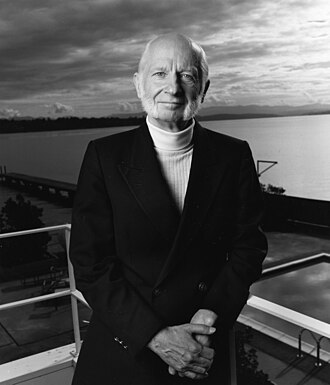
图:Photograph by Davis Freeman, University of Washington, court… · Attribution · Wikimedia Commons
汉斯·德默尔特1922—2017
Hans Georg Dehmelt
物理学家, 德国
汉斯·格奥尔格·德默尔特,德国-美国物理学家,1989年获诺贝尔物理学奖。
摘自维基百科「汉斯·德默尔特」,CC BY-SA 4.0
- 出生
- 1922 年 9 月 9 日,格尔利茨
- 逝世
- 2017 年 3 月 7 日,西雅图
- 国籍
- 德国、美国
- 学科
- 物理学、博物与综合
- 职业
- 物理学家、大学教师
- 母语 / 工作语言
- 德语、英语
- 母校
- 哥廷根大学、弗罗茨瓦夫大学
- 工作单位
- 华盛顿大学、杜克大学
研究领域
师承
博士导师2
来自 Wikidata 的「博士导师」「师从」「博士生」「学生」记录,可能不全。
所获奖项(7)
- 1970戴维森-格尔默奖
- 1985伦福德奖金
- 1989诺贝尔物理学奖
- 1995美国国家科学奖章
- —Humboldt Research Fellowship
- —美国物理学会会士
- —洪堡奖
学会与院士
百科正文
生平
汉斯·德默尔特出生于德国格尔利茨,在柏林长大的。1940年中学毕业后他在一个机动防空部队中当兵。他于斯大林格勒战役中幸存,然后被陆军遣送到布雷斯劳大学学习物理。1944年他被派往西部战线,在突出部之役中被美军俘虏。1946年他被释放后继续在哥廷根大学学习,他的导师包括理查德·贝克、沃纳·海森堡、马克斯·冯·劳厄、沃尔夫冈·保罗和马克斯·普朗克。在普朗克的葬礼上他甚至被选为抬棺材的人之一。1948年他大学毕业,他的毕业论文是关于汤普森质谱。1949年他获得博士学位,他的博士论文的题目是《碘化物晶体中的核四极频率》。他首先在杜克大学待了两年后1952年去西雅图的华盛顿大学。1955年他在华盛顿大学成为助理教授,1958年提升为破例教授,1961年称为正式教授。2002年他退休。
德默尔特第一次婚姻有一个儿子和一个孙子,他前妻逝世后他与一位物理学家结婚。1961年他获得美国公民权。
2017年3月7日,德默尔特以高龄94岁于美国西雅图去世。
成就
1956年德默尔特首次描写了离子阱对高分辨率质谱的优点。此后他开始研究怎样建造离子阱。1959年他成功地将电子在一个多腔磁控管中限制了10秒钟,后来的彭宁离子阱就是按照这个原理运行的。1973年德默尔特与戴维·瓦恩兰等合作持久保存一个单独电子并建造了一个电子振荡器。在此后的数年终他不断改善这个技术,1987年他以此非常精确地测量了电子和正电子的电子自旋g因子。
1989年德默尔特与沃尔夫冈·保罗一起因为“开发离子阱技术”分享诺贝尔物理学奖的一半,诺曼·拉姆齐获得了另一半。
以上内容摘自维基百科「汉斯·德默尔特」,按 CC BY-SA 4.0 使用,去掉了参考文献、外部链接等尾部小节,公式改写成了纯文本。全文、配图和出处见原文。
英文维基百科补充中文条目比较短,下面是英文条目「Hans Georg Dehmelt」的原文
Hans Georg Dehmelt (German pronunciation: [ˈhans ˈɡeːɔʁk ˈdeːml̩t]; 9 September 1922 – 7 March 2017) was a German and American physicist, who was awarded a Nobel Prize in Physics in 1989, for co-developing the ion trap technique (Penning trap) with Wolfgang Paul, for which they shared one-half of the prize (the other half of the Prize in that year was awarded to Norman Foster Ramsey). Their technique was used for high precision measurement of the electron magnetic moment.
Biography
At the age of ten Dehmelt enrolled in the Berlinisches Gymnasium zum Grauen Kloster, a Latin school in Berlin, where he was admitted on a scholarship. After graduating in 1940, he volunteered for service in the German Army, which ordered him to attend the University of Breslau to study physics in 1943. After a year of study he returned to army service and was captured during the Battle of the Bulge.
After his release from an American prisoner of war camp in 1946, Dehmelt returned to his study of physics at the University of Göttingen, where he supported himself by repairing and bartering old, pre-war radio sets. He completed his master's thesis in 1948 and received his PhD in 1950, both from the University of Göttingen. He was then invited to Duke University as a postdoctoral associate, emigrating in 1952. Dehmelt became an assistant professor at the University of Washington in Seattle, Washington in 1955, an associate professor in 1958, and a full professor in 1961.
In 1955 he built his first electron impact tube in George Volkoff's laboratory at the University of British Columbia and experimented on paramagnetic resonances in polarized atoms and free electrons. In the 1960s, Dehmelt and his students worked on spectroscopy of hydrogen and helium ions. The electron was finally isolated in 1973 with David Wineland, who continued work on trapped ions at NIST.
He created the first geonium atom in 1976, which he then used to measure precise magnetic moments of the electron and positron with R. S. Van Dyck into the 1980s, work that led to his Nobel prize. In 1979 Dehmelt led a team that took the first photo of a single atom. He continued work on ion traps at the University of Washington, until his retirement in October 2002.
In May 2010, he was honoured as one of Washington's Nobel laureates by Crown Princess Victoria of Sweden at a special event in Seattle.
He was married to Irmgard Lassow, now deceased, and the couple had a son, Gerd, also deceased. In 1989 Dehmelt married Diana Dundore, a physician.
Dehmelt died on March 7, 2017, in Seattle, Washington, aged 94.
Awards and honors
Davisson-Germer Prize in 1970.
Rumford Prize in 1985.
Nobel Prize in Physics in 1989.
Golden Plate Award of the American Academy of Achievement in 1990.
National Medal of Science in 1995.
以上内容摘自英文维基百科「Hans Georg Dehmelt」,按 CC BY-SA 4.0 使用,去掉了参考文献、外部链接等尾部小节,公式改写成了纯文本。全文、配图和出处见原文。
同年获同一奖项
同一学科、同时代的科学家


同一学科的科学家
更多 ›