格物
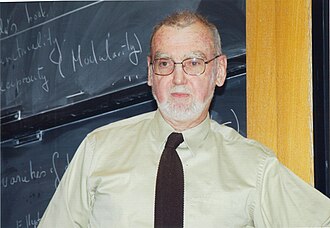
图:Author - Dr. Jeff Mozzochi (passed copyright for the photo t… · CC BY-SA 3.0 · Wikimedia Commons
罗伯特·朗兰兹1936—
Robert Langlands
加拿大数学家
罗伯特·费伦·朗兰兹,出生于加拿大不列颠哥伦比亚省新西敏,二十世纪最重要的数学家之一,现任普林斯顿高等研究院教授。他对数论和表示理论具有非凡的洞察力。
摘自维基百科「罗伯特·朗兰兹」,CC BY-SA 4.0
- 出生
- 1936 年 10 月 6 日,新威斯敏斯特
- 国籍
- 加拿大、美国
- 学科
- 物理学、数学、博物与综合
- 职业
- 数学家、大学教师、物理学家
- 母语 / 工作语言
- 英语
- 母校
- 不列颠哥伦比亚大学、耶鲁大学、Semiahmoo Secondary School
- 工作单位
- 普林斯顿大学(1960—1967)、耶鲁大学(1967—1972)、普林斯顿高等研究院(1972—2007)
研究领域
师承
博士导师1
博士生8
来自 Wikidata 的「博士导师」「师从」「博士生」「学生」记录,可能不全。
所获奖项(19)
- 1975Wilbur Lucius Cross奖章
- 1988玛丽亚姆·米尔扎哈尼数学奖
- 1989巴黎第七大学名誉博士
- 1996沃尔夫数学奖
- 2000法国科学院大奖章
- 2002honorary doctorate at the Laval University
- 2005Steele Prize for Seminal Contribution to Research
- 2006内默斯数学奖
- 2007邵逸夫数学科学奖
- 2013美国数学会会士
- 2018阿贝尔奖
- —英国皇家学会院士
- —Cole Prize in Number Theory
- —Humboldt Research Fellowship
- —洪堡奖
- —加拿大皇家学会院士
- —柯尔奖
- —邵逸夫奖
- —加拿大勋章同伴
学会与院士
百科正文
朗兰兹毕业于耶鲁大学。1960年代初他建立了约化群的艾森斯坦级数的一般理论。自1990年后,朗兰兹转攻数学物理。
奖项
他是著名的朗兰兹纲领的提出者。1996年他获得了沃尔夫奖。在2007年获得了邵逸夫奖数学科学奖。2018年获得阿贝尔奖。
以上内容摘自维基百科「罗伯特·朗兰兹」,按 CC BY-SA 4.0 使用,去掉了参考文献、外部链接等尾部小节,公式改写成了纯文本。全文、配图和出处见原文。
英文维基百科补充中文条目比较短,下面是英文条目「Robert Langlands」的原文
Robert Phelan Langlands (; born October 6, 1936) is a Canadian mathematician. He is best known as the founder of the Langlands program, a vast web of conjectures and results connecting representation theory and automorphic forms to the study of Galois groups in number theory, for which he received the 2018 Abel Prize. He is emeritus professor and occupied Albert Einstein's office at the Institute for Advanced Study in Princeton, until 2020 when he retired.
Early life and career
Langlands was born in New Westminster, British Columbia, Canada, in 1936 to Robert Langlands and Kathleen J Phelan. He has two younger sisters (Mary b. 1938; Sally b. 1941). In 1945, his family moved to White Rock, near the US border, where his parents had a building supply and construction business.
He graduated from Semiahmoo Secondary School and started enrolling at the University of British Columbia at the age of 16, receiving his undergraduate degree in mathematics in 1957; he continued at UBC to receive a M.Sc. in 1958. He then went to Yale University, where he received a Ph.D. in 1960.
His first academic position was at Princeton University from 1960 to 1967, where he worked as an associate professor. He spent a year in Turkey at METU during 1967–68 in an office next to Cahit Arf's. He was a Miller Research Fellow at the University of California, Berkeley, from 1964 to 1965, then was a professor at Yale University from 1967 to 1972. He was appointed Hermann Weyl Professor at the Institute for Advanced Study in 1972, and became professor emeritus in January 2007.
Research
Langlands's Ph.D. thesis was on the analytical theory of Lie semigroups, but he soon moved into representation theory, adapting the methods of Harish-Chandra to the theory of automorphic forms. His first accomplishment in this field was a formula for the dimension of certain spaces of automorphic forms, in which particular types of Harish-Chandra's discrete series appeared.
He next constructed an analytical theory of Eisenstein series for reductive groups of rank greater than one, thus extending work of Hans Maass, Walter Roelcke, and Atle Selberg from the early 1950s for rank one groups such as SL (2). This amounted to describing in general terms the continuous spectra of arithmetic quotients, and showing that all automorphic forms arise in terms of cusp forms and the residues of Eisenstein series induced from cusp forms on smaller subgroups. As a first application, he proved the Weil conjecture on Tamagawa numbers for the large class of arbitrary simply connected Chevalley groups defined over the rational numbers. Previously this had been known only in a few isolated cases and for certain classical groups where it could be shown by induction.
Awards and honors
Langlands has received the 1996 Wolf Prize (which he shared with Andrew Wiles), the 2005 AMS Steele Prize, the 1980 Jeffery–Williams Prize, the 1988 NAS Award in Mathematics from the National Academy of Sciences, the 2000 grande médaille de l'Académie des sciences de Paris, the 2006 Nemmers Prize in Mathematics, the 2007 Shaw Prize in Mathematical Sciences (with Richard Taylor) for his work on automorphic forms. In 2018, Langlands was awarded the Abel Prize for "his visionary program connecting representation theory to number theory".
He was elected a Fellow of the Royal Society of Canada in 1972 and a Fellow of the Royal Society in 1981. In 2012, he became a fellow of the American Mathematical Society. Langlands was elected as a member of the American Academy of Arts and Sciences in 1990. He was elected as a member of the National Academy of Sciences in 1993 and a member of the American Philosophical Society in 2004.
Among other honorary degrees, in 2003, Langlands received a doctorate honoris causa from Université Laval.
In 2019, Langlands was appointed a Companion of the Order of Canada.
On January 10, 2020, Langlands was honoured at Semiahmoo Secondary, which installed a mural to celebrate his contributions to mathematics.
Personal life
Langlands has been married to Charlotte Lorraine Cheverie (b 1935) since 1957. They have four children (2 daughters and 2 sons). He holds Canadian and American citizenships.
In addition to his mathematical studies, Langlands likes to learn foreign languages, both for better understanding of foreign publications on his topic and as a hobby. He speaks English, French, Turkish and German, and reads (but does not speak) Russian.
以上节选摘自英文维基百科「Robert Langlands」,按 CC BY-SA 4.0 使用,去掉了参考文献、外部链接等尾部小节,公式改写成了纯文本。篇幅所限,较长的小节只摘了开头一部分,有的小节没有收;全文、配图和出处见原文。
同一学科、同时代的科学家


同一学科的科学家
更多 ›