格物
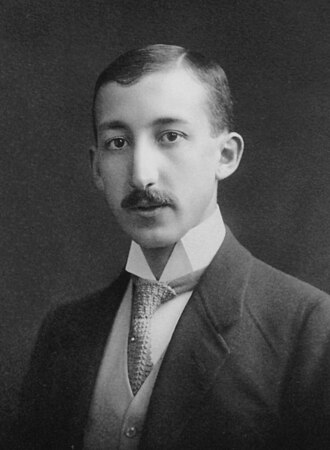
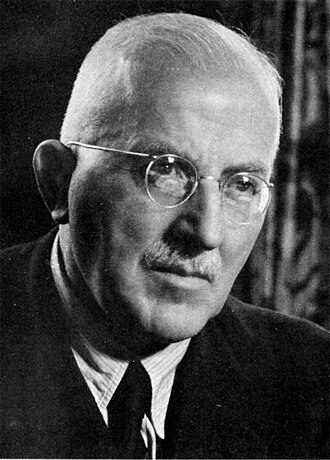
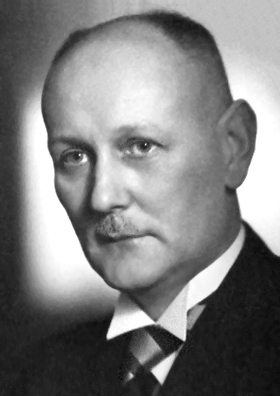
图:作者不详 · Public domain · Wikimedia Commons
乔治·德海韦西1885—1966
George de Hevesy
化学家, 匈牙利
乔治·查尔斯·德海韦西,匈牙利语名海韦西·哲尔吉,匈牙利化学家,1944年获1943年度的诺贝尔化学奖。
摘自维基百科「乔治·德海韦西」,CC BY-SA 4.0
- 出生
- 1885 年 8 月 1 日,布达佩斯
- 逝世
- 1966 年 7 月 5 日,布赖斯高地区弗赖堡
- 国籍
- 匈牙利、瑞典
- 学科
- 化学
- 职业
- 化学家、大学教师
- 母语 / 工作语言
- 匈牙利语、瑞典语
- 母校
- 弗赖堡大学(博士,1908 年)、罗兰大学(1904 年)、柏林工业大学(1907 年)、皮里亚斯特高中(1903 年)
- 工作单位
- 弗赖堡大学、罗兰大学、苏黎世联邦理工学院、尼尔斯·波耳研究所、曼彻斯特大学、哥本哈根大学、斯德哥尔摩大学
研究领域
主要贡献
发现的元素
师承
博士导师2
博士生1
来自 Wikidata 的「博士导师」「师从」「博士生」「学生」记录,可能不全。
所获奖项(7)
学会与院士
百科正文
生平
1885年出生于布达佩斯。1966年逝世于弗莱堡。
以上内容摘自维基百科「乔治·德海韦西」,按 CC BY-SA 4.0 使用,去掉了参考文献、外部链接等尾部小节,公式改写成了纯文本。全文、配图和出处见原文。
英文维基百科补充中文条目比较短,下面是英文条目「George de Hevesy」的原文
George Charles de Hevesy (born György Bischitz; Hungarian: Hevesy György Károly; German: Georg Karl von Hevesy; 1 August 1885 – 5 July 1966) was a Hungarian radiochemist and Nobel Prize in Chemistry laureate, recognized in 1943 for his key role in the development of radioactive tracers to study chemical processes such as in the metabolism of animals. He also co-discovered the element hafnium.
Biography
Early years
Hevesy György was born in Budapest, Hungary, to a wealthy and ennobled family of Hungarian-Jewish descent, the fifth of eight children to his parents Lajos Bischitz and Baroness Eugénia (Jenny) Schossberger (ennobled as "De Tornya"). Grandparents from both sides of the family had provided the presidents of the Jewish community of Pest. George grew up in Budapest and graduated high school in 1903 from Piarist Gimnázium. The family's name in 1904 was Hevesy-Bischitz, and Hevesy later changed his own.
De Hevesy began his studies in chemistry at the University of Budapest for one year, and at the Technische Hochschule in Charlottenburg (now Technische Universität Berlin) for several months, but transferred to the University of Freiburg. There he met Ludwig Gattermann. In 1906, he started his Ph.D. thesis with Georg Franz Julius Meyer, acquiring his doctorate in physics in 1908. In 1908, Hevesy was offered a position at the ETH Zürich, Switzerland, yet being independently wealthy, he was able to choose his research environment. He worked first with Fritz Haber in Karlsruhe, Germany, then with Ernest Rutherford in Manchester, England, where he also met Niels Bohr. Back at home in Budapest, he was appointed professor in physical chemistry in 1918. In 1920, he settled in Copenhagen.
Research
In 1922, de Hevesy co-discovered (with Dirk Coster) the element hafnium (72Hf) (Latin Hafnia for "Copenhagen", the home town of Niels Bohr). Mendeleev's 1869 periodic table arranged the chemical elements into a logical system, but a chemical element with 72 protons was missing.
World War II and beyond
Prior to the onset of World War II, Max von Laue and James Franck had sent their gold Nobel Prize medals to Denmark to keep them from being confiscated by the Nazis. After the Nazi invasion of Denmark this placed them in danger; it was illegal at the time to send gold out of Germany, and were it discovered that Laue and Franck had done so, they could have faced prosecution. To prevent this, de Hevesy concealed the medals by dissolving them in aqua regia and placing the resulting solution on a shelf in his laboratory at the Niels Bohr Institute in Copenhagen. After the war, he returned to find the solution undisturbed and precipitated the gold out of the acid. The Nobel Society then recast the medals using the recovered gold and returned them to the two laureates.
By 1943, Copenhagen was no longer safe for a Jewish scientist and de Hevesy fled to Sweden, where he worked at the Stockholm University until 1961. In Stockholm, de Hevesy was received at the department of chemistry by the German-born Swedish professor and Nobel Prize winner Hans von Euler-Chelpin, who remained strongly pro-Germany throughout the war. Despite this, de Hevesy and von Euler-Chelpin collaborated on many scientific papers during and after the war.
While in Stockholm, de Hevesy received the Nobel Prize in chemistry. He was later inducted into the Royal Swedish Academy of Sciences and received the Copley Medal, of which he was particularly proud. De Hevesy stated: "The public thinks the Nobel Prize in chemistry for the highest honor that a scientist can receive, but it is not so.
Family life and death
De Hevesy married Pia Riis in 1924. They had one son and three daughters together, one of whom (Eugenie) married a grandson of the Swedish Nobel laureate Svante Arrhenius. De Hevesy died in 1966 at the age of eighty and was buried in Freiburg. At his family's request, his remains were interred at his birthplace in Budapest at the Kerepesi Cemetery in 2001. He had published a total of 397 scientific documents, one of which was the Becquerel-Curie Memorial Lecture, in which he had reminisced about the careers of pioneers of radiochemistry.
On 10 May 2005 the Hevesy Laboratory was founded at Risø National Laboratory for Sustainable Energy, now Technical University of Denmark, DTU Nutech. It was named after George de Hevesy as the father of the isotope tracer principle under the initiative of the lab's first director, Prof. Mikael Jensen.
以上节选摘自英文维基百科「George de Hevesy」,按 CC BY-SA 4.0 使用,去掉了参考文献、外部链接等尾部小节,公式改写成了纯文本。篇幅所限,较长的小节只摘了开头一部分,有的小节没有收;全文、配图和出处见原文。
同一学科、同时代的科学家