 格物
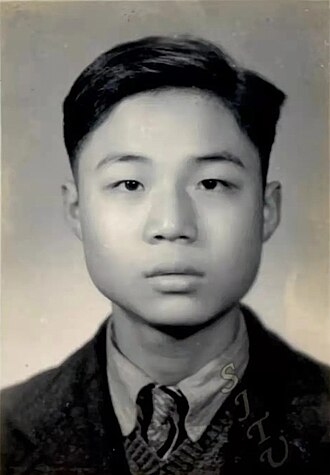
图:作者不详 · Public domain · Wikimedia Commons
- 出生
- 1930 年 2 月 4 日,苏州市
- 逝世
- 2026 年 5 月 31 日,北京市
- 国籍
- 中华人民共和国
- 职业
- 空气动力学家、政治人物
- 母校
- 上海交通大学
所获奖项(1)
- 2021国家最高科学技术奖
学会与院士
百科正文
生平
顾诵芬于1947年毕业于上海市私立南洋模范中学,并考入国立交通大学攻读空气动力学专业。1951年,大学毕业他前往航空工业局工作。1956年起,他任职于沈阳飞机制造厂飞机设计室,担任空气动力组组长。期间,他在歼教-1上设计出了亚声速两侧进气道,是中国首次应用此技术。后他又设计了初教-6的机翼布局,以提升失速尾旋特性。
1961年后,顾诵芬历任沈阳飞机设计研究所副总设计师、总设计师、副所长、所长等职。期间,他于1963年起开始负责中国首架高空高速歼击机——歼-8I的总体、气动力设计,并解决了方向安定性、跨声速抖振等重要技术问题。1981年,他出任歼-8Ⅰ的改进型——歼-8II飞机总设计师,被誉为“歼8之父”。1986年后,他出任航空工业部科学技术委员会副主任。1988年,兼任航空研究院副院长。此后他又领导了飞机主动控制技术(ACT)的研究,并于1990年代起又主持了高性能远景飞机的概念研究。1991年,他当选中国科学院技术科学部学部委员(院士)。1994年,他又成功当选为中国工程院院士。
他还曾任中国航空学会副理事长,第六、七届全国人大代表,第八届全国人大常委等职。1998年3月,第九届全国人大第一次会议上,他当选为全国人民代表大会常务委员会委员。2021年,他被授予国家最高科学技术奖。2022年3月3日,他入选2021感动中国年度人物。
2026年5月31日,顾诵芬逝世,享年96岁。
以上内容摘自维基百科「顾诵芬」,按 CC BY-SA 4.0 使用,去掉了参考文献、外部链接等尾部小节,公式改写成了纯文本。全文、配图和出处见原文。
英文维基百科补充中文条目比较短,下面是英文条目「Gu Songfen」的原文
Gu Songfen (Chinese: 顾诵芬; 4 February 1930 – 31 May 2026) was a Chinese aircraft designer. He participated in the design of the Shenyang JJ-1, the People's Republic of China's first jet trainer. He was the chief designer of the Shenyang J-8 and J-8II, the PRC's first high-speed, high-altitude interceptor fighter jets. He served as vice president and chief designer of the Shenyang Aircraft Design Institute and was an academician of both the Chinese Academy of Sciences and the Chinese Academy of Engineering.
Early life
Gu was born 4 February 1930 in Suzhou, Jiangsu, China. He is the youngest son of Gu Tinglong (顾廷龙), a well known sinologist and calligrapher. His given name "Songfen" comes from a passage of the 3rd-century treatise Wen fu written by Lu Ji.
In 1935, Gu Tinglong accepted a job at the Yenching University library, and moved the family to Beijing. Two years later, the Second Sino-Japanese War broke out and Japanese warplanes bombed the Xiyuan Barracks of the Chinese 29th Army on 28 July 1937. As the Gu family lived near the barracks, their house was shaken by the explosions. Songfen recalled watching the bombs fall out of the planes, before adults urged him to hide under the dining table. He attributed to this experience as the main reason he decided to become an aircraft designer.
To escape Japanese occupation, in 1938 Gu Tinglong moved the family to the Shanghai French Concession, where he helped establish the United Library (合众图书馆).
Early career: the Shenyang JJ-1
Gu graduated from university in 1951, and was assigned to work for the newly established Aviation Industry Bureau of the Ministry of Heavy Industry, under the PRC's top aircraft designers Xu Shunshou and Huang Zhiqian. The People's Republic of China (PRC), which had just been founded two years earlier, was still establishing its aviation industry, and in the early years Gu mostly worked on servicing Soviet-made aircraft.
In August 1956, the Aviation Industry Bureau established the PRC's first airplane design office in Shenyang, with Xu Shunshou as its director, Huang Zhiqian and Ye Zhengda as deputy directors. Gu, then 26 years old, was appointed head of the aerodynamics group. The office's first task was to design and build a jet trainer, the Shenyang JJ-1. The plane took its first flight on 26 July 1958, which marked a new era for the PRC's aviation industry.
Chief Designer of the Shenyang J-8 and J-8II
In October 1964, the PRC government decided to design and build its first high-speed, high-altitude interceptor fighter jet, later named the Shenyang J-8. Huang Zhiqian was appointed its chief designer, with Gu serving as his deputy. After Huang died in the Pakistan International Airlines Flight 705 crash in 1965, Gu succeeded him as chief designer. The project was delayed by the outbreak of the Cultural Revolution 1966, but the J-8 completed its maiden flight on 5 July 1969, which is considered another milestone in the development of the PRC's aviation industry. In November 1985, the J-8 project won the Special Prize of the State Science and Technology Progress Award, and Gu was named as the first recipient.
By 1977, Gu was chief designer and vice president of the Shenyang Aircraft Design Institute (then called the 601 Institute). In May 1981, Gu was appointed Chief Designer of the Shenyang J-8II, the next generation of the J-8 interceptor. The first J-8II plane completed its maiden flight on 12 June 1984, and its design was finalized in 1988.
Administrative career and honours
Gu was transferred to Beijing in 1986 to serve as Deputy Director of the national government's Aviation Industry and Technology Commission. In this capacity, he participated in planning the future development of the PRC's aviation industry. In June 2001, Gu, Wang Daheng, Shi Changxu, and more than a dozen other scientists proposed the development of the PRC's own jetliner. The proposal was adopted by the PRC government in 2007, and the Comac C919 took its maiden flight ten years later, on 5 May 2017.
He was elected an academician of the Chinese Academy of Sciences in 1991, and of the Chinese Academy of Engineering in 1994. Gu won the 1995 Ho Leung Ho Lee Prize for Science and Technology Progress. He was elected a delegate to the 7th, 8th, and 9th National People's Congress, and was a member of the Standing Committee of the 9th National People's Congress. In 2022, Gu became a laureate of the Asian Scientist 100 by the Asian Scientist.
Death
Gu died on 31 May 2026, at the age of 96.
以上节选摘自英文维基百科「Gu Songfen」,按 CC BY-SA 4.0 使用,去掉了参考文献、外部链接等尾部小节,公式改写成了纯文本。篇幅所限,较长的小节只摘了开头一部分,有的小节没有收;全文、配图和出处见原文。