格物
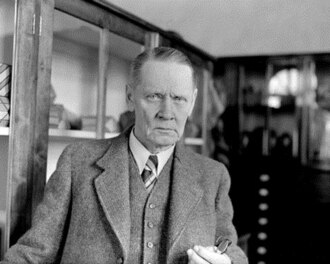
图:作者不详 · Public domain · Wikimedia Commons
彭蒂·埃斯科拉1883—1964
Pentti Eskola
芬兰地质学家及教授
彭蒂·埃里斯·埃斯科拉 是一位芬兰地质学家,专门研究花岗岩岩石学并发展了变质岩相的概念。他于1958年获得沃拉斯顿奖章并在1964年获得维特勒森奖,死后举行了国葬。绿铬矿(eskolaite)是以他的名字命名的矿物。
摘自维基百科「彭蒂·埃斯科拉」,CC BY-SA 4.0
- 出生
- 1883 年 1 月 8 日,洪基拉赫蒂
- 逝世
- 1964 年 12 月 6 日,赫尔辛基
- 国籍
- 俄罗斯帝国、俄罗斯共和国、芬兰
- 学科
- 地球科学
- 职业
- 地质学家、大学教师
- 母语 / 工作语言
- 德语、芬兰语
- 母校
- Imperial Alexander University
- 工作单位
- 赫尔辛基大学
研究领域
所获奖项(5)
- 1951彭罗斯奖章得主列表
- 1958沃拉斯顿奖章
- 1962Leopold-von-Buch-Plaque
- 1964维特勒森奖
- —honorary member of the German Mineralogical Society
学会与院士
百科正文
埃斯科拉出生在洪基拉赫蒂,是一个农民的儿子。他于1906年毕业于赫尔辛基大学,并于1914年获得博士学位,论文题目是奥里耶尔维地区的岩石学。埃斯科拉是威廉·拉姆齐的学生。他于1920-21年访问了挪威和美国,他在华盛顿特区的地球物理实验室工作,并在加拿大地质调查局工作,期间他考究了榴辉岩。他于1922年成为芬兰调查局的地质学家,并于1924年加入赫尔辛基大学担任地质学教授,一直工作到1954年。
埃斯科拉关于变质作用的主要工作受到他在23岁时阅读的雅各布·塞德霍尔姆的著作。他开始思考花岗岩和片麻岩的起源和形成,并想出了一种方法,可以在不同的压力和温度条件下对地层进行分类,从而实现不同的化学平衡。
埃斯科拉于1914年结婚。他的妻子曼迪·维罗(Mandi Wiiro)在去世前长期患病。他们的儿子马蒂(Matti,1916-1941)因在二战期间在俄罗斯前线阵亡所以先于他们去世,归还给父母的遗物只有一个钱包,里面装着他收集来种在他们家庭农场的苹果种子,埃斯科拉为纪念儿子而种植。
他的女儿派韦泰尔(Päivätär)成为了一名化学老师。
埃斯科拉还在一本关于世界观的书中讨论了哲学,并与哲学家罗尔夫·阿恩基尔(Rolf Arnkil)和西格弗里德·西雷纽斯(Sigfrid Sirenius)通信。
以上内容摘自维基百科「彭蒂·埃斯科拉」,按 CC BY-SA 4.0 使用,去掉了参考文献、外部链接等尾部小节,公式改写成了纯文本。全文、配图和出处见原文。
英文维基百科补充中文条目比较短,下面是英文条目「Pentti Eskola」的原文
Pentti Elias Eskola (8 January 1883 – 6 December 1964) was a Finnish geologist who specialised in the petrology of granites and developed the concept of metamorphic facies. He won the Wollaston Medal in 1958, the Vetlesen Prize in 1964, and was given a state funeral upon his death. The mineral eskolaite is named in his honor.
Eskola was born in Lellainen, the son of a farmer. He graduated from the University of Helsinki in 1906 and received a doctorate in 1914 with a dissertation on the petrology of the Orijärvi Region. Eskola was a student of Wilhelm Ramsay. He visited Norway and the US in 1920–21 working at the Geophysical Laboratory in Washington, D.C., and with the Geological Survey of Canada during which time he examined eclogites. He became a geologist for the Finnish Survey in 1922 and joined as a professor of geology at Helsinki in 1924 working there until 1954.
Eskola's major work on metamorphism was influenced by the work of J.J. Sederholm whose work he read when he was just 23. He began to think of the origin and formation of the granites and gneisses and came up with a method to classify the formation under different pressure and temperature conditions resulting in varying chemical equilibria being achieved.
Eskola married in 1914. His wife Mandi Wiiro suffered from a long illness before passing. Their son Matti (1916–1941) predeceased them, as he was killed during World War II on the Russian front and all that was returned to his parents was a purse which contained apple seeds that he collected to plant in their family farm, which Eskola planted in memory of his son.
His daughter Päivätär became a chemistry teacher.
Eskola also discussed philosophy in a book on world outlook and corresponded with philosophers Rolf Arnkil and Sigfrid Sirenius.
以上内容摘自英文维基百科「Pentti Eskola」,按 CC BY-SA 4.0 使用,去掉了参考文献、外部链接等尾部小节,公式改写成了纯文本。全文、配图和出处见原文。
同一学科、同时代的科学家


同一学科的科学家
更多 ›