 格物
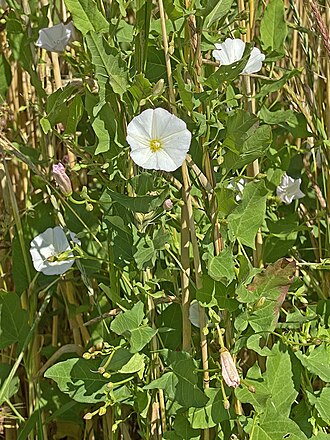
图:W. Bulach · CC BY-SA 4.0 · Wikimedia Commons
- 学名
- Convolvulus arvensis
- 分类等级
- 种
- 上级类群
- 旋花属
- 大类
- 被子植物
- 命名
- 卡尔·林奈,1753 年
- 中文别名
- 箭叶旋花、扶秧苗、白花藤、扶田秧、面根藤
- 栖息地
- 旱田、放牧地、园林、草原、人行道
- 用途
- 药用植物、饲料、传统医学
- 数据库
- NCBI 分类 · GBIF
百科正文
形态
这是一种攀爬草本多年生植物,长达0.5-2米。叶子呈成螺旋形分布,形状为线状至箭形,2-5厘米长,叶柄长度为1-3厘米。花呈喇叭形,直径为1-2.5厘米,白色或浅桃红色,有5条放射状深桃红色条纹。
分类
田旋花有两个变种:
田旋花(Convolvulus arvensis var. arvensis),叶子较宽。
线叶田旋花(Convolvulus arvensis var. linearifolius),叶子较细。
入侵物种
尽管田旋花的花朵吸引人,但是却不受花圃欢迎。因为其生长得很快,侵占了其他栽培的植物。田旋花引入到北美洲后,在某些地方成为入侵物种。其浓密的植被侵占了农田,使农作物减产。1998年该物种使美国农作物损失达3.77亿美元。
以上内容摘自维基百科「田旋花」,按 CC BY-SA 4.0 使用,去掉了参考文献、外部链接等尾部小节,公式改写成了纯文本。全文、配图和出处见原文。
英文维基百科补充中文条目比较短,下面是英文条目「Convolvulus arvensis」的原文
Convolvulus arvensis, or field bindweed, is a species of bindweed in the Convolvulaceae native to Europe and Asia. It is a rhizomatous and climbing or creeping herbaceous perennial plant with stems growing to 0.5–2 metres (1.6–6.6 ft) in length. It is usually found at ground level with small white and pink flowers.
Other common names, mostly obsolete, include lesser bindweed, European bindweed, withy wind (in basket willow crops), perennial morning glory, small-flowered morning glory, creeping Jenny, and possession vine.
Taxonomy
Field bindweed was first described in 1753 by Carl Linnaeus in the Species Plantarum. In the following centuries, many subspecies, varieties, and synonymous taxa were discovered and described as purportedly new species in places including China, Russia, Egypt, and Morocco. New species and forms were described as far as Chile, Mexico, and the state of California when botanists encountered the plant there, although it is not native to these areas.
In the ninth volume of Augustin Pyramus de Candolle's Prodromus, published in 1845, Jacques Denys Choisy reduced a number of these synonyms to ten varieties of Convolvulus arvensis, although he also recognised a number of species now also reduced to synonyms of C. arvensis. Over time, most or all of these species and varieties were no longer recognised by the relevant authorities.
Description
Convolvulus arvensis is a perennial vine that typically climbs to 1 metre (3.3 ft). The vine produces woody rhizomes from which it resprouts in the spring, or when the aboveground vines are removed.
The leaves are spirally arranged, linear to arrowhead-shaped, 2–5 cm (0.79–1.97 in) long and alternate, with a 1–3 cm (0.39–1.18 in) petiole. The flowers are trumpet-shaped, 1–2.5 cm (0.39–0.98 in) diameter, white or pale pink, with five slightly darker pink radial stripes. Flowering occurs in mid summer (in the UK, between June and September) when white to pale pink, funnel-shaped flowers develop. Flowers are approximately 1.9–2.5 cm (0.75–0.98 in) across and are subtended by small bracts. The fruit are light brown, rounded and 3–4 mm (0.12–0.16 in) wide.
Ecology
Plants are typically found inhabiting farmland, waste places, along roads, in pastures, grassy slopes, and also along streams in North America. It is able to colonise hot asphalt surfaces by covering it from the sides of roads, and worm its way between pavement stones. It grows from 600 to 4,500 metres (2,000 to 14,800 ft) in altitude in China, and is absent from the warmer southern provinces. It prefers dry areas with humus-poor, nutrient-rich and alkaline soils. It is a characteristic species in the phytosociological vegetation association Convolvulo-Agropyretum, belonging to the couch grass dry grasslands alliance (called Convolvulo-Agropyrion repentis in syntaxonomy).
Like the other Convolvulus bindweeds of Eurasia, it is specifically pollinated by sweat bees in the genus Systropha.
Chemistry and uses
Bindweed contains several alkaloids which are toxic for mice, including pseudotropine, and lesser amounts of tropine, tropinone, and meso-cuscohygrine. The alkaloids are also reported to give the plant psychoactive properties.
Its leaves contain glycosides and have been traditionally used to treat hypertension and as a laxative and diuretic.
Economic impacts
Although it produces attractive flowers, it is often unwelcome in gardens as a nuisance weed due to its rapid growth and choking of cultivated plants. It was most likely introduced into North America as a contaminant in crop seed as early as 1739, and became an invasive species. Its dense mats invade agricultural fields and reduce crop yields; it is estimated that crop losses due to this plant in the United States exceeded US$377 million in the year 1998 alone. It is one of the most serious weeds of agricultural fields in many temperate regions of the US.
Control and management
Bindweed is difficult to eliminate. The roots may extend several metres deep. New plants may sprout from seeds that are up to 20 years old. New plants can also form from root runners and root fragments.
Methods for controlling bindweed include:
In culture
In one of the tales collected by Jacob and Wilhelm Grimm, Our Lady's Little Glass, this flower is used by Mary, mother of Jesus, to drink wine with when she helps free a wagoner's cart. The story goes on to say that "the little flower is still always called Our Lady's Little Glass".
以上节选摘自英文维基百科「Convolvulus arvensis」,按 CC BY-SA 4.0 使用,去掉了参考文献、外部链接等尾部小节,公式改写成了纯文本。篇幅所限,较长的小节只摘了开头一部分,有的小节没有收;全文、配图和出处见原文。