 格物
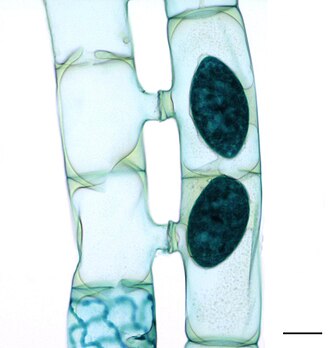
图:Jon Houseman · CC BY-SA 4.0 · Wikimedia Commons
- 学名
- Zygnematophyceae
- 分类等级
- 纲
- 上级类群
- 轮藻门
- 大类
- 其他植物
- 数据库
- NCBI 分类 · GBIF
下级类群(2)
百科正文
下属分类
- 本纲包括以下目:
- 双星藻目 Zygnematales
- 目和科的地位未定的属:
- 螺带鼓藻属 Spirotaenia Bréb. ex Ralfs
以上内容摘自维基百科「双星藻纲」,按 CC BY-SA 4.0 使用,去掉了参考文献、外部链接等尾部小节,公式改写成了纯文本。全文、配图和出处见原文。
英文维基百科补充中文条目比较短,下面是英文条目「Zygnematophyceae」的原文
Zygnematophyceae (or Conjugatophyceae) is a class of green algae in the paraphylum streptophyte algae, also referred to as Charophyta, consisting of more than 4000 described species. The Zygnematophyceae are the sister clade of the Embryophyta (land plants).
Common members of the Zygnematophyceae include the filamentous algae Spirogyra and Mougeotia, as well as desmids, which are microscopic algae characterized by symmetrical and elaborately ornate cells.
Morphology
The body plan of Zygnematophyceae is simple, and the group appears to have gone through a secondary loss of morphological complexity. The most basal members are unicellular, but filamentous species have evolved at least five times, and a few species form colonies. Each cell contains a single nucleus.
The chloroplasts of the Zygnematophyceae are large, typically axile but sometimes parietally located, and contain one or several pyrenoids. One or several chloroplasts may be present in a single cell. The shape of the chloroplast may be star-shaped (in Zygnema), ribbon-shaped (in Spirogyra), or elaborately lobed and dissected. In some taxa, particularly Mougeotia, the chloroplast is able to move in response to different light conditions.
Reproduction
The Zygnematophyceae are able to reproduce both asexually and sexually. Asexual reproduction takes place via fragmentation, cell division, akinete formation, or parthenospores.
Sexual reproduction in the Zygnematophyceae takes place through a process called conjugation. Unusually, the gametes lack flagella, and they also lack centrioles which suggest that flagella were not secondarily lost. This lack of flagella sets the Zygnematophyceae apart from nearly all groups of algae, except for red algae and cyanobacteria (also known as blue-green algae, if they are classified as such). The gametes are scarcely differentiated from vegetative cells.
In conjugation, cells or filaments of opposite sex line up, and tubes form between corresponding cells. The male cells then become amoeboid and crawl across the female, or sometimes both cells crawl into the connecting tube. The cells then meet and fuse to form a zygote, which later undergoes meiosis to produce new cells or filaments.
Taxonomy
The Zygnematophyceae is monophyletic. Traditionally, it has been known to contain two orders, the Zygnematales and Desmidiales. However, the Zygnematales were found to be paraphyletic with respect to the Desmidiales, and so it was split up. As of 2023, five orders and two subclasses are recognized: the Spirogloeales in Spirogloeophycidae, and the Serritaeniales, the Zygnematales, the Spirogyrales, and the Desmidiales in Zygnematophycidae.
- Class Zygnematophyceae
- Subclass Spirogloeophycidae Melkonian, Gontcharov & Marin 2019
- Order Spirogloeales Melkonian, Gontcharov & Marin 2019
- Family Spirogloeaceae Melkonian, Gontcharov & Marin 2019
- Subclass Zygnematophycidae Melkonian, Gontcharov & Marin 2019
- Order Serritaeniales Hess & de Vries 2022
- Family Serritaeniaceae Hess & de Vries 2022
- Order Zygnematales Borge & Pascher 1931
- Family Zygnemataceae (Meneghini) Kützing 1843
- Family Mesotaeniaceae Oltmans 1904 (paraphyletic)
- Order Spirogyrales Hess & de Vries 2022
- Family Spirogyraceae Palla 1894
Habitat
Members of the Zygnematophyceae are common in nearly all freshwater habitats, particularly filamentous genera such as Spirogyra and Mougeotia. Some Spirogyra species can tolerate disturbed habitats. On the other hand, desmids (the Desmidiales) often prefer bogs, peatlands, and lakes.
Fossil record
Vegetative cells of the Zygnematophyceae are fragile and usually not preserved, but the zygospores are resistant to decay and can become fossilized. The Zygnematophyceae have been recorded from at least the middle Devonian period, and before the Carboniferous period, all the major groups had diverged. Fossils of zygospores are indicators of warming spring conditions and shallow, stagnant mesotrophic habitats.
Genomes
The first genomes published for Zygnematophyceae were Mesotaenium endlicherianum and Spirogloea muscicola. Since then, genomes have been published on Penium margaritaceum, Zygnema spp., and the Closterium peracerosum–strigosum–littorale complex. Furthermore, the gene models of Mesotaenium endlicherianum have been updated.
以上节选摘自英文维基百科「Zygnematophyceae」,按 CC BY-SA 4.0 使用,去掉了参考文献、外部链接等尾部小节,公式改写成了纯文本。篇幅所限,较长的小节只摘了开头一部分,有的小节没有收;全文、配图和出处见原文。