 格物
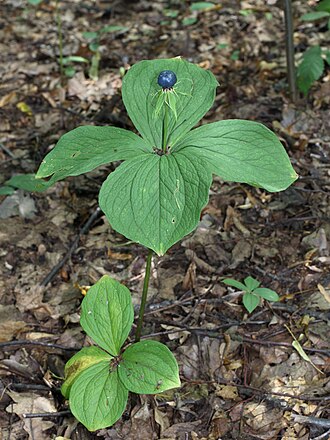
图:George Chernilevsky · Public domain · Wikimedia Commons
- 学名
- Paris quadrifolia
- 分类等级
- 种
- 上级类群
- 重楼属
- 大类
- 被子植物
- 命名
- 卡尔·林奈,1753 年
- 数据库
- NCBI 分类 · GBIF
分类阶元
百科正文
英文维基百科补充中文条目比较短,下面是英文条目「Paris quadrifolia」的原文
Paris quadrifolia, the herb Paris or true lover's knot, is a species of flowering plant in the family Melanthiaceae. It occurs in temperate and cool areas throughout Eurasia, from Spain to Yakutia, and from Iceland to Mongolia. It prefers calcareous soils and lives in damp and shady places, especially old established woods and stream banks.
P. quadrifolia is in decline in Europe due to loss of habitat. In Iceland, for example, it is on the red list.
Description
P. quadrifolia is a perennial herbaceous plant that is 25 to 40 cm (10 to 15.5 in) tall. It may have 3–8 leaves but typically there are four leaves arranged as opposing pairs. The flowers are wispy and inconspicuous.
The plant flowers during the months of June and July. It has a solitary flower with four narrow greenish filiform (threadlike) petals, four green petaloid sepals, eight golden yellow stamens, and a round purple to red ovary. The flower is borne above a single whorl of four leaves.
Each plant produces at most one blueberry-like berry, which persists for an average of 46.2 days, and bears an average of 33.6 seeds per fruit. Fruits average 89.6% water, and their dry weight includes 14.5% carbohydrates and 2.6% lipids. The berry is poisonous, because it contains solanine, as are other plant tissues. Poisonings are rare because the plant's solitary berry has a repulsive taste that makes it difficult to mistake for a bilberry.
Raphides occur in at least the perianth, the stem, the smaller cells of the rhizome, and in abundance in the root. Its raphis-cells are elongated, pointed at the ends, and much longer than the contained raphides.
Taxonomy
It was described by Carl Linnaeus in 1753.
Ecology
In some patches studied by Ehrlén and Eriksson 1993, the small rodents Clethrionomys glareolus and Apodemus sp. removed up to 80% of the fruits. They are granivorous, consuming most of the seeds but only a small proportion of the fruit's pulp. As some seeds normally escape predation, they also act as seed dispersers.
Etymology
The specific epithet quadrifolia means four-leaved.
Conservation
It is categorised as a species of Least Concern (LC) according to the IUCN red list.
以上内容摘自英文维基百科「Paris quadrifolia」,按 CC BY-SA 4.0 使用,去掉了参考文献、外部链接等尾部小节,公式改写成了纯文本。全文、配图和出处见原文。