 格物
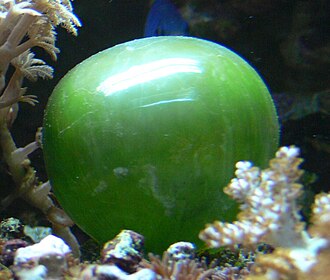
图:Haplochromis · Public domain · Wikimedia Commons
- 学名
- Ulvophyceae
- 分类等级
- 纲
- 上级类群
- 绿藻亚门
- 大类
- 其他植物
- 命名
- Karl R. Mattox、Kenneth D. Stewart,1984 年
- 数据库
- NCBI 分类 · GBIF
下级类群(6)
百科正文
石莼纲在栖地和形态学较多变而不易辨别。藻体大部分是由叶状体 (类似陆地植物的叶片)所构成。
分类
截至2018年3月22日 (2018-03-22),本纲包括下列各科:
羽藻目 Bryopsidales:旧属羽藻纲 (Bryopsidophyceae)
- 刚毛藻目 Cladophorales
- 似松藻目 Codiolales
- 绒枝藻目 Dasycladales
- Order Oltmannsiellopsidales
- Order Scotinosphaerales
- 管枝藻目 Siphonocladales
- 桔色藻目 Trentepohliales
- 丝藻目 Ulotrichales:亦作软丝藻目
- 石莼目 Ulvales
- Order Ulvophyceae incertae sedis
以上内容摘自维基百科「石蓴綱」,按 CC BY-SA 4.0 使用,去掉了参考文献、外部链接等尾部小节,公式改写成了纯文本。全文、配图和出处见原文。
英文维基百科补充中文条目比较短,下面是英文条目「Ulvophyceae」的原文
The Ulvophyceae or ulvophytes are a class of green algae, distinguished mainly on the basis of ultrastructural morphology, life cycle and molecular phylogenetic data. The sea lettuce, Ulva, belongs here. Other well-known members include Caulerpa, Codium, Acetabularia, Cladophora, Trentepohlia and Monostroma.
The Ulvophytes are diverse in their morphology and their habitat. Most are seaweeds such as those listed above. Others, such as Rhizoclonium, Pithophora and some species of Cladophora live in fresh water and in some areas are considered weeds.
Morphology
Ulvophycean algae are diverse in morphology. The thalli are typically colonial (some are unicellular). A few taxa have flagella in their vegetative stage, such as Oltmannsiellopsis. Common forms include filaments (both unbranched and branched), tubular and blade-like thalli (such as in Ulva), and siphonous thalli. Siphonous thalli are composed of a single giant cell (siphon) with thousands of nuclei and chloroplasts.
The life cycle of members of the Ulvophyceae are similarly diverse. Species often reproduce asexually by forming aplanospores, akinetes or zoospores; zoospores have two or four flagella. Asexual reproduction may also occur through fragmentation of the thallus, where the pieces of the thallus grow into a new organism. Sexual reproduction is isogamous or anisogamous, and may be haplontic or diplohaplontic (i.e., involving an alternation of generations). In several taxa, the zygote exists as a small, microscopic dormant stage (also interpreted as a unicellular sporophyte) and is called the Codiolum phase.
Ultrastructure
The class Ulvophyceae was originally defined by K. R. Mattox and K. D. Stewart based on ultrastructural characters. These were: a counter-clockwise arrangement of the flagellar basal bodies, cytokinesis by furrowing, a closed persistent mitotic spindle, and the lack of a phycoplast.
Ecology
The Ulvophyceae are most diverse in marine habitats. A substantial number of species also live in brackish or freshwater habitats; in temperate regions they are typically most abundant during the spring and summer months. They may be found in still (e.g. lakes and ponds) or flowing waters (e.g. rivers and streams); they are typically attached to a substrate such as rocks, sediments, other aquatic algae, or occasionally animals like turtles or mollusc shells. Similarly, some species live in terrestrial habitats growing on soil, rocks, trees, plants, and other artificial substrates.
Ulvophycean algae are often beneficial to their habitats; for example, Cladophora has been described as an ecosystem engineer and provides a range of niches for other aquatic organisms. However, Cladophora and a few other taxa, such as Pithophora and Ulva often form nuisance blooms due to eutrophication.
Some species of ulvophytes are endosymbiotic within other algae, such as Ulvella which grows within other filamentous algae. Within the terrestrial order Trentepohliales, some taxa form symbioses with lichens as their phycobionts. Marine lichens also host some Ulvophyceae as symbionts; the diversity of these symbiotic algae is currently under-studied.
Evolution
The origin and early diversification of the Ulvophyceae likely took place in the late Neoproterozoic, though may have taken place earlier, in the Mesoproterozoic. Although most contemporary ulvophytes are marine macroalgae (seaweeds), ancestral ulvophytes may have been freshwater, unicellular green algae. Molecular phylogenetic evidence suggests that macroscopic growth was achieved independently in the various major lineages of Ulvophyceae (Ulvales-Ulotrichales, Trentepohliales, Cladophorales, Bryopsidales and Dasycladales).
The fossil record of Ulvophyceae is generally sparse, as most algae do not biomineralize well. Nevertheless, some orders such as the Dasycladales and Bryopsidales have calcified thalli and a more extensive fossil record. The earliest known representative is the Cladophorales Proterocladus antiquus from the Mesoproterozoic-Neoproterozoic boundary in North China. However, its taxonomic placement is not certain.
Because Ulvophyceae lacks a consistent set of ultrastructural characteristics, its monophyly has been questioned. Molecular phylogenetic studies have found Ulvophyceae to be monophyletic, albeit without strong support. The internal relationships between the different clades is also unclear.
以上节选摘自英文维基百科「Ulvophyceae」,按 CC BY-SA 4.0 使用,去掉了参考文献、外部链接等尾部小节,公式改写成了纯文本。篇幅所限,较长的小节只摘了开头一部分,有的小节没有收;全文、配图和出处见原文。