 格物
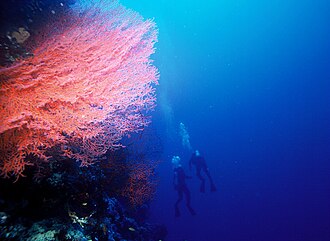
图:Albert Kok at Dutch Wikipedia (Original text: Albert Kok) · Public domain · Wikimedia Commons
- 学名
- Octocorallia
- 分类等级
- 纲
- 上级类群
- 珊瑚亚门
- 大类
- 其他动物
- 数据库
- NCBI 分类
下级类群(6)
百科正文
系统发育
- 在系统发育方面,八放珊瑚亚纲是一种单系群。过往的八放珊瑚亚纲可分为六个目:
- 海鸡冠目(Alcyonacea):又名软珊瑚目,包括了海鸡冠、手指珊瑚等
- 柳珊瑚目(Gorgonacea):又名角珊瑚目,包括了海鞭、海扇等
匍匐珊瑚目(Stolonifera):又名笙珊瑚目或走根珊瑚目,包括了草皮珊瑚等
- 苍珊瑚目(Helioporacea):又名蓝珊瑚目、共鞘目
- 海笔目(Pennatulacea):又名海螅目,包括了海笔、海仙人掌等
- 而现在的分类如下:
- 软珊瑚目(Malacalcyonacea)
- 硬软珊瑚目 (Scleralcyonacea)
世界海洋物种目录在2022将全轴珊瑚亚目(Holaxonia)、原海鸡冠亚目(Protoalcyonaria)、骨轴珊瑚亚目(Scleraxonia)、软珊瑚亚目(Alcyoniina)、匍匐珊瑚亚目(Stolonifera)并成软珊瑚目(Malacalcyonacea)。而钙轴珊瑚亚目(Calcaxonia)分出去成为硬软珊瑚目(Scleralcyonacea)。苍珊瑚目(Helioporacea)改成苍珊瑚科(Helioporidae),海笔目(Pennatulacea),则变成海笔亚目(Pennatuloidea)。
以上内容摘自维基百科「八放珊瑚亞綱」,按 CC BY-SA 4.0 使用,去掉了参考文献、外部链接等尾部小节,公式改写成了纯文本。全文、配图和出处见原文。
英文维基百科补充中文条目比较短,下面是英文条目「Octocorallia」的原文
Octocorallia, along with Hexacorallia, is one of the two extant classes of Anthozoa. It comprises over 3,000 species of marine and brackish animals consisting of colonial polyps with eight-fold symmetry, commonly referred to informally as "soft corals". It was previously known by the now-unaccepted scientific names Alcyonacea and Gorgonacea, both deprecated c. 2022, and by the also deprecated name of Alcyonaria, in earlier times.
Its only two orders are Malacalcyonacea and Scleralcyonacea, which include corals such as those under the common names of blue corals, sea pens, and gorgonians (sea fans and sea whips). These animals have an internal skeleton secreted by their mesoglea, and polyps with typically eight tentacles and eight mesenteries. As is the case with all cnidarians, their complex life cycle includes a motile, planktonic phase (a larva called planula), and a later characteristic sessile phase.
Octocorals have existed at least since the Ordovician period, as shown by Maurits Lindström's findings in the 1970s. A 2023 work suggested that the Cambrian fossil Pywackia may represent a Cambrian octocoral, and molecular techniques have even pointed to a Precambrian origin for Octocorallia. For instance, a 2021 study built a time-calibrated phylogenetic tree that has placed the origin of Octocorallia in the Ediacaran (578 Mya).
Biology
Octocorals resemble the stony corals in general appearance and the size of their polyps, but lack the distinctive stony skeleton. Also unlike the stony corals, each polyp has only eight tentacles, each of which is feather-like in shape, with numerous side branches, or pinnules.
Octocorals are colonial organisms, with numerous tiny polyps embedded in a soft matrix that forms the visible structure of the colony. The matrix is composed of mesogleal tissue, lined by a continuous epidermis and perforated by numerous tiny channels. The channels interconnect the gastrovascular cavities of the polyps, allowing water and nutrients to flow freely between all the members of the colony. The skeletal material, called coenenchyme, is composed of living tissue secreted by numerous wandering amoebocytes. Although it is generally soft, in many species it is reinforced with calcareous or horny material.
The polyp is largely embedded within the colonial skeleton, with only the uppermost surface, including the tentacles and mouth, projecting about the surface. The mouth is slit-like, with a single ciliated groove, or siphonoglyph, at one side to help control water flow. It opens into a tubular pharynx that projects down into a gastrovascular cavity that occupies the hollow interior. The pharynx is surrounded by eight radial partitions, or mesenteries, that divide the upper part of the gastrovascular cavity into chambers, one of which connects to the hollow space inside each tentacle. The gonads are located near the base of each mesentery. Octocorals have high phenotypic plasticity from adapting to dynamic environments where temperature, pH, and other parameters are in constant flux and have shown high recruitment rates post-die-off events caused by El Niño events.
Bioluminescence is found in 32 genera, a trait estimated to have evolved 540 million years ago, the earliest timing of emergence of bioluminescence in the marine environment.
Phylogeny
Octocorallia is considered to be monophyletic, meaning that all contained species are descended from a common ancestor, but the relationships between subdivisions are not well known. The sea pens (Pennatulacea) and blue coral (Helioporacea) continue to be assigned separate orders, whereas the current order Alcyonacea was historically represented by four orders: Alcyonacea, Gorgonacea, Stolonifera and Telestacea.
Unplaced taxa
The following taxa are unplaced within Octocorallia according to the World Register of Marine Species as of April 2024:
- Families:
- Haimeidae Wright, 1865
- Pseudogorgiidae Utinomi & Harada, 1973
- Genera:
以上内容摘自英文维基百科「Octocorallia」,按 CC BY-SA 4.0 使用,去掉了参考文献、外部链接等尾部小节,公式改写成了纯文本。全文、配图和出处见原文。