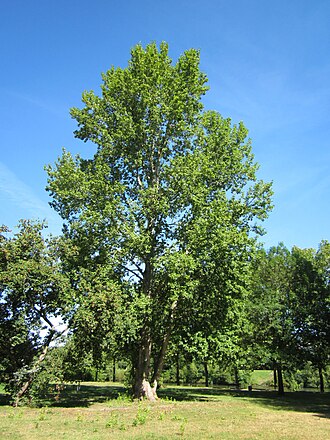
格物

图:Jakub Hałun · CC BY-SA 3.0 · Wikimedia Commons
- 学名
- Populus alba
- 分类等级
- 种
- 上级类群
- 杨属
- 大类
- 被子植物
- 命名
- 卡尔·林奈,1753 年
- 中文别名
- 河北杨、银白杨叶
- 保护状况(IUCN)
- 无危物种
- 用途
- 药用植物
- 数据库
- NCBI 分类 · GBIF · IUCN 红色名录
百科正文
其种加词“alba”意为“白色的”。
形态
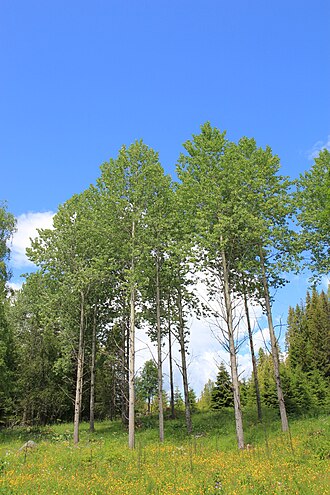
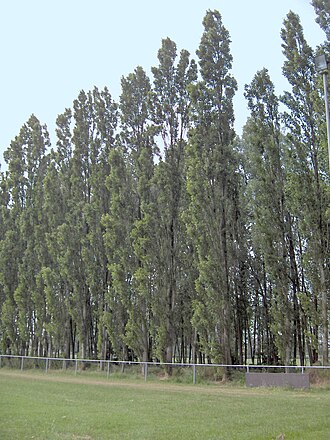
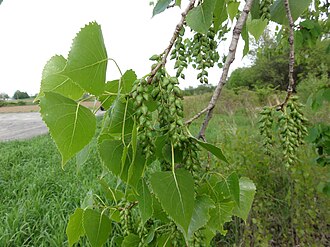
落叶乔木,高可达35米。灰白色树皮;芽、幼枝、叶下面及叶柄均密被白色绒毛;宽卵形、三角状卵形(长枝上)或卵形(短枝上)叶子,3-5掌状缺裂,裂缘有粗缺齿。
分布
分布于北非、亚洲西北部、欧洲以及东亚的中国西北、及山西、河北、河南、山东、辽宁等地,生长于海拔120米至3,800米的地区。沙荒、轻碱土均可生长。
异名
Populus alba L. var. bachofenii (Wierzb.) Wesmael.
Populus alba L. var. pyramidalis Bunge
以上内容摘自维基百科「银白杨」,按 CC BY-SA 4.0 使用,去掉了参考文献、外部链接等尾部小节,公式改写成了纯文本。全文、配图和出处见原文。
英文维基百科补充中文条目比较短,下面是英文条目「Populus alba」的原文
Populus alba, commonly called silver poplar, silverleaf poplar, white poplar, or abele, is a species of poplar, most closely related to the aspens (Populus sect. Populus). It is native to a region spanning from the Atlas Mountains of Africa, through most of South and Central Europe, into Central Asia; it has been introduced to many temperate, moist regions worldwide. It grows in moist sites, often by watersides, in regions with hot summers and cold to mild winters.
Description
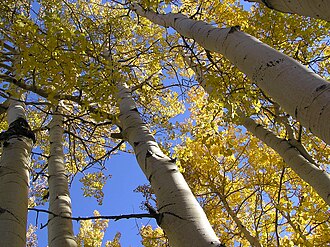
It is a medium-sized deciduous tree, growing to heights of up to 15–30 m (49–98 ft) (rarely more), with a trunk up to 2 m (6.6 ft) in diameter and a broad, rounded crown. The bark is smooth and greenish-white to greyish-white with characteristic diamond-shaped dark marks on young trees, becoming blackish and fissured at the base of old trees. The young shoots are covered with whitish-grey down, including the small buds. The leaves are 4–15 cm (1+1⁄2–6 in) long, five-lobed, with a thick covering of white scurfy down on both sides, but thicker underneath; this layer wears off 8 cm (3+1⁄4 in) long, produced in early spring; they are dioecious, with male and female catkins on separate trees; the male catkins are grey with conspicuous dark red stamens, the female catkins are greyish-green. The female catkins lengthen to 8–10 cm (3+1⁄4–4 in) after pollination, with several green seed capsules, maturing in late spring to early summer.
Hybridization
White poplar hybridizes with the closely related common aspen Populus tremula; the resulting hybrid, known as grey poplar (Populus × canescens), is intermediate between its parents, with a thin, grey, downy coating on the leaves, which are also much less deeply lobed than white poplar leaves. It exhibits marked hybrid vigour, reaching 40 m (130 ft) tall and a trunk diameter over 1.5 m (4 ft 11 in), much larger than either of its parents. Most grey poplars in cultivation are male, but female trees occur naturally and some of these are also propagated.
Cultivation and uses
The wood is soft but close-grained and easy to carve, shrinking very little during seasoning. It has been used for sculpture from Europe to China and the US. The Penitent Magdalene by Donatello is one 15th-century example.
It was the most commonly used wood for panel paintings in Italy throughout the Middle Ages and Renaissance, until mostly replaced as a matrix by canvas from 1500 onwards. Most earlier Italian Renaissance paintings are painted on poplar panels, the Mona Lisa being but one example.
White poplar requires abundant light and ample moisture, and stands up well to flood water and slightly acidic soils. Its green-and-white leaves make it an effective ornamental tree, but the root suckers may cause problems in some situations. It is very attractive as an open-grown tree in water meadows, and because of its extensive root system and tolerance of salt, is also planted to strengthen coastal sand dunes.
A yellow dye is produced from the bark of the white poplar.
History
An Old English name abele, now not used, is derived from the Latin albellus, white, by way of Old French aubel and Low German name abeel.
Leuce/Leuka, the "White Poplar"; Leuce or Leuka (Ancient Greek: Λεύκη) ("White" or specifically "White Poplar") was the most beautiful of the nymphs and an Oceanid, a daughter of Oceanus. Hades fell in love with her and abducted her to the underworld. She lived out the span of her life in his realm, and when she died, the god sought consolation by creating a suitable memorial of their love: In the Elysian Fields, where the pious spend their afterlives, he brought forth a white tree into existence from her body, which became sacred for him from that moment on. In Ancient Greco-Roman mythology, it is a symbol of a peaceful afterlife and a memory of those we love who have died. Herakles crowned himself with this tree to celebrate his return from the underworld.
Invasive potential
The white poplar is an invasive species in many parts of Australia. In Western Australia, it has formed dense stands in disturbed wetlands from Perth to Albany and it is considered a threat to riparian vegetation in Victoria. It has spread along the Murrumbidgee River and in wet areas in rural parts of the Australian Capital Territory. Despite that, it is still sold in nurseries around Australia. White poplar is also an environmental weed in South Africa.
以上节选摘自英文维基百科「Populus alba」,按 CC BY-SA 4.0 使用,去掉了参考文献、外部链接等尾部小节,公式改写成了纯文本。篇幅所限,较长的小节只摘了开头一部分,有的小节没有收;全文、配图和出处见原文。