 格物
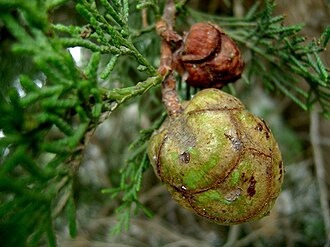
图:Taoujouti Abdelmouhaïmen · CC BY-SA 4.0 · Wikimedia Commons
- 学名
- Cupressus sempervirens
- 分类等级
- 种
- 上级类群
- 柏木属
- 大类
- 其他植物
- 命名
- 卡尔·林奈,1753 年
- 中文别名
- 柱形地中海柏木
- 保护状况(IUCN)
- 无危物种
- 数据库
- NCBI 分类 · GBIF · IUCN 红色名录
百科正文
英文维基百科补充中文条目比较短,下面是英文条目「Cupressus sempervirens」的原文
Cupressus sempervirens, the Mediterranean cypress, Italian cypress, Tuscan cypress, or Persian cypress, is a species of conifer in the family Cupressaceae, a cypress native to the eastern Mediterranean region and Iran. It is widespread throughout the Mediterranean basin and has become endemic in similar dry summer climates due to its ability to survive in both acidic and alkaline soils and withstand drought.
Cupressus sempervirens is important in Mediterranean and Middle Eastern culture; it has long been valued for its role in symbolism, various rituals, and folk medicine. In Iran it is both a sacred tree and a metaphor for "the graceful figure of the beloved". It is popular around the world as an ornamental tree and has been studied for possible medicinal properties.
In Israel, vestiges of wild specimens can be found but the majority of Mediterranean cypress trees are the result of intentional reforestation on the behalf of the JNF, and are common at cemeteries, parks, and within wooded areas.
Description
Cupressus sempervirens is a medium-sized coniferous tree growing up to 35 m (115 ft) tall, with a conic crown with level branches and variably loosely hanging branchlets. It is very long-lived, with some trees reported to be over 1,000 years old.
Cupressis sempervirens produces lateral shoots, or branches, which often grow upwards towards a light source. The foliage grows in dense, dark green sprays. The leaves are scale-like, 2–5 mm long, and produced on rounded (not flattened) shoots. The seed cones are ovoid or oblong and 25–40 mm long. The cones have 10–14 scales, which are green at first and mature to brown about 20–24 months after pollination. The male cones are 3–5 mm long and release highly allergenic pollen in late winter. The cones of C. sempervirens can withstand years of being sealed and are known to perform serotiny. The tree is moderately susceptible to cypress canker, caused by the fungus Seiridium cardinale, and can suffer extensive dieback where this disease is common.
Uses
C. sempervirens has been widely cultivated as an ornamental tree for millennia outside its native range, mainly throughout the Mediterranean region and in other areas with similar hot, dry summers and mild, rainy winters, including California, southwest South Africa, and southern Australia. It can also be grown successfully in areas with cooler, moister summers, such as the British Isles, New Zealand, and the Pacific Northwest, as well as in humid, subtropical environments such as the coastal southern United States. In some areas, particularly the United States, it is known as "Italian" or "Tuscan cypress". Within its native range, C. sempervirens has historically been planted in gardens and cemeteries and used as a windbreak alongside roads. The tree can also prevent damage to land caused by violent weather.
Habitats
Cupressus sempervirens grows primarily in places with wet winters and hot summers; in the spring and autumn, the tree grows out its roots, stems, and leaves. Like most plants, it requires light for such growth. Because the tree must survive wet winters and hot, dry summers, its roots are adapted to be stout and shallow for easier gathering of the nutrients in the soil. The roots are adapted to function in both acidic and alkaline soils.
In culture
Iran
In Persian, C. sempervirens is called the "Graceful Cypress" (sarv-e nāz), and has a strong presence in culture, poetry and gardens. It bears several metaphors, including the "graceful figure and stately gait of [the] beloved". Iranians considered cypress to be a relic of Zoroaster. A Zoroastrian tradition recorded by Daqiqi maintains that King Vishtaspa, after converting to Zoroastrianism, ordered a cypress brought from paradise by Zoroaster to be planted near the first fire temple.
The oldest living cypress is possibly the Sarv-e-Abarkooh in Iran's Yazd Province; it is estimated to be approximately 4,000 years old, although its exact age has not been determined.
Symbolism
In classical antiquity, the cypress was a symbol of mourning, and in the modern era, it remains the principal cemetery tree in both the Muslim world and Europe.
以上节选摘自英文维基百科「Cupressus sempervirens」,按 CC BY-SA 4.0 使用,去掉了参考文献、外部链接等尾部小节,公式改写成了纯文本。篇幅所限,较长的小节只摘了开头一部分,有的小节没有收;全文、配图和出处见原文。