 格物
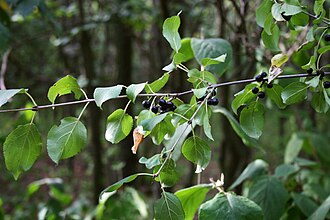
图:Franz Xaver · CC BY-SA 3.0 · Wikimedia Commons
- 学名
- Rhamnus cathartica
- 分类等级
- 种
- 上级类群
- 鼠李属
- 大类
- 被子植物
- 命名
- 卡尔·林奈,1753 年
- 中文别名
- 药鼠李实
- 保护状况(IUCN)
- 无危物种
- 用途
- 药用植物
- 数据库
- NCBI 分类 · GBIF · IUCN 红色名录
百科正文
用途
可当作一种结肠的清洁剂及通便剂,对结肠障碍、便秘以及寄生虫感染很有效。当成茶来服用时,味道非常苦。
以上内容摘自维基百科「药鼠李」,按 CC BY-SA 4.0 使用,去掉了参考文献、外部链接等尾部小节,公式改写成了纯文本。全文、配图和出处见原文。
英文维基百科补充中文条目比较短,下面是英文条目「Rhamnus cathartica」的原文
Rhamnus cathartica, the European buckthorn, common buckthorn, purging buckthorn, or just buckthorn, is a species of small tree in the flowering plant family Rhamnaceae. It is native to Europe, northwest Africa and western Asia, from the central British Isles south to Morocco, and east to Kyrgyzstan. It was introduced to North America as an ornamental shrub in the early 19th century, and is now naturalized and classified as an invasive species in the northern United States and Canada from Saskatchewan to Nova Scotia.
Description
Rhamnus cathartica is a deciduous, dioecious shrub or small tree growing up to 10 metres (33 ft) tall, with grey-brown bark and often spiny branches. The leaves are elliptic to oval, 25–90 mm (1–3+1⁄2 in) long and 12–35 mm (1⁄2–1+3⁄8 in) broad; they are green, turning yellow in autumn, have toothed margins, and are arranged somewhat variably in opposite to subopposite pairs or alternately. The flowers are yellowish-green with four petals; they are dioecious and insect pollinated and bloom in April–June. The fruit is a globose black drupe, 6–10 mm (1⁄4–3⁄8 in) across, and contains two to four seeds.
In addition to the kindred Frangula alnus, Rhamnus cathartica may be visually confused with a plant of another family, Cornus sanguinea.
The species was originally named by Carl Linnaeus as Rhamnus catharticus, but this spelling was corrected to cathartica as the genus name Rhamnus is treated as being of feminine gender.
Toxicity
The seeds and leaves are mildly poisonous for humans and most other animals, but are readily eaten by birds, who disperse the seeds in their droppings. The toxins cause stomach cramps and laxative effects that may function in seed dispersal. The chemical compounds responsible for this laxative effect are anthraquinone and emodin. The species name cathartica and the common name purging buckthorn refer to this effect.
In 1994, R. cathartica was implicated in the outbreak of an idiopathic neurological disease in horses, although no causative agent was officially identified. In trials where rodents were fed the leaves and stems of R. cathartica, glycogen metabolism became abnormal and glycogen deposits formed in the cytoplasm of liver cells. Abnormalities in glycogen metabolism lead to diabetes in humans.
Ecology
Rhamnus cathartica is shade-tolerant, moderately fast-growing and short-lived. It is a food plant of the brimstone butterfly, Gonepteryx rhamni. The sulphur-yellow males are indicative of the presence of this species or of its alternative host, Frangula alnus.
Rhamnus cathartica is the alternate host for the rust disease of cereals caused by Puccinia coronata. Crown rust fungus results in leaf damage and reductions in photosynthesis during its transit in this species.
Rhamnus cathartica is also the primary overwintering host in North America for a significant agricultural pest of soybeans, the soybean aphid.
Allelopathy
Secondary compounds, particularly emodin, have been found in the fruit, leaves, and bark of the plant, and may protect it from insects, herbivores and pathogens. The emodin present in R. cathartica fruit may prevent early consumption, as it is found most in unripe fruits, which allows seeds to reach maturity before being dispersed. Birds and mice significantly avoid eating unripe fruits, and if forced to ingest emodin or unripe fruit, the animals regurgitate the meal or produce loose, watery stools. Rhamnus cathartica is a constitutive isoprene emitter
Allelopathic effects of exudates from R. cathartica leaf litter, roots, bark, leaves and fruit may reduce germination of other plant species in the soil. Soils in buckthorn-dominated areas are higher in nitrogen and carbon than normal soils, which speeds up decomposition rates of leaf litter. This can result in bare patches of soil being formed and R. cathartica performs well in such disturbed habitats, so this may be adaptive for the setting of its seed.
Uses
The bark and fruit of Rhamnus cathartica were used as a purgative in traditional medicine, but is generally no longer used for this purpose on account of the fruit's violent action and potentially dangerous effects on the body. It also appeared to be routinely used as a purgative in some monastic settings, as was clear from the latrine pits of the Benedictine Abbey at St Albans excavated in the 1920s, where great numbers of buckthorn seeds were found mixed up with the fragments of cloth used by the monks as lavatory paper.
The wood is hard and dense, and the bark yields a dye.
以上节选摘自英文维基百科「Rhamnus cathartica」,按 CC BY-SA 4.0 使用,去掉了参考文献、外部链接等尾部小节,公式改写成了纯文本。篇幅所限,较长的小节只摘了开头一部分,有的小节没有收;全文、配图和出处见原文。