 格物
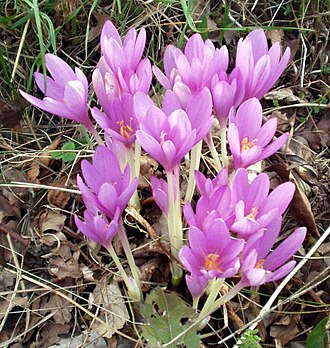
图:Stemonitis · Public domain · Wikimedia Commons
- 学名
- Colchicum autumnale
- 分类等级
- 种
- 上级类群
- 秋水仙属
- 大类
- 被子植物
- 命名
- 卡尔·林奈,1753 年
- 保护状况(IUCN)
- 无危物种
- 数据库
- NCBI 分类 · GBIF · IUCN 红色名录
分类阶元
百科正文
形态
多年生草本,地下具有卵形鳞茎。秋季先开淡红色花,第二年春天长出线形暗绿色叶子。
秋水仙的叶枯萎一段时间后,花梗才会从地上长出。
药用毒性
搜集者常将秋水仙误当作可食用的熊葱,因为两者未开花时外形十分相似,开花后秋水仙花朵的外形又极似番红花。但是,秋水仙全株含有剧毒的生物碱秋水仙素,其中以球茎含量最高,因此有致命危险。秋水仙可用于治疗痛风,但其治疗指数很低。秋水仙素的中毒症状与砷中毒症状有些类似,而且没有解毒剂。秋水仙素常用于诱导植物细胞发生多倍性。
灭绝威胁
2008年1月18日,有120个国家参与的国际植物园保护联盟(BGCI)称:“400种药用植物因过度开采和森林采伐而受到灭绝的威胁,对未来发现治愈疾病的方法造成了威胁。”这些植物包括红豆杉(树皮中所含的紫杉醇用来治疗癌症)、丽杯角属(Hoodia,产自纳米比亚,减肥药来源)、半数木兰属物种(中药中被用于治疗癌症、智力衰退和心脏病的历史达几千年之久)和秋水仙(用于治疗痛风)。联盟并发现全球有50亿人因传统医学的保健作用而得益。
以上内容摘自维基百科「秋水仙」,按 CC BY-SA 4.0 使用,去掉了参考文献、外部链接等尾部小节,公式改写成了纯文本。全文、配图和出处见原文。
英文维基百科补充中文条目比较短,下面是英文条目「Colchicum autumnale」的原文
Colchicum autumnale, commonly known as autumn crocus, meadow saffron, naked boys or naked ladies, is a toxic autumn-blooming flowering plant that resembles the true crocuses, but is a member of the plant family Colchicaceae, unlike the true crocuses, which belong to the family Iridaceae. It is called "naked boys/ladies" because the flowers emerge from the ground long before the leaves appear. Despite the vernacular name of "meadow saffron", this plant is not the source of saffron, which is obtained from the saffron crocus, Crocus sativus – and that plant, too, is sometimes called "autumn crocus".
The species is cultivated as an ornamental in temperate areas, in spite of its toxicity. The cultivar 'Nancy Lindsay' has gained the Royal Horticultural Society's Award of Garden Merit.
Description
This herbaceous perennial has leaves up to 25 cm (10 in) long. The flowers are solitary, 4–7 cm (2–3 in) across, with six tepals and six stamens with orange anthers and three white styles. At the time of fertilisation, the ovary is below ground.
Distribution and habitat
C. autumnale is the only species of its family native to Great Britain and Ireland, with notable populations under the stewardship of the County Wildlife Trusts. It also occurs across mainland Europe from Portugal to Ukraine, and is reportedly naturalised in Sweden, European Russia, and New Zealand. It grows in lowland grassy meadows.
Pharmaceutical uses
The bulb-like corms of C. autumnale contain colchicine, a useful drug with a narrow therapeutic index. Colchicine is approved in many countries for the treatment of gout and familial Mediterranean fever. Colchicine is also used in plant breeding to produce polyploid strains.
Toxicity
Colchicum is lethally toxic due to its colchicine content. Its leaves have been mistaken by foragers for those of Allium ursinum (ramsons or wild garlic), which they vaguely resemble.
This plant (and colchicine itself) poses a particular threat to felines. The corms of meadow saffron contain the highest level of toxins, but all parts of the plant are regarded as poisonous.
以上内容摘自英文维基百科「Colchicum autumnale」,按 CC BY-SA 4.0 使用,去掉了参考文献、外部链接等尾部小节,公式改写成了纯文本。全文、配图和出处见原文。