 格物
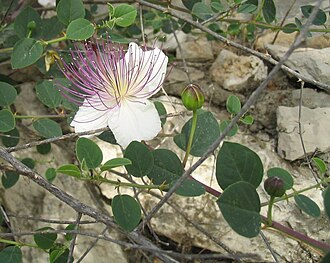
图:Public domain · Wikimedia Commons
生命之树 › 真核生物 › 植物 › 绿色植物 › 链型植物 › 十字花目 › 山柑科 › 山柑属
刺山柑种
Capparis spinosa
刺山柑,又名马槟榔、棘风蝶木、西洋风蝶木、酸豆、水瓜柳、水瓜榴或是水瓜钮,是一种多年生的有刺半蔓性灌木,属于山柑科山柑属。刺山柑在台湾常被称为续随子,但真正的续随子是大戟属植物。刺山柑的叶厚身、对生、呈鹅卵形,有大大的白色到粉白色的花朵。原产于地中海的刺山柑,会在石墙或岩岸生长。当地人会把植物的果实腌制,可作调味用途。花蕾及果实可食用,但一般都会先腌制。每100g含332 mg黄酮类化合物芦丁,芦丁是一种1930年代中期到1950年代被称为维生素P的物质。
摘自维基百科「刺山柑」,CC BY-SA 4.0
- 学名
- Capparis spinosa
- 分类等级
- 种
- 上级类群
- 山柑属
- 大类
- 被子植物
- 命名
- 卡尔·林奈,1753 年
- 中文别名
- 山柑、老鼠瓜、刺山柑根皮
- 保护状况(IUCN)
- 无危物种
- 用途
- 药用植物
- 数据库
- NCBI 分类 · GBIF · IUCN 红色名录
百科正文
历史
早在旧石器时代晚期,地中海地区和美索不达米亚就发现了关于刺山柑的考古植物学证据。
描述
灌木状植物分枝繁多,叶片互生,厚实且有光泽,呈圆形到卵形不等。花为两性花,带有甜美的香气且十分显眼,由四枚萼片和四枚白色至略带粉色的花瓣组成,并具有许多细长的紫色雄蕊,以及一个通常明显高于雄蕊的单一柱头。
分布
刺山柑原产于地中海沿岸,主要栽培地在法国、意大利及西班牙。
食用
刺山柑的独特风味来自果实和花蕾中的癸酸,可用于料理的药味或沙拉中使用:一般的做法,是把刺山柑的花蕾腌制待用。熏鲑鱼的独特香味亦是源于刺山柑。除了癸酸以外,花蕾及果实还含有芸香甙、阿魏酸和芥子酸。亦有把刺山柑与牛油混和,然后涂在面包上食用,或用来作披萨饼的馅料。
盐渍腌制的刺山柑花蕾可作为食材、调味料或装饰使用。刺山柑是地中海菜系中的常见食材,尤其在塞浦路斯、意大利、爱奥尼亚希腊和马耳他菜系中更为常见。
用途
多酚
腌制刺山柑含有多酚类物质,其中包括黄酮类化合物槲皮素(每100克含173毫克)和山柰酚(每100克含131毫克),以及花青素
其他用途
刺山柑有时被用于化妆品中。
以上内容摘自维基百科「刺山柑」,按 CC BY-SA 4.0 使用,去掉了参考文献、外部链接等尾部小节,公式改写成了纯文本。全文、配图和出处见原文。
英文维基百科补充中文条目比较短,下面是英文条目「Caper」的原文
Capparis spinosa, the caper bush, also called Flinders rose, is a perennial plant that bears rounded, fleshy leaves and large white to pinkish-white flowers.
The taxonomic status of the species is controversial and unsettled. Species within the genus Capparis are highly variable, and interspecific hybrids have been common throughout the evolutionary history of the genus. As a result, some authors have considered C. spinosa to be composed of multiple distinct species, others that the taxon is a single species with multiple varieties or subspecies, or that the taxon C. spinosa is a hybrid between C. orientalis and C. sicula.
Capparis spinosa is native to almost all the circum-Mediterranean countries, and is included in the flora of most of them, but whether it is indigenous to this region is uncertain. The family Capparaceae could have originated in the tropics and later spread to the Mediterranean basin.
The plant is best known for the edible flower buds (capers), used as a seasoning or garnish, and the fruit (caper berries), both of which are usually consumed salted or pickled. Other species of Capparis are also picked along with C. spinosa for their buds or fruits. Other parts of Capparis plants are used in the manufacture of medicines and cosmetics.
Description
The shrubby plant is many-branched, with alternate leaves, thick and shiny, round to ovate. The flowers are complete, sweetly fragrant, and showy, with four sepals and four white to pinkish-white petals, many long violet-coloured stamens, and a single stigma usually rising well above the stamens.
Accepted infraspecifics
Eleven subspecies and variants are accepted, according to Plants of the World Online:
Capparis spinosa var. aegyptia (Lam.) Boiss.
Capparis spinosa var. atlantica (Inocencio, D.Rivera, Obón & Alcaraz) Fici
Capparis spinosa var. canescens Coss.
- Capparis spinosa subsp. cordifolia (Lam.) Fici
- Capparis spinosa var. herbacea (Willd.) Fici
- Capparis spinosa var. mucronifolia (Boiss.) Hedge & Lamond ex R.R.Stewart
- Capparis spinosa var. myrtifolia (Inocencio, D.Rivera, Obón & Alcaraz) Fici
Capparis spinosa var. ovata (Desf.) Sm.
Distribution and habitat
Capparis spinosa ranges around the Mediterranean Basin, Arabian Peninsula, and portions of Western and Central Asia.
In southern Europe, it is found in southern Portugal, southern and eastern Spain (including the Balearic Islands), Mediterranean France including Corsica, Italy including Sicily and Sardinia, Malta, Croatia's Dalmatian islands, Albania, Greece and the Greek Islands, western and southern Turkey, on Cyprus, and on the Crimean Peninsula in Ukraine. In Spain, it ranges from sea level up to 1,300 metres (4,300 ft) in elevation.
Agriculture
Capers can be grown easily from fresh seeds gathered from ripe fruit and planted into a well-drained seed-raising mix. Seedlings appear in two to four weeks. Old, stored seeds enter a state of dormancy and require cold stratification to germinate. The viable embryos germinate within three to four days after partial removal of the lignified seed coats. The seed coats and the mucilage surrounding the seeds may be ecological adaptations to avoid water loss and conserve seed viability during the dry season.
Uses
Nutrition
Canned, pickled capers are 84% water, 5% carbohydrates, 2% protein, and 1% fat. Preserved capers are particularly high in sodium due to the amount of salt added to the brine. In a typical serving of 28 grams (one ounce), capers supply 6 kcal and 35% of the Daily Value (DV) for sodium, with no other nutrients in significant content. In a 100-gram amount, the sodium content is 2350 mg or 102% DV, with vitamin K (21% DV) and riboflavin (11% DV) also having appreciable levels.
History
Archaeobotanical evidence of capers has been found in the Mediterranean region and Mesopotamia as early as the Upper Paleolithic period.
The caper was used in ancient Greece as a carminative. It is represented in archaeological levels in the form of carbonised seeds and rarely as flower buds and fruits from archaic and classical antiquity contexts. Athenaeus in Deipnosophistae pays a lot of attention to the caper, as do Pliny (NH XIX, XLVIII.163) and Theophrastus.
以上节选摘自英文维基百科「Caper」,按 CC BY-SA 4.0 使用,去掉了参考文献、外部链接等尾部小节,公式改写成了纯文本。篇幅所限,较长的小节只摘了开头一部分,有的小节没有收;全文、配图和出处见原文。