 格物
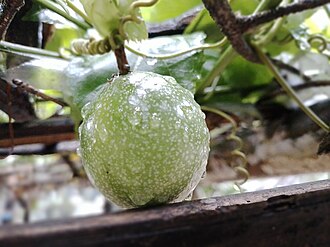
图:Rarani · CC BY-SA 4.0 · Wikimedia Commons
- 学名
- Passiflora edulis
- 分类等级
- 种
- 上级类群
- 西番莲属
- 大类
- 被子植物
- 命名
- John Sims,1818 年
- 中文别名
- 鸡蛋果、洋石榴、紫果西番莲、西番莲尖
- 用途
- 药用植物、食物
- 数据库
- NCBI 分类 · GBIF
百科正文
名称
西番莲自西班牙语转译至英语称passion fruit,意即“受难果”,“百香果”这个名称实际上是“passion”一字为音译。当时西班牙传教士发现其花的形状极似基督之十字架刑具,柱头上3个分裂,极似3根钉,花瓣红斑、恰似耶稣头部被荆棘刺出血形象,5个花药,恰似钉子或伤痕。西班牙人以Passioflos名之,直译为受难花(Passion Flower)。但英语中passion一词还有“热情”之意,故也常被误译为“热情果”,与原意无关。Passiflora,大约在公元1700年,此名称在巴西的西班牙传教士向原住民传教的教材中提到。
西番莲的花有五片花萼和五片花瓣,白色花瓣像时钟的钟面,由紫色转白色的丝状放射副花冠如像时钟之刻痕。雄蕊5枝,像钟上的字盘,雌蕊花柱3歧,柱头3裂,像钟上的时针、分针、秒针;所以在日本称为时计果。
此果在中文地区的常见不同名称:
台湾:百香果,因台湾于1907年由日本人田代安定从石川植物园引进,野化,所以也称时计果(台语,sî-kè-kó),时钟瓜(台语,sî-tsing-kue),客家人称tokeisō(时计草日语音)。
中国大陆:西番莲、热情果、百香果、鸡蛋果。
香港:热情果、百香果、西番果、巴西果(但巴西坚果也被称为巴西果,易混淆)。
营养
生西番莲含有73%的水分、22%的碳水化合物、2%的蛋白质与0.7%的脂肪(见表)。每100克(3.5盎司)的生西番莲提供97卡路里的热量,是维生素C(33%每日摄入量)的丰富来源(指比每日摄入量的20%更多),也是核黄素与钾的中等来源(10-19%每日摄入量)(见表)。其他微量营养素的含量不显著。
其他
甜西番莲
以上内容摘自维基百科「西番莲」,按 CC BY-SA 4.0 使用,去掉了参考文献、外部链接等尾部小节,公式改写成了纯文本。全文、配图和出处见原文。
英文维基百科补充中文条目比较短,下面是英文条目「Passiflora edulis」的原文
Passiflora edulis, commonly known as passion fruit, is a vine species of passion flower native to southern Brazil, through Paraguay, and northern Argentina. The fruit is a pepo, a type of botanical berry, round to oval, either yellow or dark purple at maturity, with a soft to firm, juicy interior filled with numerous seeds.
The plant is cultivated commercially in tropical and subtropical areas for its sweet, seedy fruit. This is both eaten and juiced, with the juice often added to other fruit juices to enhance aroma.
Etymology
The passion fruit is so called because it is the fruit of one of the many species of passion flower, the English translation of the Latin genus name, Passiflora. Around 1700, the name was given by missionaries in Brazil as an educational aid while trying to convert the indigenous inhabitants to Christianity; its name was flor das cinco chagas or "flower of the five wounds" to illustrate the crucifixion of Christ, with other plant components also named after an emblem in the Passion of Jesus.
Description
Passiflora edulis is a perennial vine; tendrils are borne in leaf axils, and have a red or purple hue when young. There are two main varieties: a purple-fruited type, P. edulis f. edulis, and the yellow-fruited P. edulis f. flavicarpa.
Usually the vine produces a single flower 5–7.5 cm wide at each node. The flower has 5 oblong, green sepals and 5 white petals. The sepals and petals are 4–6 mm in length and form a fringe. The base of the flower is a rich purple with 5 stamens, an ovary, and a branched style. The styles bend backward and the stigmas, which are located on top of the styles, have a very distinct head.
The fruit produced is a pepo and entirely fleshy (making it botanically a berry) and is spherical to ovoid. The outside color of the pepo ranges from dark purple with fine white specks to light yellow. The fruit is 4–7.5 cm in diameter; purple fruits are smaller, weighing around 35 grams, while yellow fruits are closer to 80 grams.
Distribution and habitat
The species is native to the region of southern Brazil through Paraguay to northern Argentina.
Cultivation
Passion fruit is widely grown in tropical and semitropical regions of the world. In the United States, it is cultivated in Florida, Hawaii, and California. It generally has to be protected from frost, although certain cultivars have survived light frosts after heavy pruning of affected areas.
Pollination
The flower of the yellow-fruited form of the passion fruit plant is self-sterile, while that of the purple-fruited form is self-compatible. In California, it is reported that pollination of flowers is most effective when done by the carpenter bee. There are three types of yellow passion fruit flowers, classified by curvature of style. To help assure the presence of carpenter bees, some gardeners place decaying logs near the vines, which provide shelter for the bees.
Diseases
Viruses
Passion fruit woodiness virus is one of the most well-known viruses to the passion fruit. It belongs to the Potyvirus group and can attack a plant at any age from nursery to mature plants.
Uses
Nutrition
Raw passion fruit is 73% water, 22% carbohydrates, 2% protein and 0.7% fat. In a reference amount of 100 g (3.5 oz), raw passion fruit supplies 97 calories and is a rich source (20% or more of the Daily Value, DV) of vitamin C (33% DV) and a moderate source (10–19% DV) of riboflavin and potassium. No other micronutrients are in significant content.
Culinary
Passion fruit has a variety of uses related to its favored taste as a whole fruit and juice.
In Australia and New Zealand, it is available commercially both fresh and tinned. It is added to fruit salads, and fresh fruit pulp or passion fruit sauce is commonly used in desserts, including as a topping for pavlova (a regional meringue cake) and ice cream, a flavouring for cheesecake, and in the icing of vanilla slices. A passion-fruit–flavored soft drink called Passiona has also been manufactured in Australia since the 1920s. It can be used in some alcoholic cocktails.
In culture
In 1884, the English Victorian painter Frank Dicksee anachronically represented a passion fruit vine growing up on a Solomonic column in his work Romeo and Juliet, today belonging to the Southampton City Art Gallery (United Kingdom). In 2006, singer-songwriter Paula Fuga released the popular song "Lilikoi", the Hawaiian language word for passion fruit; the song is featured on an album also named after the fruit.
以上节选摘自英文维基百科「Passiflora edulis」,按 CC BY-SA 4.0 使用,去掉了参考文献、外部链接等尾部小节,公式改写成了纯文本。篇幅所限,较长的小节只摘了开头一部分,有的小节没有收;全文、配图和出处见原文。