 格物
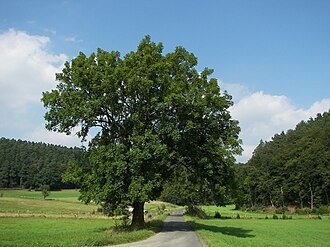
图:Willow · CC BY 2.5 · Wikimedia Commons
- 学名
- Fraxinus excelsior
- 分类等级
- 种
- 上级类群
- 梣属
- 大类
- 被子植物
- 命名
- 卡尔·林奈,1753 年
- 中文别名
- 欧梣
- 保护状况(IUCN)
- 近危物种
- 数据库
- NCBI 分类 · GBIF · IUCN 红色名录
百科正文
欧洲白蜡树通高30米,冬季有黑色芽苞。每小枝生有羽状小叶9至13枚,长20至30厘米,叶片呈深绿色,秋季变黄。极为耐寒。
以上内容摘自维基百科「欧洲白蜡树」,按 CC BY-SA 4.0 使用,去掉了参考文献、外部链接等尾部小节,公式改写成了纯文本。全文、配图和出处见原文。
英文维基百科补充中文条目比较短,下面是英文条目「Fraxinus excelsior」的原文
Fraxinus excelsior, known as the ash, or European ash or common ash to distinguish it from other types of ash, is a flowering plant species in the olive family Oleaceae. It is native throughout mainland Europe east to the Caucasus and Alborz mountains, and west to Great Britain and Ireland, the latter determining its western boundary. The northernmost location is in the Trondheimsfjord region of Norway. The species is widely cultivated and reportedly naturalised in New Zealand and in scattered locales in the United States and Canada. The wood has many uses as it is flexible, workable, strong and lightweight.
Description
It is a large deciduous tree growing to 12–18 m (39–59 ft) (exceptionally to 43 m or 141 ft) tall with a trunk up to 2 m (6.6 ft) (exceptionally to 3.5 m or 11 ft) diameter, with a tall, narrow crown. The bark is smooth and pale grey on young trees, becoming thick and vertically fissured on old trees. The shoots are stout, greenish-grey, with jet-black buds (which distinguish it from most other ash species, which have grey or brown buds).
Distribution
Fraxinus excelsior is native to Europe from northern Spain to Russia, and from southern Fennoscandia to northern Greece. It is also considered native in southwestern Asia from northern Turkey east to the Caucasus and Alborz mountains. The northernmost naturally occurring location is in the Trondheimsfjord region of Norway, though they are planted further north. The species is widely cultivated and reportedly naturalized in New Zealand and in scattered locales in the United States and Canada including Nova Scotia, New Brunswick, Quebec, Massachusetts, Connecticut, New York, New Jersey, Maryland, Ontario, Ohio, Kentucky and British Columbia.
Ecology
Ash occurs on a wide range of soil types, but is particularly associated with basic soils on calcareous substrates. The most northerly ashwood in Britain is on limestone at Rassal, Wester Ross, latitude 57.4278 N. Ash prefers moister soil types and is commonly limited by temperature and so not found at the higher colder altitudes in much of Europe, though in Iran, it may reach 2000 m asl. As a young seedling, it is shade tolerant, but older trees are light-demanding. It is an early-succession species and may well outcompete beech and oak, which are later-succession species.
Uses
The resilience and rapid growth made it an important resource for smallholders and farmers. It was probably the most versatile wood in the countryside with wide-ranging uses. Until World War II, the trees were often coppiced on a 10-year cycle to provide a sustainable source of timber for fuel and poles for building and woodworking. The colour of the wood ranges from creamy white to light brown, and the heart wood may be a darker olive-brown. Ash timber is hard, tough and very hard-wearing, with a coarse, open grain and a density of 710 kg/m3. It lacks oak's natural resistance to decay, and is not as suitable for posts buried in the ground.
Mythology
In the 13th-century Edda and other writing relating to Norse mythology, the vast ash tree Yggdrasil ("the steed (gallows) of Odin"), watered by three magical springs, serves as axis mundi, sustaining the nine worlds of the cosmos in its roots and branches.
Folklore
On the Isle of Bute in Scotland, lovers reportedly used to eat leaves of an ash tree known as the "Dreamin' Tree" that grew near the church of St Blane, and the pleasant dreams they then experienced revealed their actual spouses and intended fates.
Cultivars
Its many cultivars include;
Fraxinus excelsior 'Aurea', the traditional, slow-growing golden ash ─ not to be confused with 'Jaspidea'
- Fraxinus excelsior 'Aurea Pendula' (weeping golden ash)
- Fraxinus excelsior 'Autumn Blaze'
- Fraxinus excelsior 'Autumn Purple'
- Fraxinus excelsior 'Crispa'
- Fraxinus excelsior 'Diversifolia' (one-leaved ash)
- Fraxinus excelsior 'Erosa'
- Fraxinus excelsior 'Jaspidea' a modern, vigorous golden ash
- Fraxinus excelsior 'Monophylla'
- Fraxinus excelsior 'Nana'
以上节选摘自英文维基百科「Fraxinus excelsior」,按 CC BY-SA 4.0 使用,去掉了参考文献、外部链接等尾部小节,公式改写成了纯文本。篇幅所限,较长的小节只摘了开头一部分,有的小节没有收;全文、配图和出处见原文。