 格物
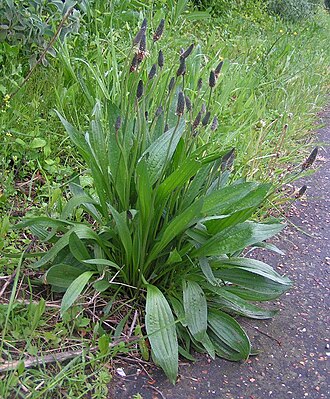
图:sannse · CC BY-SA 3.0 · Wikimedia Commons
生命之树 › 真核生物 › 植物 › 绿色植物 › 链型植物 › 唇形目 › 车前科 › 车前属
长叶车前种
Plantago lanceolata
长叶车前 又名窄叶车前、欧车前、披针叶车前,为车前属的品种之一,是一种多年生草本植物,株高约5至50厘米,根深可达60厘米左右。在英语世界里普遍被称为 ribwort plantain、English plantain、buckhorn plantain 或narrowleaf plantain。长叶车前原产于欧洲,是中欧广泛使用的药用植物之一,也是普遍常见的野草之一,目前已分布于世界各地。在北美,因其生长分布范围非常广泛,长叶车前普遍地被归类为一种入侵性杂草。
摘自维基百科「长叶车前」,CC BY-SA 4.0
- 学名
- Plantago lanceolata
- 分类等级
- 种
- 上级类群
- 车前属
- 大类
- 被子植物
- 命名
- 卡尔·林奈,1753 年
- 中文别名
- 披针叶车前、欧车前、窄叶车前、长叶车前草
- 用途
- 饲料、药用植物
- 数据库
- NCBI 分类 · GBIF
百科正文
药用价值
就像车前子,长叶车前也可入药,略不同的是,前者是种子入药,后者是叶子。在欧洲,因其优良的医药效果,长叶车前的叶子经常使用于药汤及其他草药配制中,是传统的止咳药。实际上,长叶车前叶子的有效成分可以舒缓口腔及咽喉粘膜炎或感冒所引起的不适,主要可归因于其叶子成分的(对细菌活动)抗生素功效。因此,用其叶子泡制成的茶是非常有效的止咳药。现在,在欧洲各大药房都可轻易地买到长叶车前叶子炼制成的咳嗽药水。
以上内容摘自维基百科「长叶车前」,按 CC BY-SA 4.0 使用,去掉了参考文献、外部链接等尾部小节,公式改写成了纯文本。全文、配图和出处见原文。
英文维基百科补充中文条目比较短,下面是英文条目「Plantago lanceolata」的原文
Plantago lanceolata is a species of flowering plant in the plantain family Plantaginaceae. It is known by the common names ribwort plantain, narrowleaf plantain, English plantain, ribleaf, lamb's tongue, and buckhorn. It is a common weed on cultivated or disturbed land.
Description
The plant is a rosette-forming perennial herb, with leafless, silky, hairy flower stems, growing to 45 centimetres (17+1⁄2 in) tall, exceptionally 100 cm (39 in). The basal leaves are lanceolate spreading or erect, scarcely toothed with 3–5 strong parallel veins narrowed to a short petiole. The flower stalk is deeply furrowed, ending in an ovoid inflorescence of many small flowers each with a pointed bract. Each inflorescence can produce up to 200 seeds. Flowers are 4 millimetres (1⁄8 in), with a green calyx and brownish corolla, four bent-back lobes with brown midribs and long white stamens.
Reproduction
The mode of reproduction can vary among populations. Reproduction occurs sexually, with the pollen being wind dispersed for the most part, though the plant is occasionally pollinated by bees.
Distribution and habitat
Plantago lanceolata is native to Europe and western Asia and is common across this range, including in Britain. It is widespread throughout the British Isles, but scarce on the most acidic soils (pH < 4.5). It has been introduced elsewhere in the world, including North America, Oceania and Japan at least 200 years ago and South Africa and Chile 150 years ago.
Considered to be an indicator of agriculture in pollen diagrams, P. lanceolata has been found in western Norway from the Early Neolithic onwards, which is considered an indicator of grazing in that area at the time.
The species can live anywhere from very dry meadows to places similar to a rain forest, but it does best in open, disturbed areas. It is therefore common near roadsides where other plants cannot flourish; It grows tall if it can do so, but in frequently mown areas it adopts a flat growth habit instead.
Ecology
Songbirds eat the seeds, and the leaves are eaten by rabbits.
The iridoid glycosides the plant contains make it inedible to some herbivores, but others are unperturbed by them—for example, the buckeye butterfly Junonia coenia, whose larvae eat the leaves of P. lanceolata and ingest the iridoid glycosides to make themselves unpalatable to predators.
Insect predation
Plantago lanceolata is host to many different species of the order Lepidoptera. Species such as Junonia coenia, Spilosoma congrua, and Melitaea cinxia lay their eggs on P. lanceolata plants so they can serve as a food source for the larvae when they hatch. The iridoid glycosides in the plant leaves accumulate in the caterpillars and make them unpalatable to predators.
Infection by powdery mildew
Podosphaera plantaginis is a powdery mildew fungus that infects P. lanceolata. All of the P.
Uses
Plantago lanceolata is used frequently in herbal teas and other herbal remedies. A tea from the leaves is used as a cough medicine. In traditional Austrian medicine, the leaves have been used internally (as syrup or tea) or externally (fresh leaves) for treatment of disorders of the respiratory tract, skin, insect bites, and infections. The leaves can be eaten when very young. The flower buds have a mushroom-like flavour and can be used to make stock.
100g of fresh leaves provides 21.989 kcal from 2.12 g protein, 2.81 g net carbohydrates and 0.33 g fat. They are high in fiber with 3.71 g fiber per 100g.
It can also be simmered in water to make a natural dye for use in textiles.
In culture
Children use the plant in a game where the flower's head is shot off the end of the stalk; it has been called "rifle", "1 o'clock gun" (after the gun that fires every day from Edinburgh Castle), and other names. To play the game, one would pluck a stalk and wrap a loop of the distal end of the stem around the section of stem closest to the flowerhead. The loop is tightened so it stops up behind the flowerhead and the stem is pulled backward until the flowerhead pops off. The stalk is slightly elastic so when the flowerhead separates it flies off in the direction in which the stalk is pointed like a gun, hence the gun-related names given to it.
In the West Country of England, the same game is called 'cannonballs'.
以上节选摘自英文维基百科「Plantago lanceolata」,按 CC BY-SA 4.0 使用,去掉了参考文献、外部链接等尾部小节,公式改写成了纯文本。篇幅所限,较长的小节只摘了开头一部分,有的小节没有收;全文、配图和出处见原文。