 格物
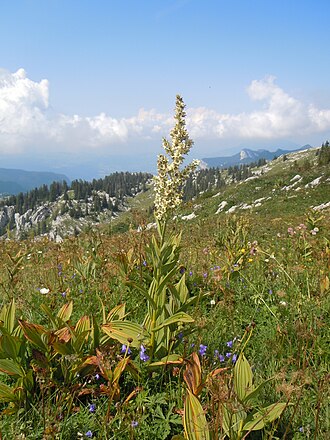
图:Patrice78500 · CC BY-SA 3.0 · Wikimedia Commons
- 学名
- Veratrum album
- 分类等级
- 种
- 上级类群
- 藜芦属
- 大类
- 被子植物
- 命名
- 卡尔·林奈,1753 年
- 数据库
- NCBI 分类 · GBIF
分类阶元
百科正文
英文维基百科补充中文条目比较短,下面是英文条目「Veratrum album」的原文
Veratrum album, the false helleborine, white hellebore, European white hellebore, or white veratrum (syn. Veratrum lobelianum Bernh.) is a poisonous plant in the family Melanthiaceae. It is native to Europe and parts of western Asia (western Siberia, Turkey, Caucasus).
Description
Veratrum album is a tall herbaceous perennial plant with alternate, pleated leaves. The flowers are white, marked with green on the top portion of the stalk. The fruit is a small pod containing winged seeds. The stout, simple stems are 50–175 cm (20–69 in) tall. The plants have an estimated lifespan of several centuries and often achieve dominance in wild areas as they are unpalatable to grazing herbivores.
Uses
Extracts from dried rhizomes of Veratrum album were briefly used as a pesticide against the Colorado potato beetle.
Research
In 1890, Georg Salzberger first isolated and named the alkaloid protoveratrine. Later investigation found that protoveratrine is a mixture of two closely related alkaloids, protoveratrine A and protoveratrine B. During the 1940s and 1950s, Veratrum album was studied in essential hypertension, hypertension during renal dysfunction, and pre-eclampsia.
Horticultural
Veratrum album is grown as an ornamental plant. In the UK, it has gained the Royal Horticultural Society's Award of Garden Merit.
Toxicity
In beverages, V. album has been mistaken for the harmless yellow gentian (Gentiana lutea) or wild garlic (Allium ursinum), resulting in poisoning. All parts of the plant are poisonous.
Symptoms
Symptoms of Veratrum alkaloid poisoning typically occur within thirty minutes to four hours of ingestion, and include:
- vomiting
- abdominal pain
- hypotension
- bradycardia
- nausea
- drowsiness
- dizziness
- dilated pupils
Treatment
Treatment for Veratrum alkaloid poisoning include supportive care and symptomatic treatments, such as fluid replacement and anti-emetics. Atropine and vasopressors act to combat bradycardia and hypotension. Duration of illness can last up to ten days but full recovery is possible within a few hours depending on dose and treatment.
Poisonings
Various Veratrum alkaloids were present in a German sneezing powder in 1982, resulting in the accidental poisoning of those who used it. Sneezing powders are commonly used to prank others. In 1983, there were nine cases of accidental poisoning as a result of these pranks due to the presence of Veratrum alkaloids in the sneezing powders. The victims were nine boys aged between 11 and 18 years old in Scandinavian countries who used supplies imported from the Federal Republic of Germany. All boys had inhaled the powder and six had ingested it. Symptoms typically presented within an hour, after which calls were made to authorities. After sneezing, the victims began to develop gastrointestinal disturbances such as vomiting in all cases and epigastric pain in two. Three of the children collapsed due to low blood pressure prior to being admitted to hospital. Seven of the children had significantly decreased blood pressure and five have cases of sinus bradycardia with no other irregularities. Half of those who had ingested the powder were treated with gastric lavage. Four of the boys were given atropine to combat bradycardia and one was given activated charcoal. Atropine normalised their heart rates within minutes but did little to assist with low blood pressure. In all cases, the patients recovered within twenty-four hours.
In 2005 and 2008, there were three reported cases of accidental poisoning. In 2009, eleven children, aged 8 to 12 years old, accidentally ingested Veratrum album at a youth camp where they had prepared homemade tea using fresh herbs. Two children remained asymptomatic, nine developed mild gastrointestinal symptoms, six presented neurological symptoms, and three showed bradycardia; after medical care, all children recovered. Four cases of accidental poisoning were reported in 2010 after Veratrum album was mistaken for wild garlic and used in self prepared-salad and soups. All victims developed nausea, vomiting, abdominal pain, sinus bradycardia, and hypotension. Complete recovery took between twenty-four and forty-eight hours.
Alexander the Great
A debate amongst historians is centred around the cause of death of Alexander the Great. Some believe the Macedonian king died of natural causes and others believe he was poisoned. The Romance suggests that his inner circle conspired to assassinate him upon his return to Babylon. A theory proposed by Schep in 2013 suggests that Veratrum album was used to kill Alexander the Great.
以上节选摘自英文维基百科「Veratrum album」,按 CC BY-SA 4.0 使用,去掉了参考文献、外部链接等尾部小节,公式改写成了纯文本。篇幅所限,较长的小节只摘了开头一部分,有的小节没有收;全文、配图和出处见原文。