格物
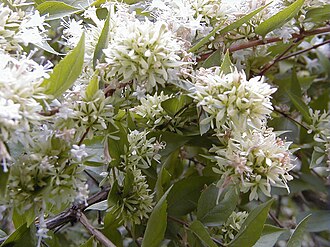
图:A. Barra · CC BY-SA 4.0 · Wikimedia Commons
- 学名
- Abelia
- 分类等级
- 属
- 上级类群
- 忍冬科
- 大类
- 被子植物
- 命名
- 罗伯特·布朗,1818 年
- 中文别名
- 六道木属
- 数据库
- NCBI 分类 · GBIF
下级类群(2)
百科正文
下属物种
六道木 Abelia biflora
醉鱼草状六道木 Abelia buddleioides
糯米条 Abelia chinensis R. Br.
南方六道木 Abelia dielsii
蓪梗花 Abelia engleriana
细瘦六道木 Abelia forrestii (Diels) W. W. Sm.
- 二翅六道木 Abelia macrotera
- 小叶六道木 Abelia parvifolia
- 伞花六道木 Abelia umbellata
Abelia uniflora R. Br.
以上内容摘自维基百科「糯米条属」,按 CC BY-SA 4.0 使用,去掉了参考文献、外部链接等尾部小节,公式改写成了纯文本。全文、配图和出处见原文。
英文维基百科补充中文条目比较短,下面是英文条目「Abelia」的原文
Abelia is a genus of flowering plants in the honeysuckle family, Caprifoliaceae. The genus currently includes six species native to China, Taiwan, and Vietnam.
The genus previously contained about 30 species and hybrids. Molecular phylogenetic studies showed that the genus was not monophyletic. Abelia section Zabelia was raised to the genus Zabelia, and the majority of Abelia species have been transferred to other genera, including Diabelia, Lonicera, and Vesalea.
Description
Species of Abelia are shrubs from 1–6 m tall. Species from warm climates are evergreen, and colder climate species deciduous. The leaves are opposite or in whorls of three, ovate, glossy, dark green, 1.5–8 cm long, turning purplish-bronze to red in autumn in the deciduous species. The flowers appear in the upper leaf axils and stem ends, 1-8 together in a short cyme; they are pendulous, white to pink, bell-shaped with a five-lobed corolla, 1–5 cm long, and usually scented. Flowering continues over a long and continuous period from late spring to fall.
Some of these species are cultivated as ornamental garden plants, and may still be described as Abelia in horticultural listings. A notable example is the hybrid Abelia × grandiflora.
Taxonomy
The generic name commemorates Clarke Abel, a keen naturalist who accompanied Lord Amherst's unsuccessful embassy to China in 1816 as a surgeon, under the sponsorship of Sir Joseph Banks. All of Abel's seeds and plants were lost in a shipwreck on the homeward voyage, however; living plants of Abelia chinensis were first imported to England in 1844 by Robert Fortune.
Some species placed in Abelia were transferred to Linnaea at various times from 1872 onwards, but these transfers were not accepted by most botanists. Molecular phylogenetic studies showed that a number of genera traditionally placed in the tribe Linnaeeae were closely related, but that Abelia was not monophyletic, even with Abelia section Zabelia split off as a separate genus Zabelia. In 2013, Maarten Christenhusz proposed that Abelia and related genera be merged into Linnaea. In 2015 Wang, Landrein, et al. also found that Abelia was polyphyletic, and that Zabelia was more closely related to Morina than to the rest of the subfamily Linnaeoideae. They organized the Linnaeoideae into six monophyletic genera by recognizing Dipelta, Kolkwitzia, and Linnaea as distinct genera, placing the former Mexican species of Abelia in the revived genus Vesalea, creating the new genus Diabelia, and leaving six Asian species in Abelia. Plants of the World Online accepts the circumscription of Wang, Landrein, et al..
Species
Six species are accepted.
Abelia chinensis R.Br.
Abelia forrestii (Diels) W.W.Sm.
Abelia × grandiflora (Rovelli ex André) Rehder (artificial hybrid of A. chinensis × A. uniflora)
Abelia macrotera (Graebn. & Buchw.) Rehder
Abelia parvifolia Hemsl.
Abelia schumannii (Graebn.) Rehder
Abelia uniflora R.Br.
Cultivation
Several species of Abelia are in cultivation. Though not fully hardy, they are easy to grow in a sheltered, sunny position. The cultivar 'Edward Goucher' has gained the Royal Horticultural Society's Award of Garden Merit.
Allergenicity
Abelia has an OPALS allergy scale rating of 5 out of 10, indicating moderate potential to cause allergic reactions, exacerbated by over-use of the same plant throughout a garden. People allergic to honeysuckle may experience cross-reactive allergic reactions with Abelia.
以上内容摘自英文维基百科「Abelia」,按 CC BY-SA 4.0 使用,去掉了参考文献、外部链接等尾部小节,公式改写成了纯文本。全文、配图和出处见原文。