 格物
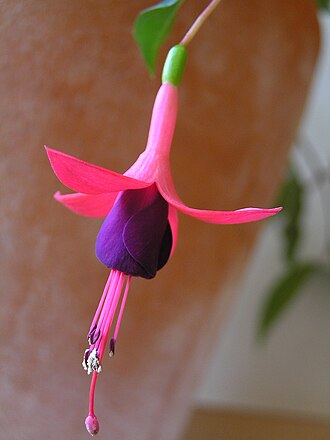
图:松岡明芳 · CC BY-SA 3.0 · Wikimedia Commons
- 学名
- Fuchsia
- 分类等级
- 属
- 上级类群
- 柳叶菜科
- 大类
- 被子植物
- 命名
- 卡尔·林奈,1753 年
- 数据库
- NCBI 分类 · GBIF
下级类群(2)
- 倒挂金钟 Fuchsia magellanica 种
- Fuchsia boliviana 种
百科正文
种类
- Fuchsia abrupta
- Fuchsia andrei
- Fuchsia asperifolia
- Fuchsia aspaiziu
- Fuchsia asplundii
- Fuchsia austromontana
- Fuchsia ayavacensis
- Fuchsia boliviana
- Fuchsia canescens
- Fuchsia confertifolia
- Fuchsia cordifolia
- Fuchsia corymbiflora
- Fuchsia cuatresasasii
- Fuchsia decussata
- Fuchsia denticulata
Fuchsia excorticata (Kotukutuku) (页面存档备份,存于互联网档案馆)
- Fuchsia fischeri
- Fuchsia fufuraceae
- Fuchsia gehringeri
- Fuchsia glaberrima
- Fuchsia hartwegii
- Fuchsia hirtella
以上内容摘自维基百科「倒挂金钟」,按 CC BY-SA 4.0 使用,去掉了参考文献、外部链接等尾部小节,公式改写成了纯文本。全文、配图和出处见原文。
英文维基百科补充中文条目比较短,下面是英文条目「Fuchsia」的原文
Fuchsia ( FEW-shə) is a genus of flowering plants that consists mostly of shrubs or small trees.
Almost 110 species of Fuchsia are recognized; the vast majority are native to South America, but a few occur north through Central America to Mexico, and also several from New Zealand to Tahiti. One species, F. magellanica, extends as far as the southern tip of South America, occurring on Tierra del Fuego in the cool temperate zone, but the majority are tropical or subtropical.
Taxonomy
The first to be scientifically described, Fuchsia triphylla, was discovered on the Caribbean island of Hispaniola (Haiti and the Dominican Republic) about 1696–1697 by the French Minim friar and botanist, Charles Plumier, during his third expedition to the Greater Antilles. He named the new genus after German botanist Leonhart Fuchs (1501–1566, pronounced [fʊks]).
The fuchsias are most closely related to the northern hemisphere genus Circaea, the two lineages having diverged around 41 million years ago.
Description
Fuchsias prefer climates with cool temperatures all year round with no frost; they prefer partial shade and warm temperatures in the morning in most other areas. They need plenty of watering to grow well.
Most fuchsias are shrubs from 0.2 to 4 m (8 in to 13 ft 1 in) tall, but one New Zealand species, the kōtukutuku (F. excorticata), is unusual in the genus in being a tree, growing up to 12–15 m (39–49 ft) tall.
Species
The majority of Fuchsia species are native to Central and South America. A small additional number are found on Hispaniola (two species), in New Zealand (three species) and on Tahiti (one species). Philip A. Munz in his A Revision of the Genus Fuchsia classified the genus into seven sections of 100 species. More recent scientific publications, especially those by the botanists Dennis E. Breedlove of the University of California and, currently, Paul E.
Cultivation
Fuchsias are popular garden shrubs, and once planted can live for years with a minimal amount of care. The British Fuchsia Society maintains a list of hardy fuchsias that have been proven to survive a number of winters throughout Britain and to be back in flower each year by July. Enthusiasts report that hundreds and even thousands of hybrids survive and prosper throughout Britain.
Cultivars
In the UK, 60 cultivated varieties of fuchsia have gained the Royal Horticultural Society's Award of Garden Merit, including:-
- 'Alice Hoffman' (pink sepals, white petals – hardy)
- 'Display' (deep pink/rose pink single)
- 'Dollar Prinzessin' (cerise sepals, purple petals – hardy)
- 'Garden News' (light pink sepals, double magenta petals – hardy)
- 'Genii' (single, cerise/purple)
- 'Hawkshead' (white self)
- 'Lady Thumb' (compact, pink sepals, white petals)
- 'Mrs Popple' (vigorous, red sepals, purple petals – hardy)
Pests and diseases
Fuchsias are eaten by the caterpillars of some Lepidoptera, such as the elephant hawk-moth (Deilephila elpenor) and the black-lyre leafroller moth ("Cnephasia" jactatana). Other major insect pests include aphids, mirid bugs such as Lygocoris, Lygus and Plesiocoris spp., vine weevils (Otiorhynchus spp.), and greenhouse whitefly (Trialeurodes vaporariorum). Problematic mites include the fuchsia gall mite (Aculops fuchsiae) and red spider mite (Tetranychus urticae).
Pronunciation and spelling
While the original pronunciation from the word's German origin is [ˈfʊksi̯ə], the standard pronunciation for the common name in English is FEW-shə. As a consequence, fuchsia is often misspelled as fuschia in English.
History
Leonhart Fuchs, the eminent namesake of the genus, was born in 1501 in Wemding in the Duchy of Bavaria. A physician and professor, he occupied the chair of Medicine at the University of Tübingen from his appointment at the age of 34 until his death in 1566. Besides his medical knowledge, according to his record of activities which was extensive for the time, he studied plants. This was usual for the period. Most remedies and medicines were herbal and the two subjects were often inseparable.
以上节选摘自英文维基百科「Fuchsia」,按 CC BY-SA 4.0 使用,去掉了参考文献、外部链接等尾部小节,公式改写成了纯文本。篇幅所限,较长的小节只摘了开头一部分,有的小节没有收;全文、配图和出处见原文。