 格物
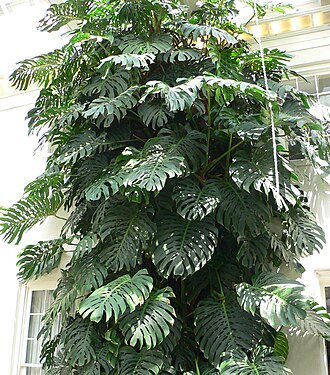
- 学名
- Monstera deliciosa
- 分类等级
- 种
- 上级类群
- 龟背竹属
- 大类
- 被子植物
- 命名
- 弗雷德里克·利布曼,1849 年
- 中文别名
- 龟背芋
- 数据库
- NCBI 分类 · GBIF
百科正文
龟背竹适应性强,性喜温暖,潮湿的环境,但也耐阴、耐阳及有一定的耐旱性,原产于墨西哥南部至危地马拉的热带雨林生境。为著名大型观赏植物。
形态
常绿藤本植物,叶革质,茎干粗壮,下部常生有褐色气生根。幼叶呈心形,植株在生长过程中的新发叶片逐渐会有不规则的羽状裂口,其因像龟背而得名。花为黄白色的肉穗花序,外具白色的佛焰苞。果实为绿色柱状聚果。
果实有凤梨香气,但含草酸钙(蓚酸)结晶,会刺激皮肤及黏膜组织,带来些微刺痒的不适感。大量接触的话,可能会让皮肤发红搔痒,黏膜肿大发炎,故小心宠物误食。
以上内容摘自维基百科「龟背竹」,按 CC BY-SA 4.0 使用,去掉了参考文献、外部链接等尾部小节,公式改写成了纯文本。全文、配图和出处见原文。
英文维基百科补充中文条目比较短,下面是英文条目「Monstera deliciosa」的原文
Monstera deliciosa, the Swiss cheese plant or split-leaf philodendron, is a species of flowering plant. The common name "Swiss cheese plant" is also used for the related species from the same genus, Monstera adansonii. The common name "split-leaf philodendron" is also used for the species Philodendron bipinnatifidum.
Monstera deliciosa is native to tropical forests of southern Mexico, south to Panama. It has been introduced to many tropical areas, and considered a low-to-moderate invasion risk in Hawaii, Seychelles, Ascension Island and the Society Islands. It is very widely grown in temperate zones as a houseplant. Although the plant contains insoluble calcium oxalate crystals, which cause a needlelike sensation when touched, the ripe fruit is edible.
Names
The specific epithet deliciosa means "delicious", referring to the edible fruit. The genus Monstera is named from the Latin word for "monstrous" or "abnormal", and refers to the unusual leaves with natural holes that members of the genus have.
Its popular name as a houseplant of "Swiss cheese plant", or just "cheese plant", is commonly stated to refer to the "eyes" or holes that develop in its leaves similar to the holes in some Swiss-type cheeses such as Emmental cheese.
Description
This member of the arum family (Araceae) is a hemiepiphyte with aerial roots. It is able to grow up to 20 m (66 ft) high in the wild, with large, leathery, glossy, pinnate, heart-shaped leaves 25–90 cm (10–35.5 in) long by 25–75 cm (10–29.5 in) broad. The leaves on young plants are smaller and entire with no lobes or holes, but soon produce lobed and fenestrate leaves as they grow. Although it can grow very tall in nature, it only measures between 2 and 3 m (6.6 and 9.8 ft) when grown indoors. The older the plant, the more the leaves are covered with its familiar large perforations.
Distribution and growth
Monstera deliciosa is native to humid tropical forests, in lowlands and on lower mountains, in the south of Mexico and also in Costa Rica, Guatemala and Panama. The seeds fall to the ground, then the seedlings crawl (negative phototropism) until they meet a tree on which to attach. The many adjacent roots thus allow the plant to anchor against its new support and reach the canopy light (although it rarely grows in full sun and prefers a light dimmed by the foliage).
Cultivation
Monstera deliciosa is commonly grown outdoors as an ornamental plant in the tropics and subtropics. The plant requires a lot of space and a rich and loose soil (ideally garden soil and compost in equal parts). If it grows in the ground it is better to plant it near a tree, where it can climb, if not against a trellis. It is a "moderately greedy plant", in that it needs to be watered just to keep the soil slightly moist. Its hardiness is 11 (that is to say the coldest at −1 °C or 30 °F). It cannot withstand these temperatures for more than a few hours, but it can live outside in certain temperate regions (Mediterranean coast, Brittany).
Toxicity
Monstera deliciosa is moderately toxic to both cats and dogs because it contains needle-like insoluble calcium oxalate crystals. These crystals may cause injury to the mouth, tongue, and digestive tract. It also causes dermatitis by direct contact with cat and dog skin.
Uses
In those areas where it grows naturally, M. deliciosa is considered a delicacy due to its sweet and exotic flavor. The fruit may be ripened by cutting it when the first scales begin to lift up and it begins to exude a pungent odor. It is wrapped in a paper bag and set aside until the scales begin popping off. The scales are then brushed off or fall away to reveal the edible flesh underneath. The flesh, which is similar to pineapple in texture, can be cut away from the core and eaten. It has a fruity taste similar to jackfruit and pineapple.
以上节选摘自英文维基百科「Monstera deliciosa」,按 CC BY-SA 4.0 使用,去掉了参考文献、外部链接等尾部小节,公式改写成了纯文本。篇幅所限,较长的小节只摘了开头一部分,有的小节没有收;全文、配图和出处见原文。