 格物
- 学名
- Tilia tomentosa
- 分类等级
- 种
- 上级类群
- 椴树属
- 大类
- 被子植物
- 命名
- Conrad Moench
- 中文别名
- 银叶椴
- 保护状况(IUCN)
- 无危物种
- 数据库
- NCBI 分类 · GBIF · IUCN 红色名录
百科正文
分布
本种生长于欧洲东南部和亚洲西南部,由匈牙利和巴尔干地区向东至土耳其西部,主要生长在中海拔地区。
形态
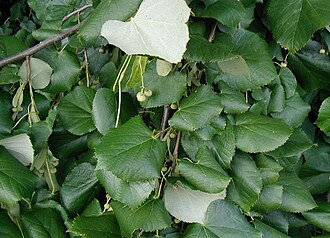
落叶性乔木,植株高度可以生长至20-35米高,树干直径可达2米以上。叶互生,圆形至三角卵形,叶长宽约4-13公分,叶柄长2.5-4公分,叶面绿色,大多数无毛;叶背白色,密生白色绵毛。花淡黄色,两性花,在夏季中期至晚期开花,花序为聚伞花序,每个花序约有3-10朵花,苞片淡绿色。果实为核果,长约0.8-1公分,外表覆有绒毛。
以上内容摘自维基百科「銀毛椴」,按 CC BY-SA 4.0 使用,去掉了参考文献、外部链接等尾部小节,公式改写成了纯文本。全文、配图和出处见原文。
英文维基百科补充中文条目比较短,下面是英文条目「Tilia tomentosa」的原文
Tilia tomentosa, known as silver linden in the US and silver lime in the UK, is a species of flowering plant in the family Malvaceae, native to southeastern Europe and southwestern Asia, from Romania and the Balkans east to western Turkey, occurring at moderate altitudes.
Description
Tilia tomentosa is a deciduous tree growing to 20–35 m (66–115 ft) tall, with a trunk up to 2 m (7 ft) in diameter. The leaves are alternately arranged, rounded to triangular-ovate, 4–13 cm long and broad with a 2.5–4 cm petiole, green and mostly hairless above, densely white tomentose with white hairs below, and with a coarsely toothed margin. The flowers are pale yellow, hermaphrodite, produced in cymes of three to ten in mid to late summer with a pale green subtending leafy bract; they have a strong scent and are pollinated by honeybees. The fruit is a dry nut-like drupe 8–10 mm long, downy, and slightly ribbed.
Cultivation and uses
It is widely grown as an ornamental tree throughout Europe. The cultivar 'Brabant' has a strong central stem and a symmetrical conic crown. The cultivar 'Petiolaris' (pendent or weeping silver lime) differs in longer leaf petioles 4–8 cm long and drooping leaves; it is of unknown origin and usually sterile, and may be a hybrid with another Tilia species. It is very tolerant of urban pollution, soil compaction, heat, and drought, and would be a good street tree in urban areas. In cultivation in the UK, T. tomentosa 'Petiolaris' has gained the Royal Horticultural Society's Award of Garden Merit.
An infusion made from the flowers of T. tomentosa is antispasmodic, diaphoretic and sedative. This may be attributable to the presence of pharmacologically active ligands of benzodiazepine receptor.
A widespread belief is that the nectar of this species contains mannose, which can be toxic to some bees. This is incorrect; the sight of numerous comatose bees found on the ground at flowering time is rather a result of the paucity of nectar sources in late summer in urban areas. The evidence against a toxin in the nectar being responsible for mass bee deaths under Tilia trees is supported further by Koch and Stevenson (2017) who also suggest that the presence of caffeine in linden nectar may mean that linden trees can chemically deceive foraging bees to make sub-optimal foraging decisions, in some cases leading to their starvation.
This species, while fragrant in spring, drops buds and pollen during the spring and fall.
Notable trees
Eminescu's Linden Tree (Romanian: Teiul lui Eminescu) is a 500-year-old silver lime situated in the Copou Public Garden, Iași, Romania. Mihai Eminescu reportedly wrote some of his best works underneath this silver lime, rendering the tree one of Romania's most important natural monuments and an Iași landmark.
以上内容摘自英文维基百科「Tilia tomentosa」,按 CC BY-SA 4.0 使用,去掉了参考文献、外部链接等尾部小节,公式改写成了纯文本。全文、配图和出处见原文。