 格物
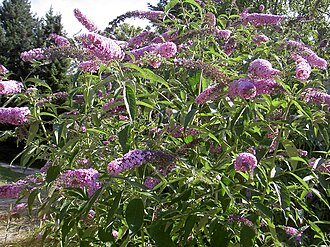
图:--IKAl 15:22, 23 July 2007 (UTC) · CC BY-SA 2.5 · Wikimedia Commons
- 学名
- Buddleja davidii
- 分类等级
- 种
- 上级类群
- 醉鱼草属
- 大类
- 被子植物
- 命名
- 阿德里安·勒内·弗朗谢
- 中文别名
- 绛花醉鱼草、穆坪醉鱼草、兴山醉鱼草、白背叶醉鱼草、白壶子
- 用途
- 药用植物、园艺植物
- 数据库
- NCBI 分类 · GBIF
百科正文
命名
学名Buddleja davidii来自英国植物学家亚当·巴德尔以及法国植物学家谭卫道。谭卫道十九世纪末发现了此品种,William Houstoun将其引进英国时,建议命名纪念巴德尔,因此学名依照两人的名字Buddle以及David命名。
形态
落叶灌木,高3~5米,小枝微有棱,被柔毛。椭圆状披针形的叶片对生,叶片大,长5-25厘米,缘有细齿,叶背密被星状绒毛。多数小聚伞花序集成穗状圆锥花序,有淡紫、红、暗红、白、蓝等色,口部橘黄,花色丰富,花味芬芳。条状矩圆形蒴果,无毛或稍有鳞毛;种子多数,两端有长尖翅。
分布
原产于中国西北部和日本,现分布在马来西亚、美国、日本、非洲、印度尼西亚、英国、新西兰以及中国大陆的云南、西藏、广西、四川、浙江、江西、陕西、甘肃、广东、贵州、湖南、江苏、湖北等地,生长于海拔800米至3,000米的地区,一般生长在山坡及沟边灌木丛中,常作为观赏植物栽培,并有很多变种已培育并命名。
此物种已在欧洲中部和南部的大部分城市中野生化,遍及荒地及花园,是一种具有观赏价值的植物,因为很多蝴蝶物种均会以其花蜜为食。
严冬时,大叶醉鱼草在温度−15℃-−20℃的北方大陆性气候地区难以存活。
以上内容摘自维基百科「大叶醉鱼草」,按 CC BY-SA 4.0 使用,去掉了参考文献、外部链接等尾部小节,公式改写成了纯文本。全文、配图和出处见原文。
英文维基百科补充中文条目比较短,下面是英文条目「Buddleja davidii」的原文
Buddleja davidii (spelling variant Buddleia davidii), also called butterfly-bush, orange eye, or summer lilac, is a species of flowering plant in the family Scrophulariaceae, native to most of China except for the far northeast. It is widely used as an ornamental plant, and many named cultivars are in cultivation. The genus was named Buddleja after the English botanist, Reverend Adam Buddle. The species name, davidii, is after the French missionary and explorer in China, Father Armand David, who was the first European to report the shrub. It was found near Yichang by Dr Augustine Henry about 1887 and sent to St Petersburg. Another botanist-missionary in China, Jean-André Soulié, sent seed to the French nursery Vilmorin, and B. davidii entered commerce in the 1890s.
B. davidii was accorded the RHS Award of Merit (AM) in 1898, and the Award of Garden Merit (AGM) in 1941.
Description
Buddleja davidii is a vigorous shrub with an arching habit, growing to 5 m (16 ft) in height. The pale grey-brown bark becomes flaky to deeply fissured with age. The branches are quadrangular in section, the younger shoots and leaves covered in a dense indumentum. The opposite lanceolate leaves are 7–20 cm (3–8 inches) long and 2–7 cm (1–3 inches) broad, grey-green to dark green above, greyish-white tomentose beneath when young and becoming grey-green with age. The flowers are honey-scented, lilac to purple or occasionally white, produced in terminal panicles, usually under 20 cm (8 inches) long but can be 30 cm (12 inches) or more long.
Taxonomy
In a 1979 revision of the taxonomy of the African and Asian species of Buddleja, the Dutch botanist Anthonius Leeuwenberg sank the six varieties of the species as synonyms of the type, considering them to be within the natural variation of the species, and not worthy of separate varietal recognition. Leeuwenberg's taxonomy was adopted in the Flora of China published in 1996, and is also upheld by both the Plants of the World Online database and the International Dendrology Society's Trees and Shrubs Online website. However, as the distinctions of the former varieties are still accepted by some in horticulture, they are listed here:
Cultivation
Buddleja davidii cultivars are widely cultivated worldwide as ornamental shrubs and for the value of their flowers as a nectar source for many species of butterfly. However, the plant does not provide food for butterfly larvae, and buddlejas might out-compete the host plants that caterpillars require.
The species and its cultivars are not able to survive the harsh winters of northern or montane climates, being killed by temperatures below about −15 to −20 °C (5 to −4 °F).
Younger wood is more floriferous, so even if frosts do not kill the previous year's growth, the shrub can be hard-pruned in spring once frosts have finished, to encourage new growth.
Invasive species
Buddleja davidii has been designated as an invasive species or a "noxious weed" in a number of countries in temperate regions, including the United Kingdom, the Republic of Ireland and New Zealand. It is naturalised in Australia and in many cities of central and southern Europe, where it can spread on open land, railway lines, urban areas and in gardens.
B. davidii was first documented as an invasive species in 1922, in the United Kingdom at Harlech in North Wales. It is now often seen there along railway lines and on the sites of derelict factories and other walls and buildings. The plant frequently grew on urban bomb sites during the aftermath of World War II, earning it the nickname of "the bomb site plant".
"Non-invasive" Buddleja cultivars
A number of Buddleja cultivars have become available that have a variety of sizes and flower colours and that are either sterile or produce less than 2% viable seed. The northwestern U.S. state of Oregon, which designated B. davidii as a "noxious weed" and initially prohibited entry, transport, purchase, sale or propagation of all of its varieties, amended its quarantine in 2009 to permit those cultivars when approved or when proven to be interspecific hybrids. The adjacent state of Washington has taken actions that are similar to those of Oregon to bring parity to nursery sales between the two states.
以上节选摘自英文维基百科「Buddleja davidii」,按 CC BY-SA 4.0 使用,去掉了参考文献、外部链接等尾部小节,公式改写成了纯文本。篇幅所限,较长的小节只摘了开头一部分,有的小节没有收;全文、配图和出处见原文。