 格物
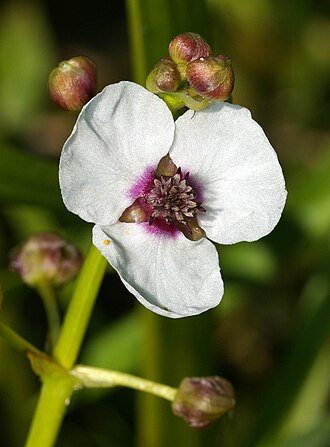
图:Christian Fischer · CC BY-SA 3.0 · Wikimedia Commons
- 学名
- Sagittaria sagittifolia
- 分类等级
- 种
- 上级类群
- 慈姑属
- 大类
- 被子植物
- 命名
- 卡尔·林奈,1753 年
- 中文别名
- 欧洲慈姑
- 保护状况(IUCN)
- 无危物种
- 数据库
- NCBI 分类 · GBIF · IUCN 红色名录
百科正文
形态
茨菰属多年生直立水生草本。有纤匐枝,末端膨大成球茎。长20-40厘米;叶子形态变化极大,通常为戟形,基部裂片长5-40厘米,宽0.4-13厘米,顶端钝或短尖,基部裂片短、与叶片等长或较长,多少向两侧开展。花葶同总状花序高10-50厘米;总状花序,花3-5朵为一轮,单性,下部为雌花,具短梗,上部为雄花,具细长花梗;苞片呈披针形;3个外轮花被片,片状,卵形,顶端钝;3个内轮花被片,花瓣状,白色,基部常有紫斑;雄蕊多枚;心皮多数,密集成球形。南北各省区水稻田或沼泽地常见。在中国南方有栽培,但亦为田间杂草;广布于欧洲。北美至亚洲。球茎供食用。
文学艺术
作家汪曾祺在散文《故乡的食物 (页面存档备份,存于互联网档案馆)》中记述了江苏高邮的“茨菇”吃法。
以上内容摘自维基百科「茨菰」,按 CC BY-SA 4.0 使用,去掉了参考文献、外部链接等尾部小节,公式改写成了纯文本。全文、配图和出处见原文。
英文维基百科补充中文条目比较短,下面是英文条目「Sagittaria sagittifolia」的原文
Sagittaria sagittifolia (also called arrowhead because of the shape of its leaves) is an Old World flowering plant in the family Alismataceae.
Description
Sagittaria sagittifolia is a herbaceous perennial plant, growing in water from 10–50 centimetres (4–19+1⁄2 inches) deep. The leaves above water are arrowhead-shaped, the leaf blade 15–25 cm (6–10 in) long and 10–22 cm (4–8+1⁄2 in) broad, on a long petiole holding the leaf up to 45 cm (17+1⁄2 in) above water level. The plant also has narrow linear submerged leaves, up to 80 cm (31+1⁄2 in) long and 2 cm broad. Panicled flowers are 2–2.5 cm broad, with three small sepals and three white petals, and numerous purple stamens.
Distribution and habitat
It is native to wetlands in most of Europe (it is extinct in Spain) and Asia in Finland and Bulgaria, in Russia, Ukraine, Siberia, Turkey and the Caucasus. It is also cultivated as a food crop in some other countries. In Britain it is the only native species of Sagittaria.
Ecology
S. sagittifolia can be weedy or invasive according to the USDA, Animal and Plant Health Inspection Service, Plant Protection and Quarantine. It also appears on state noxious weed lists for 46 states.
Uses
The round tuber is edible. It is starchy with a bland flavour and a texture similar to a potato but somewhat crunchier, even when cooked. In Japan, it is known as kuwai クワイ (慈姑) and its tuber is eaten particularly during the New Year. In China, it is known as 慈姑 cígū and often used in winter hot pots. In Vietnam, the plant's young petiole leaves and rhizomes are used for soups.
Remnants of Sagittaria sagittifolia have been found in the Paleolithic/Mesolithic site of Całowanie in Poland.
S. sagittifolia is used in Chinese medicine, and in 2006 seven new ent-rosane diterpenoids and a new labdane diterpene were purified from the plant. Four of these compounds (Sagittine A–D) exhibited antibacterial activity against Streptococcus mutans and Actinomyces naeslundii while another (Sagittine E) was only active against A. naeslundii (MIC = 62.5 μg ml–1). Recently, the same group identified five new diterpenoids from Sagittaria pygmaea. None displayed activity against A. actinomycetemcomitans, while four of the others were active against A. viscosus and three against S. mutans, of which 18-ß-D-3',6'-diacetoxyglucopyranosyl-ent-kaur-16-ene was the most active.
以上内容摘自英文维基百科「Sagittaria sagittifolia」,按 CC BY-SA 4.0 使用,去掉了参考文献、外部链接等尾部小节,公式改写成了纯文本。全文、配图和出处见原文。