 格物
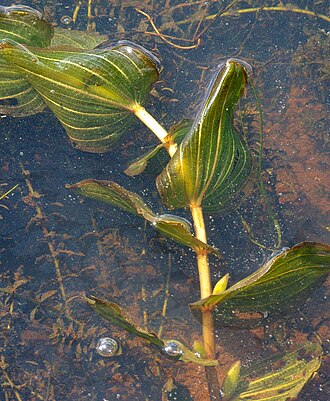
图:Christian Fischer · CC BY-SA 3.0 · Wikimedia Commons
- 学名
- Potamogeton
- 分类等级
- 属
- 上级类群
- 眼子菜科
- 大类
- 被子植物
- 命名
- 卡尔·林奈,1753 年
- 数据库
- NCBI 分类 · GBIF
下级类群(18)
- 浮叶眼子菜 Potamogeton natans 种
- 菹草 Potamogeton crispus 种
- 穿叶眼子菜 Potamogeton perfoliatus 种
- 光叶眼子菜 Potamogeton lucens 种
- 白茎眼子菜 Potamogeton praelongus 种
- 蓼叶眼子菜 Potamogeton polygonifolius 种
- 高山眼子菜 Potamogeton alpinus 种
- 钝叶眼子菜 Potamogeton obtusifolius 种
- 小眼子菜 Potamogeton pusillus 种
- 禾叶眼子菜 Potamogeton gramineus 种
- 小节眼子菜 Potamogeton nodosus 种
- 弗里斯眼子菜 Potamogeton friesii 种
- 篦齿眼子菜 Potamogeton pectinatus 种
- 扁茎眼子菜 Potamogeton compressus 种
- Potamogeton trichoides 种
- 单果眼子菜 Potamogeton acutifolius 种
- 纤细眼子菜 Potamogeton berchtoldii 种
- Potamogeton coloratus 种
百科正文
下属物种
- 兴安眼子菜 Potamogeton xinganensis
- 高山眼子菜 Potamogeton alpinus
- 小眼子菜 Potamogeton pusillus
- 钝叶眼子菜 Potamogeton obtusifolius
- 尖叶眼子菜 Potamogeton oxyphyllus
- 单果眼子菜 Potamogeton acutiflius
- 微齿眼子菜 Potamogeton maackianus
- 菹草 Potamogeton crispus - 马藻、虾藻
- 穿叶眼子菜 Potamogeton perfoliatus
- 白茎眼子菜 Potamogeton praelongus
- 光叶眼子菜 Potamogeton lucens
- 禾叶眼子菜 Potamogeton gramineus
- 浮叶眼子菜 Potamogeton natans
- 蓼叶眼子菜 Potamogeton polygonifolius
- 小节眼子菜 Potamogeton nodosus
- 眼子菜 Potamogeton distinctus
- 鸡冠眼子菜 Potamogeton cristatus
- 弗里斯眼子菜 Potamogeton friesii
- 扁茎眼子菜 Potamogeton compressus
- 竹叶眼子菜 Potamogeton wrightii
- 八蕊眼子菜 Potamogeton octandrus - 南方眼子菜
- 纤细眼子菜 Potamogeton berchtoldii
- 单果眼子菜 Potamogeton acutifolius
- 南美眼子菜 Potamogeton gayi - 盖义虾藻
- 东北眼子菜 Potamogeton mandschuriensis
以上内容摘自维基百科「眼子菜属」,按 CC BY-SA 4.0 使用,去掉了参考文献、外部链接等尾部小节,公式改写成了纯文本。全文、配图和出处见原文。
英文维基百科补充中文条目比较短,下面是英文条目「Potamogeton」的原文
Potamogeton is a genus of aquatic, mostly freshwater, plants of the family Potamogetonaceae. Most are known by the common name pondweed, although many unrelated plants may be called pondweed, such as Canadian pondweed (Elodea canadensis). The genus name means "river neighbor", originating from the Greek potamos (river) and geiton (neighbor).
Morphology
Potamogeton species range from large (stems of 6 m or more) to very small (less than 10 cm). Height is strongly influenced by environmental conditions, particularly water depth. All species are technically perennial, but some species disintegrate in autumn to a large number of asexually produced resting buds called turions, which serve both as a means of overwintering and dispersal. Turions may be borne on the rhizome, on the stem, or on stolons from the rhizome. Most species, however, persist by perennial creeping rhizomes. In some cases the turions are the only means to differentiate species.
Taxonomy
Potamogeton is a genus of freshwater aquatic plants in the Potamogetonaceae. Molecular analysis has identified Groenlandia as the sister group to Potamogeton, although the Angiosperm Phylogeny Group also lists Zannichellia, Althenia and Pseudoalthenia as closely related genera. Some researchers have used molecular analysis and pollen grain shape to argue for the placement of Stuckenia at the genus level, but others have argued there is not enough difference to justify the change, and have kept Stuckenia as a subgenus of Potamogeton.
The genus is generally divided into two groups: broad-leaved and linear-leaved. The broad-leaved group includes such species as P. natans, P. perfoliatus and P.
Distribution
Potamogeton species are found worldwide in many aquatic ecosystems. However, the greatest diversity of species occurs in the northern hemisphere, especially in North America, which is thought to be where the genus originated. Molecular evidence suggests that several independent colonizations of the southern hemisphere have occurred. However, due to their self-propagation from turions, Potamogeton populations show very low infrapopulation diversity, especially when living in deep, shaded or turbulent water where colonies do not expend energy on flowers. This has made it very difficult to use genetic data to find patterns of geographical differentiation.
Hybrids
Potamogeton species hybridise freely. At least 27 hybrids have been observed in the British Isles alone, and more than 50 worldwide, of which 36 have been confirmed using genetic techniques. The majority of these are sterile, but many are long-lived and may occur in the absence of one or even both parents. Most hybrids have been described between broad-leaved species, but this probably reflects the relative scarcity of characters among fine-leaved taxa, so that hybrids are much more difficult to identify. Use of genetic markers suggests that hybrid taxa are also reasonably frequent among fine-leaved species. At least one species, P. obtusifolius, is thought to have arisen via hybridisation.
Taxonomic history
Several species of European pondweeds, including P. natans, P. lucens and P. crispus, were included in Linnaeus's Species Plantarum in 1753. Much of the European Potamogeton flora was subsequently named during the late 18th and early 19th century. As botanists ventured further afield, pondweeds began to be collected and named from other parts of the world. The North America flora was largely named by the start of the 20th century.
Alfred Fryer became interested in Potamogeton in the 1880s, and was a recognised authority on the genus. The first parts of his work The Potamogetons (Pond Weeds) of the British Isles were published in 1898.
Ecology
Reproduction of pondweeds occurs both vegetatively and by seed, though studies suggest that in some species or situations reproduction by seed is rare. The fruits may be produced in large quantities from midsumer onwards, and are ingested by waterfowl. Germination experiments have shown that the seeds are viable after passing through the digestive tracts of birds and this mechanism is probably the only natural mechanism for long-distance dispersal between isolated water bodies. Vegetative propagation occurs by a variety of mechanisms including turions, and via growth and fragmentation of rhizomes and shoots.
以上节选摘自英文维基百科「Potamogeton」,按 CC BY-SA 4.0 使用,去掉了参考文献、外部链接等尾部小节,公式改写成了纯文本。篇幅所限,较长的小节只摘了开头一部分,有的小节没有收;全文、配图和出处见原文。