 格物
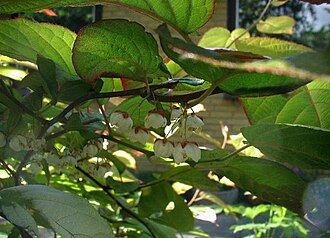
图:Sten Porse · CC BY-SA 3.0 · Wikimedia Commons
- 学名
- Actinidia
- 分类等级
- 属
- 上级类群
- 猕猴桃科
- 大类
- 被子植物
- 命名
- 约翰·林德利,1836 年
- 数据库
- NCBI 分类 · GBIF
下级类群(4)
百科正文
属名Actinidia源于希腊语aktis(光线)和eidos(相似的)的合成词,指其花柱呈放射状。
分布
猕猴桃属植物分布在东亚,主要集中在河南、陕西的秦岭地区及其余脉与太行山区,浙江江山,湖南西部的武陵山区以及台湾、朝鲜半岛与日本,并且向北延伸到西伯利亚东南方,向南延伸到中南半岛。
外形
猕猴桃属植物能长到6米高,并且能够生出蔓藤,在树阴下生长到30米长。
繁殖
猕猴桃属植物雌雄异株,栽培上以一株雄株配合7~8株母株。
营养
猕猴桃被认为是营养密度最高的水果,低钠高钾,含有丰富的维生素C、维生素E、叶酸、膳食纤维、多种氨基酸。研究显示,猕猴桃可补充身体中的钙质,增强人体对食物的吸收力。此外,猕猴桃外皮含有丰富果胶(占所含纤维的三分之一),可降低血中胆固醇。
种类
猕猴桃属下,约有40至60个种。
中国大陆市场上多为中华猕猴桃。
以上内容摘自维基百科「獼猴桃屬」,按 CC BY-SA 4.0 使用,去掉了参考文献、外部链接等尾部小节,公式改写成了纯文本。全文、配图和出处见原文。
英文维基百科补充中文条目比较短,下面是英文条目「Actinidia」的原文
Actinidia is a genus of woody and, with a few exceptions, dioecious plants native to temperate eastern Asia, occurring throughout most of China, Taiwan, Korea, and Japan, and extending north to southern areas of Russian Far East and south into Indochina. The genus includes shrubs growing to 6 metres (20 feet) tall, and vigorous, strong-growing vines, growing up to 30 m (100 ft) in tree canopies. They mostly tolerate temperatures down to around −15 °C (5 °F), and some are much hardier.
The leaves are alternate and simple, with a dentated margin and a long petiole. The flowers are solitary or in axillary cymes, usually white, with five small petals. Most of the species are dioecious with separate male and female plants, but some are monoecious. The fruit is a large berry containing numerous small seeds; in most species, the fruit is edible. In particular, this genus is known for the taxon Actinidia chinensis var. deliciosa, one of the most common cultivated kiwifruits, and for the hardy ornamental Actinidia kolomikta.
Description
Actinidia are perennial climbing vines, typically found in the lower storey of forests, along stream beds and at forest margins. Some species of Actinidia can form dense thickets, such as Actinidia kolomikta and Actinidia venosa.
Actinidia leaves alternate, and typically have a long petiole, covered in hairs in some members of the genus. Leaves can be variable in size and shape, even within individual plants. Members of Actinidia have dioecious flowers, and have cup-shaped flowers, typically with five or more petals.
The fruit of Actinidia is a berry with hundreds of small, darkly-coloured seeds, embedded into the fruit flesh. The fruit is often a bright green colour due to the presence of chlorophyll, something uncommonly found in ripe fruit. Fruit flesh often ranges from bright yellow to dark green, depending on the species.
Range and fossil record
Actinidia species are commonly found in south-western China, though they range from Siberia to Indonesia. The greatest number of taxa found in the wild are in the Yunnan province, where almost half of the known species are endemic to Yunnan. Other provinces of China with significant populations of wild Actinidia include Guanxi, Hunan, Sichuan, Guizhou, Jiangxi, Zhejiang, Guangdong, Hubei and Fujian. Fossils of the extinct species A. faveolata are known from Europe and Western Siberia extending from the Upper Oligocene to the Early Pleistocene, suggesting that the genus was previously more wide-spread across the world.
Uses
Kiwifruit is a cultivar group of A. chinesis, and hardy kiwi is the species Actinidia arguta, which has small fruit weighing 10–15 g (0.35–0.53 oz), with green edible skins and green flesh; it is hardier than A. chinensis. Some species are grown as ornamental plants, notably A. kolomikta.
In Japan, Actinidia polygama (silver vine) is noted for having an effect on cats much like that of catnip. It is mentioned in the saying 猫にまたたび、女郎に小判 (neko ni matatabi, jorō ni koban, "silver vine to a cat, a coin to a prostitute"), meaning to put someone in a good mood by providing that which they most desire.
A. kolomikta is the hardiest species (to about −40 °C or −40 °F), and has distinctive white- and pink-variegated foliage even on wild plants, an unusual phenomenon. Its fruit is very small, weighing 8 g (0.28 oz) or less.
Etymology
Actinidia is derived from Ancient Greek ἀκτῑ́ς 'ray', and is a reference to the rayed styles of the flowers.
以上内容摘自英文维基百科「Actinidia」,按 CC BY-SA 4.0 使用,去掉了参考文献、外部链接等尾部小节,公式改写成了纯文本。全文、配图和出处见原文。