 格物
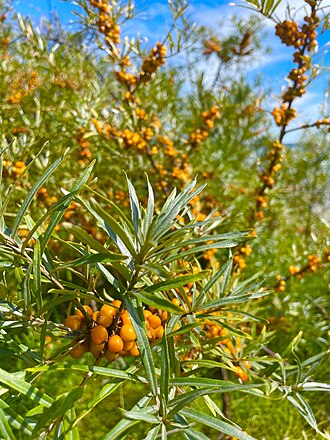
图:Виталий Уайлд · CC BY-SA 4.0 · Wikimedia Commons
- 学名
- Hippophae rhamnoides
- 分类等级
- 种
- 上级类群
- 沙棘属
- 大类
- 被子植物
- 命名
- 卡尔·林奈,1753 年
- 中文别名
- 醋柳、黑刺、黄酸刺、酸刺、酸刺柳
- 保护状况(IUCN)
- 无危物种
- 异名
- Elaeagnus rhamnoides
- 用途
- 药用植物、食物、医疗食品、水果
- 数据库
- NCBI 分类 · GBIF · IUCN 红色名录
百科正文
形态
作为一种落叶灌木,沙棘的高度在二米至四米之间,枝干粗糙、外皮呈黑色,叶披针形 或矩圆状披针形。在种下三年后开,雌雄异株,通过风来传播种子。
单个果实重量在270至480毫克之间,富含维生素C、E、B12和类胡萝卜素、类黄酮和脂肪酸。
共生菌
沙棘的根系十分发达,而且当植株成长至一至两年,其根会开始长出含弗兰克氏菌(Frankia,属放线菌门)的固氮共生菌。因着这层关系,种植有沙棘的土壤都含丰富氮肥。共生菌的固氮活动速率并不固定,会受外间天气或额外氮肥的施与而影响。
以上内容摘自维基百科「沙棘」,按 CC BY-SA 4.0 使用,去掉了参考文献、外部链接等尾部小节,公式改写成了纯文本。全文、配图和出处见原文。
英文维基百科补充中文条目比较短,下面是英文条目「Sea buckthorn」的原文
Sea-buckthorn (Hippophae rhamnoides), also known as sea buckthorn, sandthorn, sallowthorn or seaberry, is a species of flowering plant in the family Elaeagnaceae, native to cold-temperate regions of Eurasia. It is a spiny deciduous shrub. The fruit has culinary uses, while its extracts, including its oil, are used in the cosmetics industry and within traditional medicine. It is also used as animal fodder, in horticulture, and for ecological purposes.
Description and biology
Sea-buckthorn is a hardy, deciduous suckering shrub that can grow between 2–5 metres (6 ft 7 in – 16 ft 5 in) high, rarely 15 m (49 ft), forming extensive clonal colonies by root sprouts. It has rough, brown or black bark and a thick crown of greyish-green foliage. Like many species of the family Elaeagnaceae, the young shoots and leaves are covered in small silvery scales.
Taxonomy
Hippophae rhamnoides is in the family Elaeagnaceae in the order Rosales.
Subspecies
Seven subspecies are accepted, with three in Europe and four more in Asia. The subspecies vary in size, shape, number of main lateral veins in the leaves and quantity and colour of stellate hairs. The central Asian subspecies grow much taller; the European subsp. rhamnoides only reaches 5 m, but the Chinese subspecies are reported to reach 15 m to even 18 m tall.
Etymology
The genus name Hippophae comes from Ancient Greek ἵππος (híppos), meaning 'horse', and φάος (pháos), meaning 'light', and is due to the ancient Greeks use of sea-buckthorn leaves as horse fodder to make their coats shine more. The specific epithet rhamnoides derives from Rhamnus plus -oides, resembling, referring to the superficial similarity to the buckthorn genus Rhamnus.
Distribution
Hippophae rhamnoides is native to cold-temperate regions of Europe and Asia, between 27° and 69°N latitude and 7°W and 122°E longitude. These regions include the North Sea coasts of Great Britain, the Netherlands, and Denmark, the Baltic coasts of Finland, Poland, Latvia, and Germany, the Gulf of Bothnia in Sweden, as well as coastal areas of the United Kingdom, Norway and the Netherlands. In Asia, H.
Ecology
It is particularly drought- and salt-tolerant and can thus be successfully used for land reclamation, against further soil erosion, as shelterbelt or in agroforestry. These characteristics are mainly due to the deep root system that the plant develops. For example, in eastern China, new agroforestry systems have been developed to reclaim land with high salinity contents and H. rhamnoides is included in the system as shelterbelt, providing a habitat to different birds and small mammals.
Uses
Nutrition
The fruit has a high vitamin C content, approximately 400 mg per 100 grams. Additionally, the fruit has high concentrations of vitamin E and vitamin K. The berries also contain vitamin B12.
The main carotenoid is the provitamin A, beta-carotene, while other carotenoids include zeaxanthin, and lycopene.
The most prevalent dietary minerals in sea-buckthorn fruit are potassium (300–380 mg/100 g), manganese (0.28–0.32 mg/100 g), and copper (0.1 mg/100 g).
Cultivation
Soil and climate requirements
In nature H. rhamnoides is found growing profusely on a wide range of soil types, but does better in soils with a light physical structure, rich in nutrient compounds and with a pH near neutral (pH 6.5–7.5). Best growth occurs in deep, well drained, sandy loam with ample organic matter. Light, sandy soils have low water carrying capacity and are also low in nutrient mineral elements; so without the previous addition of organic matter, are not appropriate.
Interactions
Symbionts
Hippophae rhamnoides plants that are 1–2 years old develop root nodules containing actinobacteria of the genus Frankia, which are capable of fixing nitrogen. As a result of this relationship, the soils in stands of H. rhamnoides are enriched in nitrogen. The nitrogen-fixing activity of the symbiotic bacteria is not constant, but depends on external factors such as the climate or whether additional nitrogen fertilisation occurred.
以上节选摘自英文维基百科「Sea buckthorn」,按 CC BY-SA 4.0 使用,去掉了参考文献、外部链接等尾部小节,公式改写成了纯文本。篇幅所限,较长的小节只摘了开头一部分,有的小节没有收;全文、配图和出处见原文。