格物

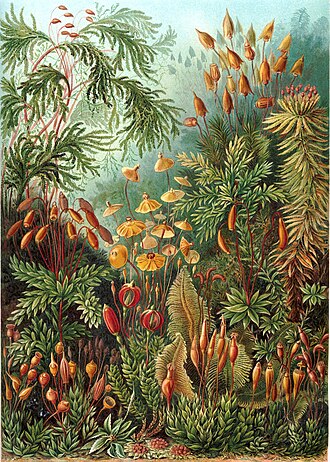
图:Ernst Haeckel · Public domain · Wikimedia Commons
- 学名
- Marchantiophyta
- 分类等级
- 门
- 英文名
- liverwort
- 上级类群
- 有胚植物
- 大类
- 其他植物
- 命名
- Raymond Stotler、Barbara J. Crandall-Stotler,2000 年
- 数据库
- NCBI 分类 · GBIF
下级类群(3)


百科正文
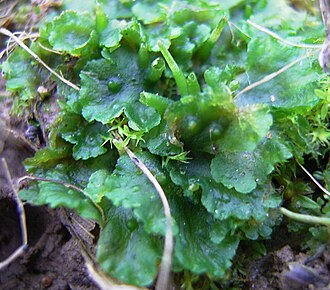
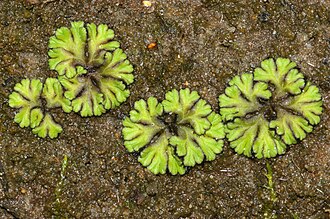
地钱预估约有9000个物种;但若对新热带界有更多研究的话,物种数量可能接近1万。一些较常见的物种外观为扁平无叶的叶状体,但大多数的物种有叶子,外观和扁平的苔藓极为相似。地钱门和近似的苔藓植物门可以由其单细胞假根来加以区分。其他的差别在所有的地钱和苔藓之间则不具一般性。但是,无清楚分化的“茎”与“叶”、有深裂或分节的叶片以及有排成三层的二叶子,这些都再再显示此类植物为一个地钱。
地钱门植物一般都很小,宽约2-20毫米,长少于10公分,因此常被忽略。然而,部分物种可能覆盖住大片的土地、岩地、树林或其他有它们纵迹的坚硬表面。地钱门分布在世界上几乎所有可能的栖地上,大多数为潮湿的地方,但在沙漠及极地中也找得到。
以上内容摘自维基百科「地錢門」,按 CC BY-SA 4.0 使用,去掉了参考文献、外部链接等尾部小节,公式改写成了纯文本。全文、配图和出处见原文。
英文维基百科补充中文条目比较短,下面是英文条目「Liverwort」的原文
Liverworts are non-vascular land plants in the division Marchantiophyta . Liverworts, mosses, and hornworts are collectively known as bryophytes. Like mosses and hornworts, liverworts have a gametophyte-dominant life cycle in which the sporophyte is dependent on the gametophyte.
Some liverworts have a flat branching thallus, while others are leafy. They are distinguished from mosses by their single-celled rhizoids, the absence of a midrib or costa in the leaves, and the presence of membrane-bound complex oil bodies.
There are an estimated 9,000 species of liverworts, most of them leafy. They occur in many terrestrial ecosystems worldwide, especially in moist tropical regions, although some are adapted to deserts and other dry environments.
Physical characteristics
Description
Most liverworts are small, from 2 to 20 millimetres (0.08 to 0.8 in) wide with individual plants less than 10 centimetres (4 in) long, so they are often overlooked. The most familiar liverworts, in the order Marchantiales, consist of a prostrate, flattened, ribbon-like or branching structure called a thallus (plant body). However, most liverworts produce flattened stems with overlapping scales or leaves in two or more ranks, the middle rank is often conspicuously different from the outer ranks; these leafy liverworts are in the order Jungermanniales.
Recognition
Liverworts can most reliably be distinguished from similar-looking mosses by their single-celled rhizoids.
Life cycle
Sexual
Liverworts, like other bryophytes, have a gametophyte-dominant life cycle, with the sporophyte dependent on the gametophyte. The sporophytes of many but not all liverworts are non-photosynthetic. Cells of the gametophyte plant each contain only a single set of genetic information, so liverworts are haploid for the majority of their life cycle. This contrasts sharply with the pattern in seed plants, where the haploid generation is represented only by the tiny pollen and ovule, while the diploid generation is the familiar plant. Another unusual feature is that the sporophytes (i.e. the diploid body) are very short-lived, withering away soon after releasing their spores.
Ecology
Liverworts grow in many ecosystems across the planet except the sea and excessively dry environments, or those exposed to high levels of direct solar radiation. They are most common (both in numbers and species) in moist tropical areas.
Thalloid liverworts host symbiotic glomeromycete fungi. Species in the Aneuraceae, however, associate with basidiomycete fungi of the genus Tulasnella, while leafy liverworts host symbiotic basidiomycete fungi of the genus Serendipita.
Evolution
External phylogeny
Traditionally, the liverworts were grouped together with the mosses and hornworts in the Division Bryophyta, within which the liverworts made up the class Hepaticae (also called Marchantiopsida). Somewhat more recently, the liverworts were given their own division (Marchantiophyta), as bryophytes became considered to be paraphyletic. However, phylogenetic evidence indicates that liverworts are likely part of a clade ("Bryophyta sensu lato" or "Bryophyta Schimp.") alongside mosses and hornworts. Hence, it has been suggested that the liverworts should be de-ranked to a class called Marchantiopsida. In addition, there is strong phylogenetic evidence that liverworts and mosses form a subclade, Setaphyta.
Relationship with humans
In ancient times, it was believed that liverworts cured diseases of the liver, hence their name, which in its Old English form liferwyrt means 'liver plant'. The archaic relationship of plant form to function is based on the medieval doctrine of signatures. At the start of the 20th century, the German zoologist Ernst Haeckel depicted liverworts in an elaborately symmetrical colour plate of the "Hepaticae" in his book Kunstformen der Natur.
Riccia fluitans (floating crystalwort) is an aquatic thallose liverwort sold for use in aquariums. Its slender branches float on the water's surface and provide habitat for both small invertebrates and the fish that feed on them.
Bryophyte genomics offers economic possibilities. Liverworts can be grown in petri dishes.
以上节选摘自英文维基百科「Liverwort」,按 CC BY-SA 4.0 使用,去掉了参考文献、外部链接等尾部小节,公式改写成了纯文本。篇幅所限,较长的小节只摘了开头一部分,有的小节没有收;全文、配图和出处见原文。