 格物
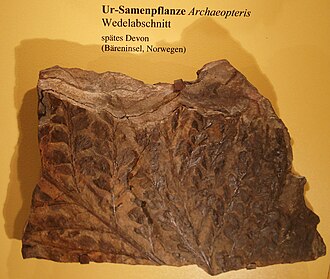
图:Ghedoghedo · CC BY-SA 3.0 · Wikimedia Commons
- 学名
- Progymnospermopsida
- 分类等级
- 纲
- 英文名
- Progymnosperm
- 上级类群
- 维管植物
- 大类
- 其他植物
下级类群(1)
- 古羊齿目 Archaeopteridales 目
百科正文
最后存活的前裸子植物可能为瓢叶目,生存于石炭纪晚期至二叠纪末的北半球。
以上内容摘自维基百科「前裸子植物」,按 CC BY-SA 4.0 使用,去掉了参考文献、外部链接等尾部小节,公式改写成了纯文本。全文、配图和出处见原文。
英文维基百科补充中文条目比较短,下面是英文条目「Progymnosperm」的原文
The progymnosperms are an extinct group of woody, spore-bearing plants that is presumed to have evolved from the trimerophytes, and eventually gave rise to the spermatophytes, ancestral to both gymnosperms and angiosperms (flowering plants). They have been treated formally at the rank of division Progymnospermophyta or class Progymnospermopsida (as opposite). The stratigraphically oldest known examples belong to the Middle Devonian order the Aneurophytales, with forms such as Protopteridium, in which the vegetative organs consisted of relatively loose clusters of axes. Tetraxylopteris is another example of a genus lacking leaves. In more advanced aneurophytaleans such as Aneurophyton these vegetative organs started to look rather more like fronds, and eventually during Late Devonian times the aneurophytaleans are presumed to have given rise to the pteridosperm order, the Lyginopteridales. In Late Devonian times, another group of progymnosperms gave rise to the first really large trees known as Archaeopteris. The latest surviving group of progymnosperms is the Noeggerathiales, which persisted until the end of the Permian.
Other characteristics:
Vascular cambium with unlimited growth potential is present as well as xylem and phloem.
Ancestors of the earliest seed plants as well as the first true trees.
Strong monopodial growth is exhibited.
Aneurophytales was homosporous, while the remaining groups were heterosporous.
Pycnoxylic wood was found in both Archaeopteridales and Noeggerathiales.
Phylogeny
Progymnosperms are a paraphyletic grade of plants.
以上内容摘自英文维基百科「Progymnosperm」,按 CC BY-SA 4.0 使用,去掉了参考文献、外部链接等尾部小节,公式改写成了纯文本。全文、配图和出处见原文。